• Produktbild: Mathematics Education
  • Produktbild: Mathematics Education

Mathematics Education Exploring the Culture of Learning

66,99 €

inkl. gesetzl. MwSt., Versandkostenfrei


Beschreibung

Produktdetails

Einband

Taschenbuch

Erscheinungsdatum

27.11.2003

Herausgeber

Barbara Allen + weitere

Verlag

Taylor and Francis

Seitenzahl

256

Maße (L/B/H)

23,4/15,6/1,4 cm

Gewicht

470 g

Sprache

Englisch

ISBN

978-0-415-32700-8

Beschreibung

Produktdetails

Einband

Taschenbuch

Erscheinungsdatum

27.11.2003

Herausgeber

Verlag

Taylor and Francis

Seitenzahl

256

Maße (L/B/H)

23,4/15,6/1,4 cm

Gewicht

470 g

Sprache

Englisch

ISBN

978-0-415-32700-8

Herstelleradresse

Libri GmbH
Europaallee 1
36244 Bad Hersfeld
DE

Email: gpsr@libri.de

Kundinnen und Kunden meinen

0 Bewertungen

Informationen zu Bewertungen

Zur Abgabe einer Bewertung ist eine Anmeldung im Konto notwendig. Die Authentizität der Bewertungen wird von uns nicht überprüft. Wir behalten uns vor, Bewertungstexte, die unseren Richtlinien widersprechen, entsprechend zu kürzen oder zu löschen.

Die Bewertungen sind nach Format, Anzahl Sterne und Datum sortiert.

Verfassen Sie die erste Bewertung zu diesem Artikel

Helfen Sie anderen Kund*innen durch Ihre Meinung

Kundinnen und Kunden meinen

0 Bewertungen filtern

Die Leseprobe wird geladen.
  • Produktbild: Mathematics Education
  • Produktbild: Mathematics Education
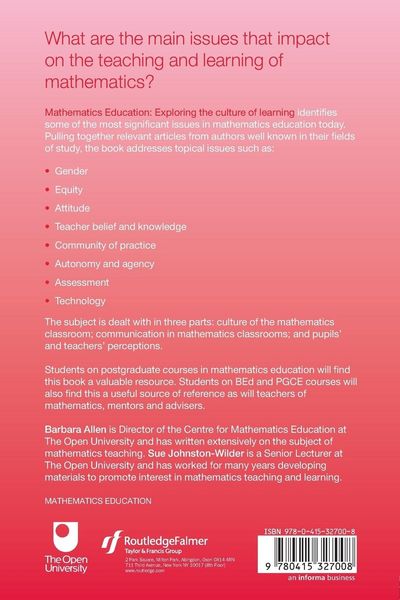
  • Introduction: Issues in researching mathematics learning Section 1: Culture of the mathematics classroom 1. Images of mathematics, values and gender: a philosophical perspective 2. Towards a sociology of learning in primary schools3. Learners as authors in mathematics classrooms 4. Paradigmatic conflicts in informal mathematics assessment as sources of social inequity5. Constructing the 'legitimate' goal of a 'realistic' mathematics item: a comparison of 10-11 and 13-14 year olds 6. Establishing a community of practice in a secondary mathematics classroom Section 2: Communication in mathematics classrooms 7. Mathematics, social class and linguistic capital: an analysis of mathematics classroom interactions8. What is the role of diagrams in communication of mathematical activity? 9. 'The Whispers' : rival classroom discourses and inquiry mathematics10. Steering between skills and creativity: a role for the computer?Section 3: Pupils' and teachers' perceptions 11. The relationship of teachers' conceptions of mathematics and mathematics teaching to instructional practice12. Setting, social class and survival of the quickest 13. 'I'll be a nothing': structure, agency and the construction of identity through assessment 14. Pupils' perspectives on learning mathematics