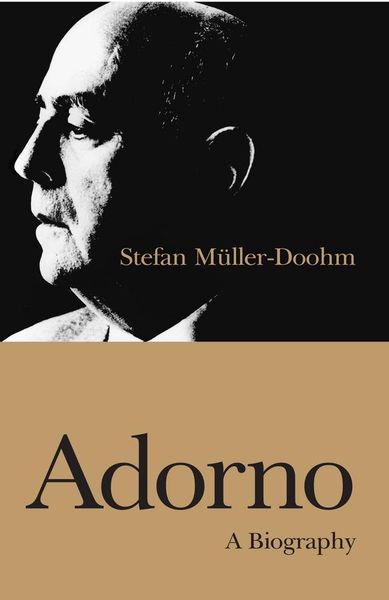
Produktbild: Adorno

Adorno A Biography

36,99 €

inkl. gesetzl. MwSt., Versandkostenfrei


Beschreibung

Produktdetails

Einband

Taschenbuch

Erscheinungsdatum

01.03.2009

Verlag

John Wiley & Sons

Seitenzahl

648

Maße (L/B/H)

23/15,2/5,6 cm

Gewicht

1060 g

Auflage

1. Auflage

Übersetzt von

Rodney Livingstone

Sprache

Englisch

ISBN

978-0-7456-3109-7

Beschreibung

Rezension

"Although Adorno died in 1969, we have had to wait more than thirty years for a biography ... Stefan Müller-Doohm's is the most detailed and probably the best. (It has been exceptionally well translated, too.)"
Times Literary Supplement
 
"Stands as a very informative account of Adorno's life, which has much to offer casual readers of Adorno and those with a thorough interest in his work [and] ties a narrative description of Adorno's life to a sensitive understanding of his thought, and of the consistency of his reflection across the different disciplinary boundaries that it traversed ... This book does all the things a biography should."
Times Higher Education Supplement
 
"Exhaustively researched and presented with exemplary balance, Müller-Doohm's re-creation of Adorno's 'damaged life' is fully worthy of its demanding subject. No future student of one of the twentieth century's most influential thinkers will be able to ignore this remarkable achievement in intellectual biography."
Martin Jay, University of California, Berkeley

Produktdetails

Einband

Taschenbuch

Erscheinungsdatum

01.03.2009

Verlag

John Wiley & Sons

Seitenzahl

648

Maße (L/B/H)

23/15,2/5,6 cm

Gewicht

1060 g

Auflage

1. Auflage

Übersetzt von

Rodney Livingstone

Sprache

Englisch

ISBN

978-0-7456-3109-7

Herstelleradresse

Libri GmbH
Europaallee 1
36244 Bad Hersfeld
DE

Email: gpsr@libri.de

Noch keine Bewertungen vorhanden

Verfassen Sie die erste Bewertung zu diesem Artikel

Helfen Sie anderen Kundinnen und Kunden durch Ihre Meinung.

Kundinnen und Kunden meinen

Bewertungen (0)

Die Leseprobe wird geladen.
  • Produktbild: Adorno
  • List of Figures viii

    List of Plates ix

    Preface xii

    Acknowledgements xiv

    Illustration Acknowledgements xvi

    Part I Origins: Family, Childhood and Youth: School and University in Frankfurt am Main Family Inheritance: A Picture of Contrasts 3

    1 Adorno's Corsican Grandfather: Jean François, alias Giovanni Francesco 5

    ¿ Fencing master Calvelli-Adorno in the Frankfurt suburb of Bockenheim 8

    2 Wiesengrund: The Jewish Heritage of his Father's Romantic Name 13

    ¿ A generous father and two musical mothers 15

    3 Between Oberrad and Amorbach 25

    ¿ School experiences of a precocious youth 32

    ¿ Arousing philosophical interests in the musical soul: Kracauer's influence on Adorno 37

    4 Éducation sentimentale 52

    ¿ First love and a number of affairs 55

    Part II A Change of Scene: Between Frankfurt, Vienna and Berlin: A Profusion of Intellectual Interests Commuting between Philosophy and Music 67

    5 Against the Stream: The City of Frankfurt and its University 69

    ¿ First meeting with Max Horkheimer in the seminar on gestalt psychology 74

    6 A Man with Philosophical Qualities in the World of Viennese Music: The Danube Metropolis 82

    ¿ Apprenticeship with his master and teacher 83

    7 In Search of a Career 95

    ¿ Between philosophy and music: no parting of the ways 100

    8 Music Criticism and Compositional Practice 110

    ¿ Theorizing the twelve-tone method: Adorno's debate with Krenek 115

    9 Towards a Theory of Aesthetics 119

    ¿ Rather more than a beginner's foray into philosophy 125

    10 A Second Anomaly in Frankfurt: The Institute of Social Research 132

    ¿ Two inaugural lectures 134

    ¿ A Privatdozent in the shadow of Walter Benjamin 145

    ¿ The Zeitschrift für Sozialforschung and Adorno's ideological critique of music 150

    ¿ In league with Horkheimer against a second school of sociology under the same roof 155

    ¿ The opera project: The Treasure of Indian Joe 159

    Part III Emigration Years: An Intellectual in a Foreign Land A Twofold Exile: Intellectual Homelessness as Personal Fate 169

    11 The 'Coordination' of the National Socialist Nation and Adorno's Reluctant Emigration 173

    ¿ Hibernating with dignity? 181

    12 Between Academic and Authentic Concerns: From Philosophy Lecturer to Advanced Student in Oxford 187

    ¿ Sticks and carrots 194

    ¿ An abiding distaste: jazz as a tolerated excess 198

    ¿ Setbacks . . . 203

    ¿ . . . and personal losses 207

    13 Writing Letters as an Aid to Philosophical Self-Clarification: Debates with Benjamin, Sohn-Rethel and Kracauer 214

    ¿ A double relationship: Gretel and Max 226

    14 Learning by Doing: Adorno's Path to Social Research 242

    ¿ In the Institute of Social Research on Morningside Heights 255

    ¿ Between two stools once again: a long road from New York to Los Angeles 267

    15 Happiness in Misfortune: Adorno's Years in California 273

    ¿ Messages in a bottle, or, How to create enlightenment about the Enlightenment 278

    ¿ Merits of social research: studies in the authoritarian personality 288

    ¿ Moral feelings in immoral times 298

    ¿ The Privy Councillor: Adorno and Thomas Mann 311

    Part IV Thinking the Unconditional and Enduring the Conditional The Explosive Power of Saying No 325

    16 Change of Scene: Surveying the Ruins 328

    ¿ Playing an active role in postwar Germany? 336

    ¿ Back to America: horoscope analysis and TV research 348

    ¿ Letting the cat out of the bag: Kafka, Beckett, Hölderlin 353

    17 Gaining Recognition for Critical Theory: Adorno's Activities in the Late 1950s and Early 1960s 366

    ¿ In the stream, but swimming against the tide 374

    ¿ Speaking of the rope while in the country of the hangman 380

    ¿ The crisis of the subject: self-preservation without a self 387

    ¿ The purpose of life: understanding the language of music 392

    ¿ Right living? Places, people, friendships 398

    18 Eating Bread: A Theory Devoured by Thought 412

    ¿ The dispute about positivism: Via discourse to the Frankfurt School 421

    ¿ Against German stuffiness 430

    ¿ The fat child 433

    ¿ What kind of a society do we live in? Adorno's analysis of the present 441

    19 With his Back to the Wall 448

    ¿ Patricide deferred 457

    ¿ The futility of defending a theory as practice 460

    ¿ Moments of happiness, despite everything 465

    ¿ The divided nature of art 470

    ¿ Death 474

    Epilogue: Thinking Against Oneself 481

    Notes 492

    References and Bibliography 615

    Index 645