Gutscheinbedingungen

**Gültig bis 06.07.2026 auf fremdsprachige Bücher online auf thalia.at, in der Thalia App ab einem Mindestbestellwert von 30€ und in allen Thalia Buchhandlungen in Österreich. In den Buchhandlungen nur gültig auf lagernde Ware. Einzelne Artikel können ausgeschlossen sein. Ausgenommen sind preisgebundene Artikel & eBooks. Pro Einkauf einmal einlösbar. Nur gültig gegen Vorlage oder im Onlineshop hinterlegter Bonuscard. Infos zur Einlösung in der Buchhandlung sind auf der Bonuscard-Vorteilspreisseite zu finden. Click & Collect nur bei Onlinevorabzahlung möglich. Keine Einlösung bei Scan & Go-Bezahlung. Keine Barauszahlung. Nicht kombinierbar mit anderen Aktionen und Gutscheinen. Gutschein wird auf max. 500€ Bestellwert angerechnet. Nicht gültig für Versandkosten und Services.

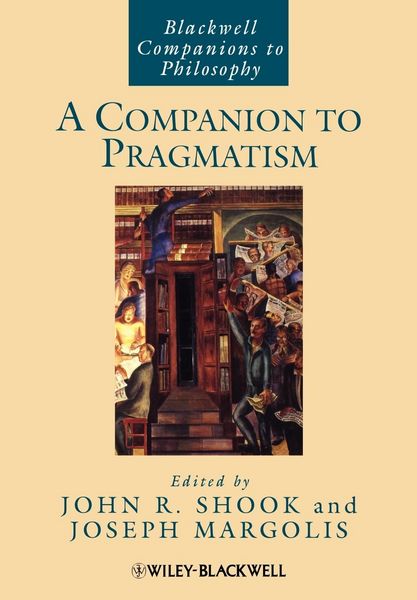
Produktbild: A Companion to Pragmatism

A Companion to Pragmatism

74,99 €

inkl. gesetzl. MwSt., Versandkostenfrei


Beschreibung

Produktdetails

Einband

Taschenbuch

Erscheinungsdatum

24.02.2009

Herausgeber

John R. Shook + weitere

Verlag

John Wiley & Sons

Seitenzahl

448

Maße (L/B/H)

24,4/17/2,4 cm

Gewicht

768 g

Auflage

1. Auflage

Sprache

Deutsch, Englisch

ISBN

978-1-4051-8833-3

Beschreibung

Rezension

"With this volume Margolis, Shook, and their collaborators celebrate the return of pragmatism to center stage of professional philosophy. Its 38 essays provide rich insights into the prospects of pragmatism as a family of methods poised to address twenty-first-century problems. Their volume is truly authoritative: its list of contributors reads like an honor roll of the field."
Larry A. Hickman, Southern Illinois University
 

"This is a splendid collection of articles about the major figures of the pragmatic tradition that also exhibits the vitality and diversity of this living tradition. Essential reading for anyone interested in the rich history, lively present debates, and promising future of pragmatic themes."
Richard J. Bernstein, New School for Social Research
 

"Unusually for an encyclopedic account, A Companion to Pragmatism is not afraid to adopt a particular interpretive approach. The introduction draws challenging conclusions about the relative importance of Peirce, James, and Dewey, but both the major figures covered and the themes developed in the book expand far beyond this original triumvirate and demonstrate the vitality and expansiveness of pragmatist philosophy."
Charlene Haddock Seigfried, Purdue University
 
"The essays, though assuming some acquaintance with the problems and history of philosophy, are clearly written and use a minimum of jargon. A brief but excellent introduction . . . and a good set of subject and name indexes complete the scholarly apparatus. Recommended."
Choice

Produktdetails

Einband

Taschenbuch

Erscheinungsdatum

24.02.2009

Herausgeber

Verlag

John Wiley & Sons

Seitenzahl

448

Maße (L/B/H)

24,4/17/2,4 cm

Gewicht

768 g

Auflage

1. Auflage

Sprache

Deutsch, Englisch

ISBN

978-1-4051-8833-3

Herstelleradresse

Libri GmbH
Europaallee 1
36244 Bad Hersfeld
DE

Email: Libri GmbH

Noch keine Bewertungen vorhanden

Verfassen Sie die erste Bewertung zu diesem Artikel

Helfen Sie anderen Kundinnen und Kunden durch Ihre Meinung.

Kundinnen und Kunden meinen

Bewertungen (0)

Die Leseprobe wird geladen.
  • Produktbild: A Companion to Pragmatism
  • List of Contributors.
     
    Preface.
     
    Notes on Abbreviations.
     
    Introduction: Pragmatism, Retrospective, and Prospective: Joseph Margolis (Temple University).
     
    Section I: Major Figures.
     
    1. Charles Sanders Peirce: Vincent Colapietro (Pennsylvania State University).
     
    2. William James: Ellen Kappy Suckiel (University of California, Santa Cruz).
     
    3. F. C. S. Schiller and European Pragmatists: John Shook (Oklahoma State University).
     
    4. John Dewey: Philip W. Jackson (University of Chicago).
     
    5. George H. Mead: Gary Cook (Beloit College).
     
    6. Jane Addams: Marilyn Fischer (University of Dayton).
     
    7. Alain Locke: Leonard Harris (Purdue University).
     
    8. C. I. Lewis: Murray Murphey (University of Pennsylvania).
     
    9. W. V. Quine: Roger Gibson (Washington University).
     
    10. Hilary Putnam: Harvey Cormier (SUNY at Stony Brook).
     
    11. Jürgen Habermas: Joseph Heath (University of Toronto).
     
    12. Richard Rorty: Kai Nielsen (Concordia University).
     
    Section II: Transforming Philosophy.
     
    13. Not Cynicism, but Synechism: Lessons From Peirce: Susan Haack (University of Miami).
     
    14. Peirce and Cartesian Rationalism: Douglas Anderson (Pennsylvania State University).
     
    15. James, Empiricism, and Absolute Idealism: Timothy Sprigge (University of Edinburgh).
     
    16. Hegel and Realism: Kenneth Westphal (University of East Anglia).
     
    17. Dewey, Dualism, and Naturalism: Tom Alexander (Southern Illinois University at Carbondale).
     
    18. Expressivism and Mead's Social Self: Mitchell Aboulafia (Pennsylvania State University).
     
    19. Marxism and Critical Theory: Paulo Ghiraldelli, Jr. (Santa Marcelina College of Arts, Brazil).
     
    20. Philosophical Hermeneutics: David Vessey (University of Chicago).
     
    21. Analytic Philosophy: Bjørn T. Ramberg (University of Oslo).
     
    22. Feminism: Shannon Sullivan (Pennsylvania State University).
     
    23. Pluralism, Relativism, and Historicism: Joseph Margolis (Temple University).
     
    24. Experience as Freedom: John McDermott (Texas A&M University).
     
    Section III: Culture and Nature.
     
    25. Pragmatism as Anti-Authoritarianism: Richard Rorty (Stanford University).
     
    26. Intelligence and Ethics: Hilary Putnam (Harvard University).
     
    27. Democracy and Value Inquiry: Ruth Anna Putnam (Wellesley College).
     
    28. Liberal Democracy: Robert Westbrook (University of Rochester).
     
    29. Pluralism and Deliberative Democracy: Judith Green (Fordham University).
     
    30. Philosophy as Education: Jim Garrison (Virginia Tech University).
     
    31. Creativity and Society: Hans Joas (Universität Erfurt) and Erkki Kilpinen (University of Helsinki).
     
    32. Religious Empiricism and Naturalism: Nancy Frankenberry (Dartmouth College).
     
    33. Aesthetics: Richard Shusterman (Florida Atlantic University).
     
    34. Aesthetic Experience and the Neurobiology of Inquiry: Jay Schulkin (Georgetown University).
     
    35. Cognitive Science: Mark Johnson (University of Oregon).
     
    36. Inquiry, Deliberation, and Method: Isaac Levi (Columbia University).
     
    37. Pragmatic Idealism and Metaphysical Realism: Nicholas Rescher (University of Pittsburgh).
     
    38. Scientific Realism, Antirealism, and Empiricism: Cheryl Misak (University of Toronto).
     
    Name Index.
     
    Subject Index