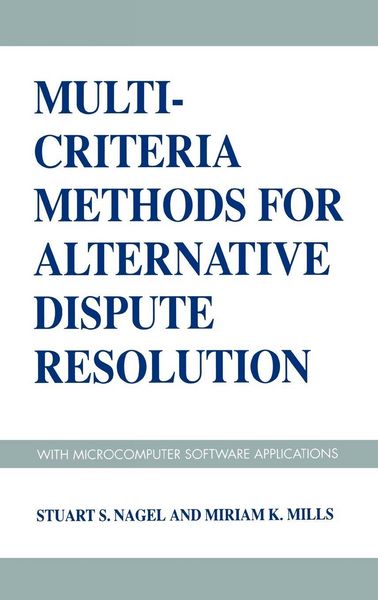
Multi-Criteria Methods for Alternative Dispute Resolution With Microcomputer Software Applications
-
- Englisch ausgewählt
113,99 €
inkl. gesetzl. MwSt.,
Beschreibung
Produktdetails
Einband
Gebundene Ausgabe
Altersempfehlung
7 - 17 Jahr(e)
Erscheinungsdatum
07.12.1990
Verlag
Bloomsbury AcademicSeitenzahl
292
Maße (L/B/H)
24/16,1/2 cm
Gewicht
605 g
Sprache
Englisch
ISBN
978-0-89930-520-2
This work examines the topic of dispute resolution, specifically the multi-criteria approach that seeks to arrive at a conclusion that is mutually beneficial to both sides. Through the use of decision-aiding software, the multi-criteria approach can allow each side to give on various criteria that are not important to it, but are important to the other side. In this way, a super-optimum solution may even be met, in which both sides receive something significantly better than they had expected. Such a result is very difficult, if not impossible, to achieve, Stuart Nagel points out, in traditional single-dimension dispute resolution.
Nagel and Mills describe the nature of multi-criteria dispute resolution utilizing decision-aiding software. The first part of the book clarifies the general character of computer-aided negotiation, computer-aided mediation, and super-optimizing dispute resolution. Part two guides the reader through the use of Policy/Goal Percentaging (P/G%) decision-aiding software, centering on general decision-making, negotiation, mediation, and prediction of outcomes. Multi-criteria resolution in the context of rule-making and legal policy disputes is the focus of part three, where such matters as determining initial alternatives and criteria, resolving deadlocks, and arriving at super-optimum solutions are discussed. Part four emphasizes dispute resolution in the context of rule-applying and litigation disputes, as well as mediation at the international level and between lawyers and clients. The final part deals with future applications, such as computer-aided mediation and group decision-making with phone modems. The book's combination of decision-aiding software, arbitration-mediation, and super-optimum expansionist decision-making brings a truly innovative approach to the topic of dispute resolution. This volume should be a welcome addition to academic, legal, and public libraries, and a valuable reference work for lawyers, law students, and legal professors and researchers.
Noch keine Bewertungen vorhanden
Verfassen Sie die erste Bewertung zu diesem Artikel
Helfen Sie anderen Kundinnen und Kunden durch Ihre Meinung.
Kurze Frage zu unserer Seite
Vielen Dank für Ihr Feedback
Wir nutzen Ihr Feedback, um unsere Produktseiten zu verbessern. Bitte haben Sie Verständnis, dass wir Ihnen keine Rückmeldung geben können. Falls Sie Kontakt mit uns aufnehmen möchten, können Sie sich aber gerne an unseren Kund*innenservice wenden.
zum Kundenservice