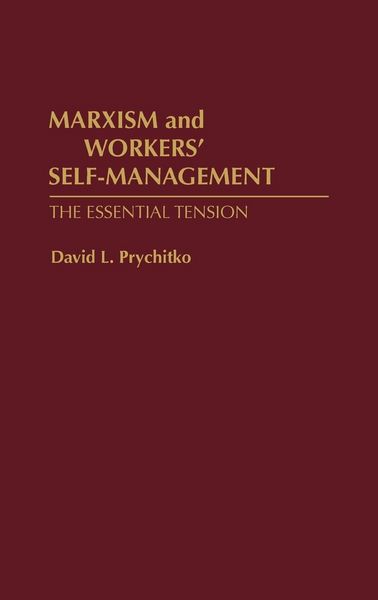
Marxism and Workers' Self-Management The Essential Tension
-
- Englisch ausgewählt
141,99 €
inkl. gesetzl. MwSt.,
Beschreibung
Produktdetails
Einband
Gebundene Ausgabe
Erscheinungsdatum
30.06.1991
Verlag
Bloomsbury AcademicSeitenzahl
178
Maße (L/B/H)
24/16,1/1,4 cm
Gewicht
438 g
Sprache
Englisch
ISBN
978-0-313-27854-9
This book comes to terms with Marxism and its relationship to workers' self-management. David L. Prychitko offers a reinterpretation of Marx's vision of socialism by arguing that Marx's understanding of the praxis-nature of humankind led him to a utopian goal of decentralized socialism based on the total abolition of market exchange. The full development of workers' self-management of industry was to be accompanied by comprehensive planning of the socially owned means of production. Prychitko takes modern economists to task for paying too little attention to the implications of Marx's praxis philosophy and to the organizational consequences of abolishing private ownership and the market process. This abolition leads inevitably, he argues, to the development of hierarchical structures of state domination and power. This tension between democratic decentralization--workers' self-management--and central economic planning--which tends to destroy meaningful self-management--can be traced back to Marx himself. The failure of state socialism in Eastern Europe and the Soviet Union has not dissuaded those who wish to keep Marx alive from pushing workers' self-management as a feasible enterprise in a free market system. Prychitko's volume does more than simply interpret the meaning of Marxism. It analyzes the tension between centralization and decentralization in contemporary theory and practice. The contemporary theory of self-managed socialism, put to much use in Yugoslavia, is critically assessed by Prychitko. After focusing on a case study of American barrel-making cooperatives that managed to compete well with traditional capitalist firms and survive an extraordinary degree of market competition, Prychitko concludes the book by speculating over the feasibility of worker-managed firms in a truly dynamic, rivalrous market setting. Marxism and Workers' Self-Management will be of great interest to scholars of Marx, political economy, social theory, and labor studies.
Noch keine Bewertungen vorhanden
Verfassen Sie die erste Bewertung zu diesem Artikel
Helfen Sie anderen Kundinnen und Kunden durch Ihre Meinung.
Kurze Frage zu unserer Seite
Vielen Dank für Ihr Feedback
Wir nutzen Ihr Feedback, um unsere Produktseiten zu verbessern. Bitte haben Sie Verständnis, dass wir Ihnen keine Rückmeldung geben können. Falls Sie Kontakt mit uns aufnehmen möchten, können Sie sich aber gerne an unseren Kund*innenservice wenden.
zum Kundenservice