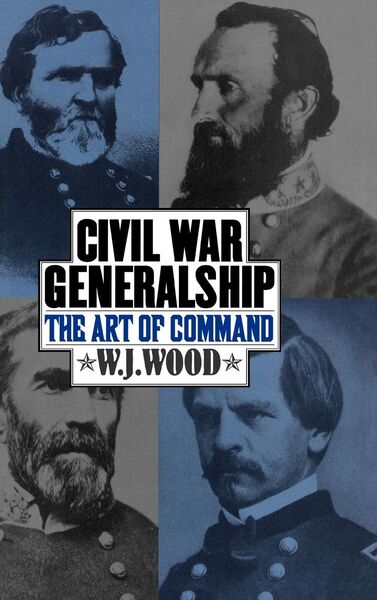
This study challenges both the accepted convention that the American Civil War was the first modern war and the myth that Civil War leaders were guided by foreign and American military thought in fighting their war. Wood's work takes an innovative approach by selecting three typical higher level commanders on each side, Union and Confederate, and then pairing them off in the campaigns and battles in which they actually confronted each other. While readers gain insight into the nature and character of a commander, they can, at the same time, observe how each put his art of command into practice. Civil War commanders at the operational level had to confront not only their opponents on campaign and in battle, they also had to develop-even create-their own method of command through their personal on-the-job training, while actually engaged in combat operations. This is the first study of Civil War command since Douglas Southall Freeman's Lee's Lieutenants (1944) that has focused solely and directly with the problems and methods of operational command; in so doing, the author has dealt with the tactical and strategical problems that threatened to overwhelm untried Civil War generals at the very onset of hostilities. The failure of antebellum American military thought to come to grips with outdated linear tactics and inapplicable strategical principles resulted in commanders on both sides in the Civil War having to lead mass armies of untried civilian soldiers into a war for which neither the led nor the leader had been prepared to fight. Higher level commanders on both sides were forced to create and develop a personal art of command while actually putting it into practice on campaign and on the battlefield. In so doing-however well or badly managed-the typical commanders under observation developed a pragmatic art that has left a legacy that still provides paradigms for military leaders in the late 20th century. This book presents the author's themes in five progressive parts. Part One provides the reader with the background necessary to appreciate the problems confronted by commanders on both sides in the Civil War and maps the terrain for the exploration of the art of command each leader had to create. Part Two begins by showing how Stonewall Jackson planned and conducted operations that led to the engagement at Cedar Mountain, providing insight into his character. The focus then shifts to Nathaniel Banks, the Union commander at Cedar Mountain. Part Two concludes with a critical review of the two leaders' performance. Part Three examines the campaign that led to the battle of Chickamauga, focusing first on the Union commander, William Rosecrans, then on his opponent, the Confederate Army commander Braxton Bragg. The battle is described in detail, followed by a critical review. Part Four follows the same pattern, this time focusing on the Confederate Army commander John Bell Hood, then on his opponent, the Union Army commander George H. Thomas. The progress of the battle of Nashville is then observed, followed by a critique of the commanders' actions and reactions. Part Five, Reflections, reviews the character of each of the six commanders as it affected the development of his art of command. The book ends with conclusions regarding the legacy left by the founders of a pragmatic art.