KI-Beratung Beta

Gutscheinbedingungen

**Gültig am 25.11.2026 auf fremdsprachige Bücher online auf thalia.at und in der Thalia App. Einzelne Artikel können ausgeschlossen sein. Ausgenommen sind preisgebundene Artikel & eBooks. Pro Einkauf einmal einlösbar. Click & Collect nur bei Onlinevorabzahlung möglich. Keine Barauszahlung. Nicht kombinierbar mit anderen Aktionen und Gutscheinen. Gutschein wird auf max. 500€ Bestellwert angerechnet. Nicht gültig für Geschenkkarten, Versandkosten und Services.

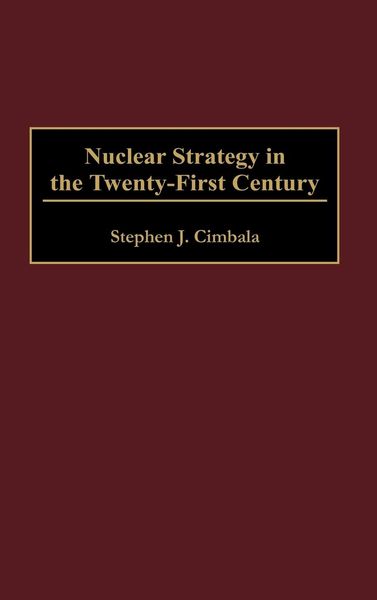
Produktbild: Nuclear Strategy in the Twenty-First Century

Nuclear Strategy in the Twenty-First Century

102,99 €

inkl. gesetzl. MwSt., Versandkostenfrei


Beschreibung

The future of nuclear weapons and nuclear strategy in the 21st century is not entirely predictable from the Cold War past. Nor is it easy to foresee on the basis of what has happened since the Soviet Union collapsed in 1991. Cimbala contends that nuclear weapons and the psychology of nuclear deterrence...

Beschreibung

The future of nuclear weapons and nuclear strategy in the 21st century is not entirely predictable from the Cold War past. Nor is it easy to foresee on the basis of what has happened since the Soviet Union collapsed in 1991. Cimbala contends that nuclear weapons and the psychology of nuclear deterrence will remain important after 2000, but the character of that importance will change. No longer will nuclear weapons be the dominators of military technology. Instead, advanced technology conventional weapons, based on information and electronics, will supplant nuclear weapons as the instruments of military supremacy in the 21st century.
What, Cimbala asks, can be expected of nuclear weapons in the 21st century, given what we have learned from previous experience in the Cold War and in the 1990s? Cimbala expects that nuclear weapons will spread among currently non-nuclear states, and states with regional grievances or hegemonic aspirations will seek to deploy small nuclear forces as deterrents against neighbors or against outside intervention by the United States in regional conflicts. Regional rogue states may also obtain nuclear weapons. Nonetheless, as Cimbala explains, the international balance of power is unlikely to change. As he makes clear, power will be less dependent on deployed military platforms and more dependent on information warfare. A thoughtful and provocative analysis that will be of particular interest to policy makers, scholars, and other researchers involved with arms control, security studies, and international relations.

Produktdetails

Einband

Gebundene Ausgabe

Erscheinungsdatum

30.05.2000

Verlag Bloomsbury Academic
Seitenzahl

226

Produktdetails

Einband

Gebundene Ausgabe

Erscheinungsdatum

30.05.2000

Verlag Bloomsbury Academic
Seitenzahl

226

Maße (L/B/H)

23,5/15,7/1,8 cm

Gewicht

476 g

Sprache

Englisch

ISBN

978-0-275-96869-4

Herstelleradresse

Libri GmbH
Europaallee 1
36244 Bad Hersfeld
DE

Email: gpsr@libri.de

Noch keine Bewertungen vorhanden

Verfassen Sie die erste Bewertung zu diesem Artikel

Helfen Sie anderen Kundinnen und Kunden durch Ihre Meinung.

Kundinnen und Kunden meinen

Bewertungen (0)

  • Produktbild: Nuclear Strategy in the Twenty-First Century
  • Nuclear History and its Lessons
    Limited War in the Nuclear Age: Military Frustration and U.S. Adaptation
    Marching Beyond Marx: The Red Army and Nuclear Weapons
    The Cuban Missile Crisis and Its Legacy
    Nuclear Policy and Strategy in the Future
    Nuclear Proliferation: Fortuitous Past, Uncertain Future
    Russia and Nuclear Weapons after the Cold War: A Potemkin Village?
    Nuclear Weapons and "Third Wave" Warfare
    Conclusion