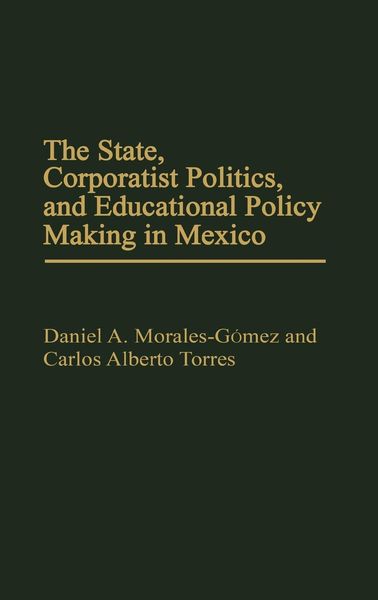
The State, Corporatist Politics, and Educational Policy Making in Mexico
-
- Englisch ausgewählt
112,99 €
inkl. gesetzl. MwSt.,
Beschreibung
Produktdetails
Einband
Gebundene Ausgabe
Erscheinungsdatum
11.05.1990
Verlag
PraegerSeitenzahl
224
Maße (L/B/H)
24/16,1/1,7 cm
Gewicht
505 g
Sprache
Englisch
ISBN
978-0-275-93484-2
An important contribution to the growing body of work on Latin American policy making in education, this volume presents a critical analysis of the conflicts and contradictions inherent in educational policy planning in Mexico since the early 1970s. In an effort to forge a clearer and more comprehensive understanding of the processes involved, the authors examine the complex relationships among the politics of a corporative State built on the remains of a revolutionary tradition, the current model of associated-dependent development, and the process of policy formation in formal and nonformal education. Analysis of specific cases enables the authors to present an overview of the factors involved in the designing, planing, and implementation of educational policies in Mexico, as well as assessing the effects of educational change on the poorest sectors of its society.
Morales-Gomez and Torres begin by analyzing some of the political economy factors that historically have determined the current process of associate-dependent development in Mexico and how they have evolved and shaped the role of education in the country. They show how educational policies and practices are affected by the processes of sociopolitical change that underly the formation and evolution of the corporatist State. A critical review of the structure and functioning of the educational system in Mexico precedes three case studies of formal and nonformal education that illustrate the relationships among the predominant ideas shaping current development in the country, the process of policy formation in education, and the actual practice of formal and nonformal education. The first case study examines primary education as a manifestation of the contradictions in educational policy; the second focuses on some of the nonformal initiatives carried out by the government over the last two decades; and the third looks at adult workers' education.
Noch keine Bewertungen vorhanden
Verfassen Sie die erste Bewertung zu diesem Artikel
Helfen Sie anderen Kundinnen und Kunden durch Ihre Meinung.
Kurze Frage zu unserer Seite
Vielen Dank für Ihr Feedback
Wir nutzen Ihr Feedback, um unsere Produktseiten zu verbessern. Bitte haben Sie Verständnis, dass wir Ihnen keine Rückmeldung geben können. Falls Sie Kontakt mit uns aufnehmen möchten, können Sie sich aber gerne an unseren Kund*innenservice wenden.
zum Kundenservice