• Produktbild: Mathematical Economics
  • Produktbild: Mathematical Economics

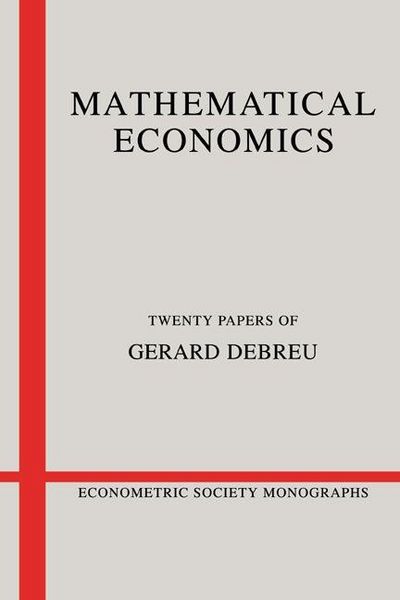
Mathematical Economics Twenty Papers of Gerard Debreu

69,99 €

inkl. gesetzl. MwSt., Versandkostenfrei


Beschreibung

Produktdetails

Einband

Taschenbuch

Erscheinungsdatum

27.03.2006

Herausgeber

Andrew Chesher + weitere

Verlag

Cambridge Academic

Seitenzahl

264

Maße (L/B/H)

22,9/15,2/1,6 cm

Gewicht

351 g

Sprache

Englisch

ISBN

978-0-521-33561-4

Beschreibung

Produktdetails

Einband

Taschenbuch

Erscheinungsdatum

27.03.2006

Herausgeber

Verlag

Cambridge Academic

Seitenzahl

264

Maße (L/B/H)

22,9/15,2/1,6 cm

Gewicht

351 g

Sprache

Englisch

ISBN

978-0-521-33561-4

Kundinnen und Kunden meinen

0 Bewertungen

Informationen zu Bewertungen

Zur Abgabe einer Bewertung ist eine Anmeldung im Konto notwendig. Die Authentizität der Bewertungen wird von uns nicht überprüft. Wir behalten uns vor, Bewertungstexte, die unseren Richtlinien widersprechen, entsprechend zu kürzen oder zu löschen.

Die Bewertungen sind nach Format, Anzahl Sterne und Datum sortiert.

Verfassen Sie die erste Bewertung zu diesem Artikel

Helfen Sie anderen Kund*innen durch Ihre Meinung

Kundinnen und Kunden meinen

0 Bewertungen filtern

  • Produktbild: Mathematical Economics
  • Produktbild: Mathematical Economics
  • Introduction Werner Hildenbrand; 1. The coefficient of resource utilization; 2. A social equilibrium existence theorem; 3. A classical tax-subsidy problem; 4. Existence of an equilibrium for a competitive economy Kenneth J. Arrow and Gerard Debreu; 5. Valuation equilibrium and Pareto optimum; 6. Representation of a preference ordering by a numerical function; 7. Market equilibrium; 8. Economics under uncertainty; 9. Topological methods in cardinal utiltity theory; 10. New concepts and techniques for equilibrium analysis; 11. A limit theorem on the core of an economy Gerard Debreu and Herbert Scarf; 12. Continuty properties of Paretian utility; 13. Neighboring economic agents; 14. Economies with a finite set of equilibria; 15. Smooth preferences; 16. Excess demand functions; 17. The rate of convergence of the core of an economy; 18. Four aspects of the mathematical theory of economic equilibrium; 19. The application to economies of differential topology and global analysis: regular differentiable economies; 20. Least concave utility functions.