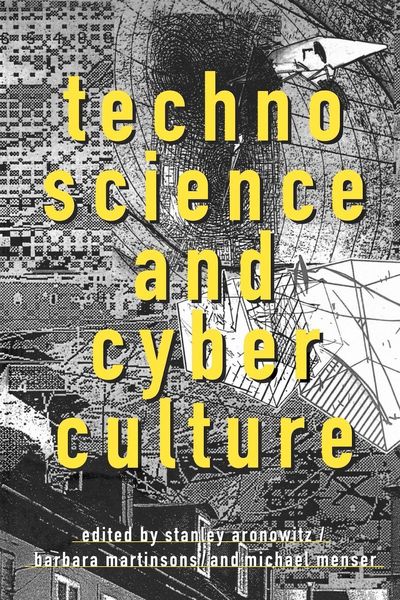

• Produktbild: Technoscience and Cyberculture
  • Produktbild: Technoscience and Cyberculture

Technoscience and Cyberculture

66,99 €

inkl. gesetzl. MwSt., Versandkostenfrei


Beschreibung

Produktdetails

Einband

Taschenbuch

Erscheinungsdatum

21.11.1995

Herausgeber

Aronowitz Stanley

Verlag

Taylor and Francis

Seitenzahl

332

Maße (L/B/H)

22,9/15,2/1,8 cm

Gewicht

610 g

Sprache

Englisch

ISBN

978-0-415-91176-4

Beschreibung

Portrait

Stanley Aronowitz is Professor of Sociology at the Graduate Center of the City University of New York. Barbara R. Martinsons is Associate Director at the CUNY Center for Cultural Studies. Michael Menser is Adjunct Lecturer in Philosophy at Brooklyn College.

Produktdetails

Einband

Taschenbuch

Erscheinungsdatum

21.11.1995

Herausgeber

Aronowitz Stanley

Verlag

Taylor and Francis

Seitenzahl

332

Maße (L/B/H)

22,9/15,2/1,8 cm

Gewicht

610 g

Sprache

Englisch

ISBN

978-0-415-91176-4

Herstelleradresse

Libri GmbH
Europaallee 1
36244 Bad Hersfeld
DE

Email: gpsr@libri.de

Kundinnen und Kunden meinen

0 Bewertungen

Informationen zu Bewertungen

Zur Abgabe einer Bewertung ist eine Anmeldung im Konto notwendig. Die Authentizität der Bewertungen wird von uns nicht überprüft. Wir behalten uns vor, Bewertungstexte, die unseren Richtlinien widersprechen, entsprechend zu kürzen oder zu löschen.

Die Bewertungen sind nach Format, Anzahl Sterne und Datum sortiert.

Verfassen Sie die erste Bewertung zu diesem Artikel

Helfen Sie anderen Kund*innen durch Ihre Meinung

Kundinnen und Kunden meinen

0 Bewertungen filtern

Die Leseprobe wird geladen.
  • Produktbild: Technoscience and Cyberculture
  • Produktbild: Technoscience and Cyberculture
  • Introduction Establishing Markers in the Milieu, Jennifer Rich, Michael Menser; Part I The Cultural Study of Science and Technology: A Manifesto; Chapter I On Cultural Studies, Science, and Technology, Michael Menser, Stanley Aronowitz; Part II From the Social Study of Science to Cultural Studies; Chapter II Perspectives onthe Evolution of Science Studies, Dorothy Nelkin; Chapter III When Eliza Doolittle Studies 'enry 'iggins, Sharon Traweek; Chapter IV Math Fictions, Zolkower Betina; Chapter V Citadels, Rhizomes, and String Figures, Emily Martin; Part III World, Weather, War; Chapter VI Earth to Gore, Earth to Gore, Andrew Ross; Chapter VII Mapping Space: Imaging Technologies and the Planetary Bodu, Jody Berland; Chapter VIII The Bomb's-Eye View: Smart Llleapons and Military T.V., John Broughton; Part IV Markets and the Future of Work; Chapter IX Virtual Capitalism, Arthur Kroker; Chapter X Markets and Antimarkets in the World Economy, Manuel De Lancia; Chapter XI Technoscience and the Labor Process, William DiFazio; partV Bioethics; Chapter XII Genetic Services, Social Context, and Public Priorities, Philip Boyle; Chapter XIII Genetics in Public Health: Implications of Genetic Screening and Counseling in Rural and Culturally Diverse Populations, Ralph W. Trottier; part VI Risky Reading, Writing, and Other Unsafe Practices; ChapterXIV Boundary Isolations, Peter Lamborn Wilson; Chapter XV The Possibility of Agency for Photographic Subjects, Barbara Martinsons; Chapter XVI Remarks on Narrative and Technology, or Poetry and Truth, Samuel R. Delany; part VII Visualizing and Producing Anarchic Spaces; Chapter XVII The Question of Space, Woods Lebbeus; Chapter XVIII Becoming-Heterarch: On Technocultural Theory, Minor Science, and the Production of Space, Michael Menser;