
KI-Beratung Beta

  • Produktbild: Handbook of Affect and Social Cognition
  • Produktbild: Handbook of Affect and Social Cognition

Handbook of Affect and Social Cognition

136,99 €

inkl. gesetzl. MwSt., Versandkostenfrei


Beschreibung

Produktdetails

Einband

Taschenbuch

Erscheinungsdatum

01.11.2001

Herausgeber

Forgas Joseph P.

Verlag

Taylor and Francis

Seitenzahl

476

Maße (L/B/H)

22,9/15,2/2,5 cm

Gewicht

683 g

Sprache

Englisch

ISBN

978-0-8058-4283-8

Beschreibung

Portrait

Joseph P. Forgas

Produktdetails

Einband

Taschenbuch

Erscheinungsdatum

01.11.2001

Herausgeber

Forgas Joseph P.

Verlag

Taylor and Francis

Seitenzahl

476

Maße (L/B/H)

22,9/15,2/2,5 cm

Gewicht

683 g

Sprache

Englisch

ISBN

978-0-8058-4283-8

Herstelleradresse

Libri GmbH
Europaallee 1
36244 Bad Hersfeld
DE

Email: gpsr@libri.de

Noch keine Bewertungen vorhanden

Verfassen Sie die erste Bewertung zu diesem Artikel

Helfen Sie anderen Kundinnen und Kunden durch Ihre Meinung.

Kundinnen und Kunden meinen

Bewertungen (0)

Die Leseprobe wird geladen.
  • Produktbild: Handbook of Affect and Social Cognition
  • Produktbild: Handbook of Affect and Social Cognition
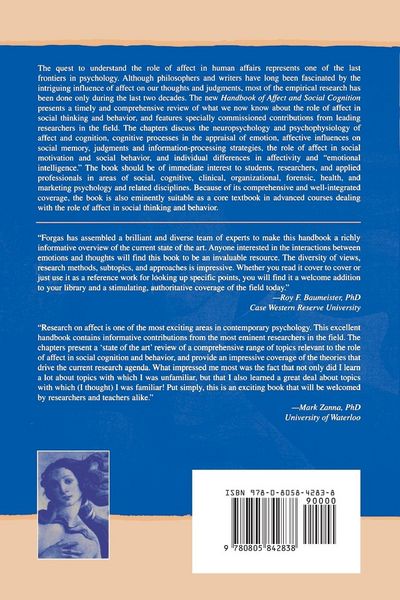
  • Contents: Preface. J.P. Forgas, Introduction: Affect and Social Cognition. Part I: The Relationship Between Affect and Cognition: Fundamental Issues. R. Adolphs, A.R. Damasio, The Interaction of Affect and Cognition: A Neurobiological Perspective. T.A. Ito, J.T. Cacioppo, Affect and Attitudes: A Social Neuroscience Approach. C.A. Smith, L.D. Kirby, Affect and Cognitive Appraisal Processes. Part II: Affective Influences on the Content of Cognition. G.H. Bower, J.P. Forgas, Mood and Social Memory. G.L. Clore, K. Gasper, E. Garvin, Affect as Information. C. Sedikides, J.D. Green, Affective Influences on the Self-Concept: Qualifying the Mood-Congruency Principle. Part III: Affective Influences on Social Information Processing. K. Fiedler, Affective Influences on Social Information Processing. E.T. Higgins, Promotion and Prevention Experiences: Relating Emotions to Nonemotional Motivational States. R.E. Petty, D. DeSteno, D.D. Rucker, The Role of Affect in Attitude Change. Part IV: Affective Influences on Motivation and Intentions. E. Harmon-Jones, The Role of Affect in Cognitive-Dissonance Processes. Y. Trope, M. Ferguson, R. Raghunathan, Mood as a Resource in Processing Self-Relevant Information. M.W. Erber, R. Erber, The Role of Motivated Social Cognition in the Regulation of Affective States. Part V: Affective Influences on Cognitively Mediated Social Behaviors. J.P. Forgas, Affect, Cognition, and Interpersonal Behavior: The Mediating Role of Processing Strategies. G.V. Bodenhausen, T. Mussweiler, S. Gabriel, K.N. Moreno, Affective Influences on Stereotyping and Intergroup Relations. P. Salovey, J.B. Detweiler, W.T. Steward, B.T. Bedell, Affect and Health-Relevant Cognition. Part VI: The Role of Individual Differences in Affectivity. C.L. Rusting, Personality as a Moderator of Affective Influences on Cognition. J. Suls, Affect, Stress, and Personality. J.D. Mayer, Emotion, Intelligence, and Emotional Intelligence.