Gutscheinbedingungen

**Gültig bis 06.07.2026 auf fremdsprachige Bücher online auf thalia.at, in der Thalia App ab einem Mindestbestellwert von 30€ und in allen Thalia Buchhandlungen in Österreich. In den Buchhandlungen nur gültig auf lagernde Ware. Einzelne Artikel können ausgeschlossen sein. Ausgenommen sind preisgebundene Artikel & eBooks. Pro Einkauf einmal einlösbar. Nur gültig gegen Vorlage oder im Onlineshop hinterlegter Bonuscard. Infos zur Einlösung in der Buchhandlung sind auf der Bonuscard-Vorteilspreisseite zu finden. Click & Collect nur bei Onlinevorabzahlung möglich. Keine Einlösung bei Scan & Go-Bezahlung. Keine Barauszahlung. Nicht kombinierbar mit anderen Aktionen und Gutscheinen. Gutschein wird auf max. 500€ Bestellwert angerechnet. Nicht gültig für Versandkosten und Services.

  • Produktbild: Approaches to the Evolution of Language
  • Produktbild: Approaches to the Evolution of Language

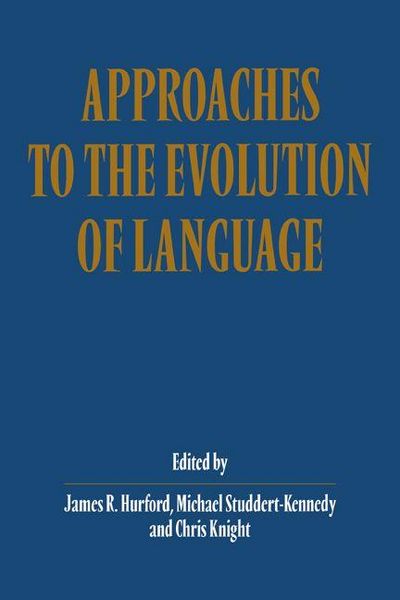
Approaches to the Evolution of Language Social and Cognitive Bases

112,99 €

inkl. gesetzl. MwSt., Versandkostenfrei


Beschreibung

Produktdetails

Einband

Taschenbuch

Erscheinungsdatum

22.12.2007

Herausgeber

Hurford James R. + weitere

Verlag

Cambridge Academic

Seitenzahl

456

Maße (L/B/H)

22,9/15,2/2,4 cm

Gewicht

719 g

Sprache

Englisch

ISBN

978-0-521-63964-4

Beschreibung

Produktdetails

Einband

Taschenbuch

Erscheinungsdatum

22.12.2007

Herausgeber

Verlag

Cambridge Academic

Seitenzahl

456

Maße (L/B/H)

22,9/15,2/2,4 cm

Gewicht

719 g

Sprache

Englisch

ISBN

978-0-521-63964-4

Herstelleradresse

Libri GmbH
Europaallee 1
36244 Bad Hersfeld
DE

Email: Libri GmbH

Noch keine Bewertungen vorhanden

Verfassen Sie die erste Bewertung zu diesem Artikel

Helfen Sie anderen Kundinnen und Kunden durch Ihre Meinung.

Kundinnen und Kunden meinen

Bewertungen (0)

  • Produktbild: Approaches to the Evolution of Language
  • Produktbild: Approaches to the Evolution of Language
  • Introduction Michael Studdert-Kennedy, Chris Knight, and James R. Hurford; Part I. Grounding Language Function in Social Cognition: 1. Introduction: Grounding language function in social cognition Chris Knight; 2. On discontinuing the continuity-discontinuity debate Jean Aitchison; 3. The origin of language and cognition Ib Ulbaek; 4. Mimesis and the executive suite: missing links in language evolution Merlin Donald; 5. Ritual/speech co-evolution: a 'selfish gene' solution to the problem of deception Chris Knight; 6. Theory of mind and the evolution of language Robin Dunbar; 7. Old wives' tales: the gossip hypothesis and the reliability of cheap signals Camilla Power; 8. Altruism, status, and the origin of relevance Jean-Louis Dessalles; 9. The evolution of language from social intelligence Robert Worden; Part II. The Emergence of Phonology: 10. Introduction: the emergence of phonology Michael Studdert-Kennedy; 11. Long call structure in apes as a possible precursor for language Mária Ujhelyi; 12. Social sound-making as a precursor to spoken language John F. Locke; 13. The particulate origins of language generativity: from syllable to gesture Michael Studdert-Kennedy; 14. Evolution of the mechanisms of language output: comparative neurobiology of vocal and manual communication Peter MacNeilage; 15. Systemic constraints and adaptive change in the formation of sound structure Björn Lindblom; 16. The development of sound systems in human language Klaus J. Kohler; 17. Synonymy avoidance, phonology and the origin of syntax Andrew Carstairs-McCarthy; Part III. The Emergence of Syntax: 18. Introduction: the emergence of syntax James R. Hurford; 19. On the supposed 'counterfunctionality' of universal grammar: some evolutionary implications Frederick J. Newmeyer; 20. Language evolution and the minimalist program: the origins of syntax Robert C. Berwick; 21. Catastrophic evolution: the case for a single step from protolanguage to full human language Derek Bickerton; 22. Fitness and the selective adaptation of language Simon Kirby; 23. Synthesizing the origins of language and meaning using co-evolution, self-organization and level formation Luc Steels; 24. Computational simulations of the emergence of grammar John Batali.