Gutscheinbedingungen

**Gültig nur für Bestellungen an die Wunsch-Poststation bis 10.06.2026 auf Spielzeug, Schreibwaren, Filme, Geschenke & Trends, Musik, tolino eReader & Zubehör, Hörbücher und Hörbuch-Downloads (außer Abo), nicht preisgebundene Bücher und Kalender online auf thalia.at und in der Thalia App. Einzelne Artikel können ausgeschlossen sein. Aufgrund der Buchpreisbindung sind deutschsprachige Bücher und eBooks ausgenommen. Zusätzlich ausgenommen sind preisgebundene Artikel, Abos & Flatrates, eBooks, Games, Geschenkkarten/-boxen, Shelfies, Software, Zeitschriften sowie einzelne Artikel von tonies®. Pro Einkauf einmal einlösbar. Kein Click & Collect möglich. Keine Barauszahlung. Nicht kombinierbar mit anderen Aktionen und Gutscheinen. Gutschein wird auf max. 500€ Bestellwert angerechnet. Nicht gültig für Versandkosten und Services.

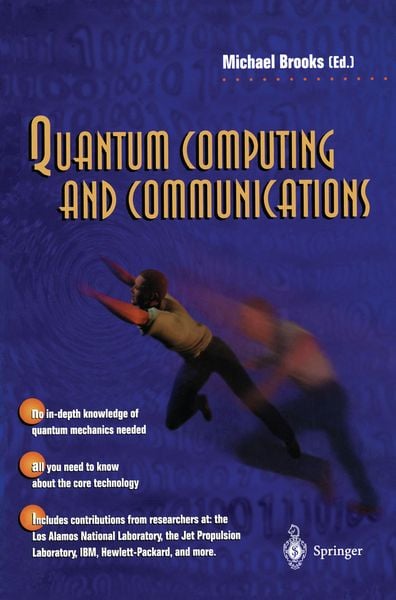
  • Produktbild: Quantum Computing and Communications
  • Produktbild: Quantum Computing and Communications

Quantum Computing and Communications

49,99 €

inkl. gesetzl. MwSt., Versandkostenfrei


Beschreibung

Produktdetails

Einband

Taschenbuch

Erscheinungsdatum

21.05.1999

Herausgeber

Michael Brooks

Verlag

Springer London

Seitenzahl

152

Maße (L/B/H)

23,5/15,5/1 cm

Gewicht

268 g

Auflage

Softcover reprint of the original 1st ed. 1999

Sprache

Englisch

ISBN

978-1-85233-091-0

Beschreibung

Produktdetails

Einband

Taschenbuch

Erscheinungsdatum

21.05.1999

Herausgeber

Michael Brooks

Verlag

Springer London

Seitenzahl

152

Maße (L/B/H)

23,5/15,5/1 cm

Gewicht

268 g

Auflage

Softcover reprint of the original 1st ed. 1999

Sprache

Englisch

ISBN

978-1-85233-091-0

Herstelleradresse

Springer-Verlag KG
Sachsenplatz 4-6
1201 Wien
AT

Email: ProductSafety@springernature.com

Kundinnen und Kunden meinen

0 Bewertungen

Informationen zu Bewertungen

Zur Abgabe einer Bewertung ist eine Anmeldung im Konto notwendig. Die Authentizität der Bewertungen wird von uns nicht überprüft. Wir behalten uns vor, Bewertungstexte, die unseren Richtlinien widersprechen, entsprechend zu kürzen oder zu löschen.

Die Bewertungen sind nach Format, Anzahl Sterne und Datum sortiert.

Verfassen Sie die erste Bewertung zu diesem Artikel

Helfen Sie anderen Kund*innen durch Ihre Meinung

Kundinnen und Kunden meinen

0 Bewertungen filtern

  • Produktbild: Quantum Computing and Communications
  • Produktbild: Quantum Computing and Communications
  • Section I A Wide Perspective.- 1 Introduction.- 1.1 Exploiting the Quantum World.- 1.2 Historical Background.- 1.3 Worldwide Efforts in QCC.- 2 The Fundamentals of Quantum Information.- 3 Quantum Computer Science.- 3.1 Introduction.- 3.2 Algorithms and the Complexity Problem.- 3.3 The Quantum Computation Answer.- 3.4 Quantum Algorithms.- 3.5 Quantum Logic Gates and Networks.- 3.6 Obstacles.- 3.7 A Workable Solution: Quantum Error Correction.- 3.8 Conclusions.- 4 Experimental Realizations.- 4.1 Introduction.- 4.2 Trapped Ions.- 4.3 Nuclear Magnetic Resonance.- 4.4 Cavity Quantum Electrodynamics.- 4.5 Quantum Dots.- 5 Optical Technologies for Quantum Computing and Communications.- 5.1 Introduction.- 5.2 Using the Quantum Nature of Light.- 5.2.1 Potential.- 5.2.2 Problems.- 5.3 Quantum Noise in Optical Communications.- 5.4 Generic Technologies in Quantum Communications.- 5.4.1 Nonlinear Optics.- 5.4.2 Cavity Quantum Electrodynamics.- 5.5 Operations Performed on Optical Signals.- 5.5.1 Signal Generation.- 5.5.2 Detection.- 5.5.3 Attenuation.- 5.5.4 Distribution.- 5.5.5 Amplification.- 5.6 Conclusions: Towards the Second Generation.- 6 Applications.- 6.1 Introduction.- 6.2 Emerging Technologies.- 6.2.1 Quantum Cryptography.- 6.2.2 Quantum Repeaters.- 6.2.3 Quantum Simulators.- 6.2.4 Metrology and Few Photon Applications.- 6.3 Conclusions: Measuring Progress.- 7 A Note on the Question of Scaling: Decoherence and Error Correction.- Section II Personal Perspectives.- 8 Solid State Quantum Computation: Prospects, Proposals, and Prejudices.- 9 Information is Physical, But Slippery.- 10 Nanocircuitry, Defect Tolerance and Quantum Computing: Architectural and Manufacturing Considerations.- 11 Quantum Computing and NMR.- 12 Quantum Networks and Quantum Algorithms.- 13 Quantum Cryptography.- Section III A Perspective for the Future.- 14 Realizing the Potential of Quantum Information Processing.- 14.1 Prospects for Quantum Computing.- 14.2 Prospects for Special Applications.- 14.2.1 Quantum Simulation.- 14.2.2 Limited Qubit and Reduced-Noise High Precision Applications.- 14.2.3 Secure Communications.- 14.3 Meeting The Needs of the QIP Field.- 14.3.1 The Need for Academic Focus.- 14.3.2 The Need for Industrial Focus.- 14.3.3 The Need for Awareness.- 15 The Role of Europe.- 15.1 The Pioneering Stage.- 15.2 Today.- 15.2.1 Multi-Disciplinary or Trans-Disciplinary Nature of the Community.- 15.2.2 The Numbers Involved.- 15.2.3 The Geographical Spread.- 15.2.4 The Industrial Scene.- 15.2.5 Summary of the European Scene.- 16 Quantum Computing and Communications: A View from the USA.- 16.1 Introduction.- 16.2 What Works Well.- 16.3 What Does Not Work So Well.- 16.4 NASA/JPL.- 16.5 Lessons Learned from Experience with NASA.- 16.6 Opportunities for Europe.- 16.7 Commercialization.- 16.8 Recommendations.- 16.8.1 Programmatic Recommendations.- 16.8.2 Technology Solutions.- 16.8.3 Quantum Computer Science.- 16.8.4 Education and Training.- Section IV Reference materials.- 17 Quantum Information Processing: A Brief Overview of Recent Advances.- 17.1 Introduction.- 17.2 The Underlying Physical System.- 17.2.1 Quantum Bits and Quantum Superpositions.- 17.2.2 Quantum Gates.- 17.2.3 Quantum Parallelism.- 17.3 Fundamentals of Quantum Information.- 17.3.1 Entanglement.- 17.3.2 Quantum Dense Coding.- 17.3.3 Quantum Teleportation.- 17.4 Quantum Cryptography.- 17.4.1 Standard Cryptosystems.- 17.4.2 Quantum Key Distribution.- 17.5 Quantum Computing.- 17.5.1 Quantum Algorithms.- 17.5.2 Grover’s Search Algorithm.- 17.5.3 Period Finding and Shor’s Factorization Algorithm.- 17.5.4 Minimum Requirements for any Quantum System to Be a Quantum Computer.- 17.5.5 Simulation of Other Quantum Systems.- 17.6 Quantum Decoherence.- 17.6.1 What is Decoherence?.- 17.6.2 Quantum Error Correction.- 17.7 Experimental Realizations.- 17.7.1 Systems with Few Degrees of Freedom.- 17.7.2 Macroscopic Systems.- 17.8 Conclusions.- 18 Categories and Definitions.- 18.1 Definitions and Glossary of Terms.- 18.1.1 Definition of Quantum Computing and Communications.- 18.1.2 Sub-Sector Definitions.- 18.1.3 Some Relevant Terms.- 18.2 The Disciplines that Contribute to Quantum Information Processing.- Appendix A The Pathfinder Project.- A.1 Pathfmder Activities.- A.1.1 Newsletters.- A.1.2 Database of Active Individuals and Organizations.- A.1.3 Taxonomy of the Subject.- A.1.4 Helsinki Conference.- A.1.5 QIP Report.- A.2 Pathfinder Project Partners.- Appendix B A Preliminary QIP Roadmap.