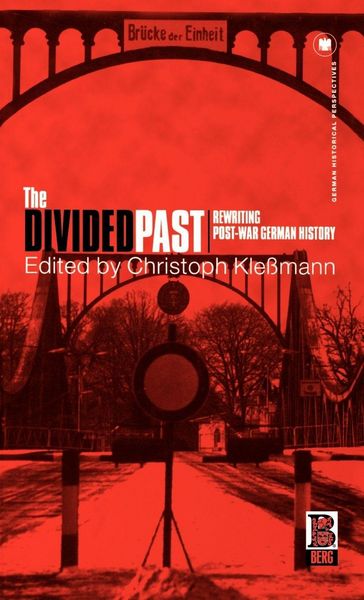
The Divided Past Rewriting Post-War German History
-
- Englisch ausgewählt
219,99 €
inkl. gesetzl. MwSt.,
Beschreibung
Produktdetails
Einband
Gebundene Ausgabe
Erscheinungsdatum
25.10.2001
Herausgeber
Christoph Klessmann + weitereVerlag
Berg 3PLSeitenzahl
212
Maße (L/B/H)
22,2/14,5/1,6 cm
Gewicht
436 g
Sprache
Englisch
ISBN
978-1-85973-511-4
This book tackles head on the central problems of writing German post-war history in the aftermath of unification. Since 1990, historians have been debating whether the development of the Federal Republic and the East German State constituted separate histories or whether they share what should be considered a joint past. This book addresses the specific forms of segregation and interconnectedness between the 'twoGermanies' and acknowledges the asymmetry of the relationship, as well as the effect that this had on the internal and external policies of both sides. This is a book that confronts the need for historiography to break away from the traditional master narrative. It offers an alternative in the form of the differing points of view necessary to gain a new perspective on the central problem of a separate, yet joint, German post-war history. Drawing on both methodological and historiographicalapproaches, authors tackle this vexed problem in the context of generational and woman's history, secularization, the labour movement, and the legitimization of the "workers' state", and culminate by addressing the perennial question: how does a nation live with catastrophe? 'Includes both programmatic statements and examples of work from a German national perspective ... For Klessmann, although the two states were separate entities, their histories were nonetheless inextricably interconnected. He believes that by exploring the influence of each German state on the other, much can be learned about the postwar Germanies ... According to Klessmann,the West was present in the East in a variety of ways, but perhaps most importantly as ''an image transmitted via the media and relatives that served as a constant point of reference for East Germans judging their standard of living''.'Journal of Modern History, Volume 75, Number 3, September 2003
Noch keine Bewertungen vorhanden
Verfassen Sie die erste Bewertung zu diesem Artikel
Helfen Sie anderen Kundinnen und Kunden durch Ihre Meinung.
Kurze Frage zu unserer Seite
Vielen Dank für Ihr Feedback
Wir nutzen Ihr Feedback, um unsere Produktseiten zu verbessern. Bitte haben Sie Verständnis, dass wir Ihnen keine Rückmeldung geben können. Falls Sie Kontakt mit uns aufnehmen möchten, können Sie sich aber gerne an unseren Kund*innenservice wenden.
zum Kundenservice