• Produktbild: The Science of Writing
  • Produktbild: The Science of Writing

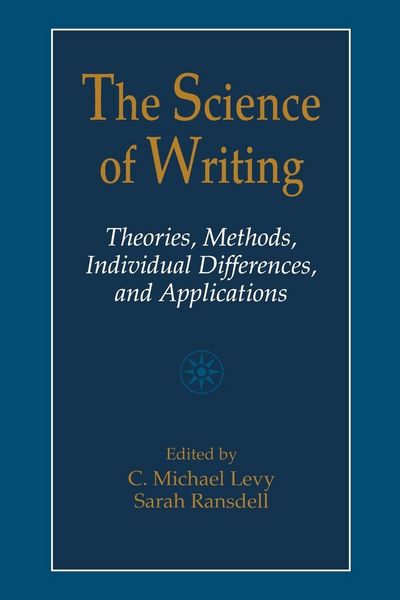
The Science of Writing Theories, Methods, Individual Differences and Applications

86,99 €

inkl. gesetzl. MwSt., Versandkostenfrei


Beschreibung

Produktdetails

Einband

Taschenbuch

Erscheinungsdatum

01.05.1996

Herausgeber

Levy C. Michael + weitere

Verlag

Taylor & Francis

Seitenzahl

448

Maße (L/B/H)

22,9/15,2/2,4 cm

Gewicht

830 g

Sprache

Englisch

ISBN

978-0-8058-2109-3

Beschreibung

Rezension

"This book is a thorough presentation of the latest developments in the theory and practice of writing research....This extensive, yet concise book describes how writing processes are studied scientifically today, what these studies can tell us and, most importantly, what we can do with the information. This practical dimension makes this book excellent. Perhaps we have here the next classic volume that will inspire writing research of the future."
European Journal of Cognitive Psychology

Produktdetails

Einband

Taschenbuch

Erscheinungsdatum

01.05.1996

Herausgeber

Verlag

Taylor & Francis

Seitenzahl

448

Maße (L/B/H)

22,9/15,2/2,4 cm

Gewicht

830 g

Sprache

Englisch

ISBN

978-0-8058-2109-3

Noch keine Bewertungen vorhanden

Verfassen Sie die erste Bewertung zu diesem Artikel

Helfen Sie anderen Kundinnen und Kunden durch Ihre Meinung.

Kundinnen und Kunden meinen

Bewertungen (0)

Die Leseprobe wird geladen.
  • Produktbild: The Science of Writing
  • Produktbild: The Science of Writing
  • Contents: Preface. Part I: Theories of Writing and Frameworks for Writing Research. J.R. Hayes, A New Framework for Understanding Cognition and Affect in Writing. J.R. Hayes, J.G. Nash, On the Nature of Planning in Writing. R.T. Kellogg, A Model of Working Memory in Writing. J. Grabowski, Writing and Speaking: Common Grounds and Differences Toward a Regulation Theory of Written Language Production. S. Ransdell, C.M. Levy, Working Memory Constraints on Writing Quality and Fluency. G. Rijlaarsdam, H. van den Bergh, The Dynamics of Composing -- An Agenda for the Research into an Interactive Compensatory Model of Writing: Many Questions, Some Answers. M. Sharples, An Account of Writing as Creative Design. Part II: Analytic Tools and Techniques. C.M. Levy, S. Ransdell, Writing Signatures. K.S. Eklundh, P. Kollberg, A Computer Tool and Framework for Analyzing Online Revisions. M. Torrance, G.V. Thomas, E.J. Robinson, Finding Something to Write About: Strategic and Automatic Processes in Idea Generation. H. van den Bergh, G. Rijlaarsdam, The Dynamics of Composing: Modeling Writing Process Data. D. Janssen, L. van Waes, H. van den Bergh, Effects of Thinking Aloud on Writing Processes. T. Sanders, C. van Wijk, Text Analysis as a Research Tool: How Hierarchical Text Structure Contributes to the Understanding of Conceptual Processes in Writing. Part III: Individual Differences and Applications. I. Levin, D.L. Share, E. Shatil, A Qualitative-Quantitative Study of Preschool Writing: Its Development and Contribution to School Literacy. R. Madigan, P. Linton, S. Johnson, The Paradox of Writing Apprehension. T. van der Geest, Studying "Real-Life" Writing Processes: A Proposal and an Example. B.K. Britton, Rewriting: The Arts and Sciences of Improving Expository Instructional Text. S. Graham, K.R. Harris, Self-Regulation and Strategy Instruction for Students Who Find Writing and Learning Challenging. J.E. Reece, G. Cumming, Evaluating Speech-Based Composition Methods: Planning, Dictation, and the Listening Word Processor.