KI-Beratung Beta

Gutscheinbedingungen

**Gültig bis 30.11.2026 auf Spielzeug, Schreibwaren, Filme, Geschenke & Trends, Musik, tolino eReader & Zubehör, Hörbücher und Hörbuch-Downloads, nicht preisgebundene Bücher und Kalender online auf thalia.at und in der Thalia App. Einzelne Artikel können ausgeschlossen sein. Aufgrund der Buchpreisbindung sind deutschsprachige Bücher und eBooks ausgenommen. Zusätzlich ausgenommen sind Abos & Flatrates, Games, Geschenkkarten/-boxen, Shelfies, Software, Zeitschriften sowie einzelne Artikel von tonies®. Pro Einkauf einmal einlösbar. Nur gültig mit im Onlineshop hinterlegter Bonuscard. Click & Collect nur bei Onlinevorabzahlung möglich. Keine Barauszahlung. Nicht kombinierbar mit anderen Aktionen und Gutscheinen. Gutschein wird auf max. 500€ Bestellwert angerechnet. Nicht gültig für Versandkosten und Services.

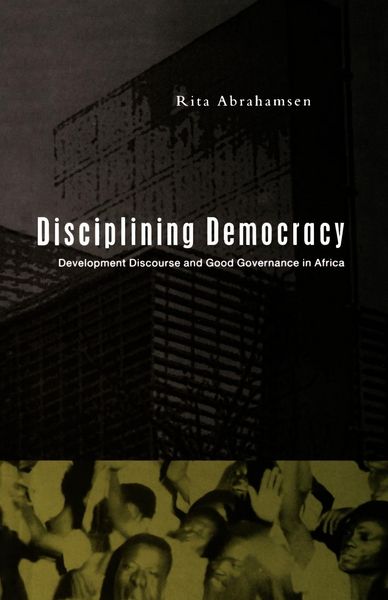
Produktbild: Disciplining Democracy

Disciplining Democracy

65,99 €

inkl. gesetzl. MwSt., Versandkostenfrei


Beschreibung

Not very long ago, authoritarian forms of government were widely regarded as necessary for rapid economic growth and development, and Western donors supported dictatorial regimes in every continent. Today the political mantra is democracy, and the World Bank and Western donors require it almost as a...

Beschreibung

Not very long ago, authoritarian forms of government were widely regarded as necessary for rapid economic growth and development, and Western donors supported dictatorial regimes in every continent. Today the political mantra is democracy, and the World Bank and Western donors require it almost as a condition of assistance. This thought-provoking book argues not simply that the West's good governance agenda came into being with the demise of the Soviet Union. Much more importantly, it shows how this agenda comprises only very superficial democratic institutional forms that are compatible with continued structural adjustment. African governments, in particular, remain in a cleft stick - supposedly responsible to their electorates at home, in fact beholden to external creditors and donors. The result is the creation of fragile democracies unable to respond to the demands of the poor - who are in the great majority - for socio-economic improvements, and where the requirements of external actors frequently overrule the wishes of domestic constituencies.
Using the example of the good governance discourse, Rita Abrahamsen contributes powerfully to our understanding of development, not as some universally valid set of goals or procedures, but as a historically contingent form of knowledge intimately connected to prevailing structures and relations of power. Her book argues that a key effect of contemporary development discourse, despite all its proclamations in favour of democracy, is to help reproduce a world order that is essentially undemocratic.

Produktdetails

Einband

Taschenbuch

Erscheinungsdatum

16.12.2000

Verlag Bloomsbury Academic
Seitenzahl

188

Produktdetails

Einband

Taschenbuch

Erscheinungsdatum

16.12.2000

Verlag Bloomsbury Academic
Seitenzahl

188

Maße (L/B/H)

21,6/14/1 cm

Gewicht

245 g

Sprache

Englisch

ISBN

978-1-85649-859-3

Herstelleradresse

Libri GmbH
Europaallee 1
36244 Bad Hersfeld
DE

Email: gpsr@libri.de

Noch keine Bewertungen vorhanden

Verfassen Sie die erste Bewertung zu diesem Artikel

Helfen Sie anderen Kundinnen und Kunden durch Ihre Meinung.

Kundinnen und Kunden meinen

Bewertungen (0)

  • Produktbild: Disciplining Democracy
  • Acknowledgments
    Introduction
    1. Democratisation and Development Discourse
    2. New World Order, New Development Discourse
    3. The Seductiveness of Good Governance
    4. The Democratisation of Poverty
    5. Whose Democracy?
    6. Economic Liberalisation and Democratic Erosion
    7. The Success of the Good Governance Discourse