Produktbild: Origins of War

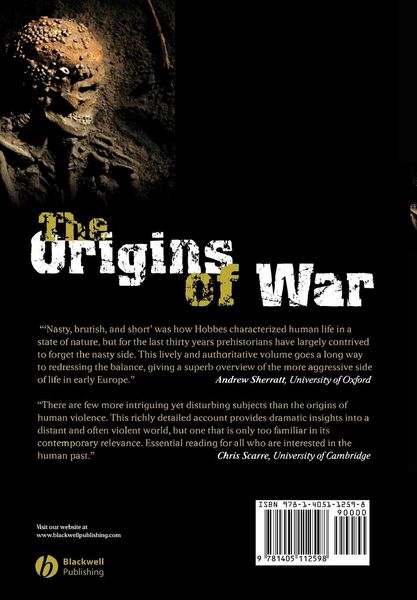
Origins of War Violence in Prehistory

199,99 €

inkl. gesetzl. MwSt., Versandkostenfrei


Beschreibung

Produktdetails

Einband

Gebundene Ausgabe

Erscheinungsdatum

17.12.2004

Verlag

Wiley

Seitenzahl

304

Maße (L/B/H)

23,5/15,7/2,2 cm

Gewicht

553 g

Sprache

Englisch

ISBN

978-1-4051-1259-8

Beschreibung

Produktdetails

Einband

Gebundene Ausgabe

Erscheinungsdatum

17.12.2004

Verlag

Wiley

Seitenzahl

304

Maße (L/B/H)

23,5/15,7/2,2 cm

Gewicht

553 g

Sprache

Englisch

ISBN

978-1-4051-1259-8

Herstelleradresse

Libri GmbH
Europaallee 1
36244 Bad Hersfeld
DE

Email: gpsr@libri.de

Noch keine Bewertungen vorhanden

Verfassen Sie die erste Bewertung zu diesem Artikel

Helfen Sie anderen Kundinnen und Kunden durch Ihre Meinung.

Kundinnen und Kunden meinen

Bewertungen (0)

  • Produktbild: Origins of War
  • Preface.

    Acknowledgments.

    Introduction:.

    Bloodshed at the Beginning of History.

    War: An Ongoing Feature of Literature and Religion.

    Archaeology: Tracking Down History.

    War in Prehistory: From the Garrigues of Languedoc to the Temples of Malta.

    Corsica: Conquered and Re-conquered.

    Violence and Aggression Prior to Mankind.

    Warfare: Nature or Culture?.

    Exchange or Battle?.

    Was There a Palaeolithic "War"?.

    Ritual Warfare and War between "Great Men".

    Prehistoric Man: Neither Violent Brute nor Innocent Lamb.

    The Issue of Sacrifice.

    Is Prehistoric Violence "Readable"?.

    2. Violence in Hunter-gatherer Society:.

    Neanderthal Man and Cannibalism.

    Prehistoric Cannibalism.

    Suspicious Disappearances in Charente (France).

    Cain's Predecessors.

    Violence in the Artwork of the Quaternary Era.

    Sicily: Torture in 10,000 BC?.

    From the Throwing Stick to the Bow and Arrow.

    The First Bows.

    Conflict in Sudan.

    Coveted Land.

    Conflict during the Mesolithic.

    The Enemy: Mutilated and Tortured.

    3. Agriculture: A Calming or Aggravating Influence?:.

    The Neolithic in Europe: A Peaceful or Dangerous Conquest?.

    The Talheim Massacre.

    Disturbances during the Neolithic.

    Fontbregoua (France): Another Case of Cannibalism?.

    Cannibalistic Farmers?.

    Neolithic Art, the Medium of Violence?.

    Battle Scenes in the Sierras of the Spanish Levant.

    Injuries and Capital Executions.

    Causes for Quarrel.

    Hunters and/or Farmers in Confrontation.

    The Strong and the Weak.

    4. Humans as Targets: 4,000-8,000 Years Ago:.

    The Contrasting Geography of Violence.

    A Progressive Intensification of Conflict?.

    War upon the Plateaus of Southern France?.

    The Difficulties of Making an Assessment.

    Effective Weapons of Death.

    Injury and Trepanation.

    Did Collective Burial Sites Sometimes Serve as Communal Graves?.

    Lessons from the San Juan Ante Portam Latinam Burial Site (Alava, Spain).

    Ballistic Accuracy.

    5. The Warrior: An Ideological Construction:.

    The Importance of the Male.

    Accompanying a Man in Death.

    A Full Quiver: For Hunting, for Fighting or for Show.

    Arrows and Jewels: Masculine/Feminine.

    Menhir Statues: The First Armed Steles.

    From Mount Bego to the Italian Alps.

    Masculinity/Femininity: Reversing the Symbols.

    Open Villages and Fortified Settlements.

    Proto-Warriors of the West.

    6. The Concept of the Hero Emerges:.

    Weapons and Their Significance.

    The Warrior Becomes a Feature of Barbarian Europe.

    The Sword: King of Weapons.

    Ramparts, Forts and Citadels.

    The Orient: Chariots in Battle.

    The Development of a Cavalry.

    Tracing the Footsteps of Heroes.

    Steles: Marking Combatants for Posterity.

    Multiple Sacrifices.

    Mutilated Bodies Preserved in Peat Bogs.

    Conclusions.

    Appendices.

    Notes.

    Bibliography.

    Works by Jean Guilaine.

    Index