Gutscheinbedingungen

**Gültig bis 17.08.2026 auf Schreibwaren & Office-Artikel online auf thalia.at, in der Thalia App und in teilnehmenden Thalia Buchhandlungen in Österreich mit Schulsortiment. In den Buchhandlungen nur gültig auf lagernde Ware. Einzelne Artikel können ausgeschlossen sein. Ausgenommen sind preisgebundene Artikel. Pro Einkauf einmal einlösbar. Nur gültig gegen Vorlage oder im Onlineshop hinterlegter Bonuscard. Infos zur Einlösung in der Buchhandlung sind auf der Bonuscard-Vorteilspreisseite zu finden. Click & Collect nur bei Onlinevorabzahlung möglich. Keine Einlösung bei Scan & Go-Bezahlung. Keine Barauszahlung. Nicht kombinierbar mit anderen Aktionen und Gutscheinen. Gutschein wird auf max. 500€ Bestellwert angerechnet. Nicht gültig für Geschenkkarten, Versandkosten und Services.

  • Produktbild: Modality and Structure in Signed and Spoken Languages
  • Produktbild: Modality and Structure in Signed and Spoken Languages

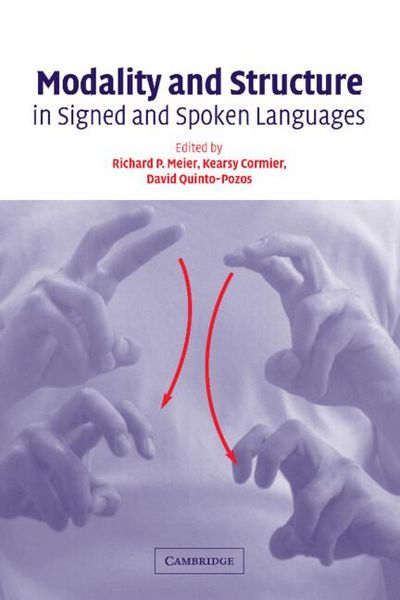
Modality and Structure in Signed and Spoken Languages

133,99 €

inkl. gesetzl. MwSt., Versandkostenfrei


Beschreibung

Produktdetails

Einband

Gebundene Ausgabe

Erscheinungsdatum

02.03.2015

Herausgeber

Richard P. Meier + weitere

Verlag

Cambridge University Press

Seitenzahl

500

Maße (L/B/H)

23,5/15,7/3,4 cm

Gewicht

955 g

Sprache

Englisch

ISBN

978-0-521-80385-4

Beschreibung

Produktdetails

Einband

Gebundene Ausgabe

Erscheinungsdatum

02.03.2015

Herausgeber

Verlag

Cambridge University Press

Seitenzahl

500

Maße (L/B/H)

23,5/15,7/3,4 cm

Gewicht

955 g

Sprache

Englisch

ISBN

978-0-521-80385-4

Noch keine Bewertungen vorhanden

Verfassen Sie die erste Bewertung zu diesem Artikel

Helfen Sie anderen Kundinnen und Kunden durch Ihre Meinung.

Kundinnen und Kunden meinen

Bewertungen (0)

  • Produktbild: Modality and Structure in Signed and Spoken Languages
  • Produktbild: Modality and Structure in Signed and Spoken Languages
  • 1. Why different, why the same? Explaining effects and non-effects of modality upon linguistic structure in sign and speech Richard P. Meier; Part I. Phonological Structure in Signed Languages: 2. Modality differences in sign language phonology and morphophonemics Diane Brentari; 3. Beads on a string? Representations of repetition in spoken and signed languages Rachel Channon; 4. Psycholinguistic investigations of phonological structure in American Sign Language David P. Corina and Ursula C. Hildebrandt; 5. Modality-dependent aspects of sign language production: evidence from slips of the hands and their repairs in German Sign Language Annette Hohenberger, Daniela Happ and Helen Leuninger; 6. The role of manually coded English in language development of deaf children Samuel J. Supalla and Cecile McKee; Part II. Gesture and Iconicity in Sign and Speech: 7. A modality-free notion of gesture and how it can help us with the morpheme vs. gesture question in sign language linguistics (or at least give us some criteria to work with) Arika Okrent; 8. Gesture as the substrate in the process of ASL grammaticization Terry Janzen and Barbara Shaffer; 9. A cross-linguistic examination of the lexicons of four signed languages Anne-Marie Currie, Richard P. Meier and Keith Walters; Part III. Syntax in Sign: Few or No Effects of Modality: 10. Where are all the modality effects? Diane Lillo-Martin; 11. Applying morphosyntactic and phonological readjustment rules in natural language negation Roland Pfau; 12. Nominal expressions in Hong Kong Sign Language: does modality make a difference? Gladys Tang and Felix Sze; Part IV. Using Space and Describing Space: 13. Pronominal reference in signed and spoken language: are grammatical categories modality-dependent? Susan Lloyd McBurney; 14. Is verb agreement the same cross-modally? Christian Rathmann and Gaurav Mathur; 15. The effects of modality on spatial language: how signers and speakers talk about space Karen Emmorey; 16. The effects of modality on BSL development in an exceptional learner Gary Morgan, Neil Smith, Ianthi Tsimpli and Bencie Woll; 17. Deictic points in the visual/gestural and tactile/gestural modalities David Quinto-Pozos.