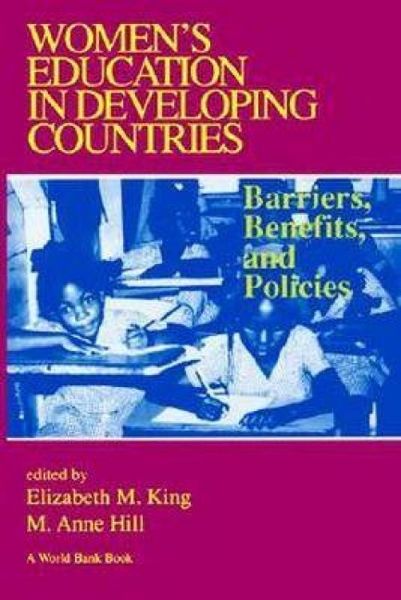
Women's Education in Developing Countries Barriers, Benefits and Policies
-
- Englisch ausgewählt
41,99 €
inkl. gesetzl. MwSt.,
Beschreibung
Produktdetails
Einband
Taschenbuch
Erscheinungsdatum
01.07.1997
Herausgeber
Elizabeth M. King + weitereVerlag
World Bank PublicationsSeitenzahl
352
Maße (L/B/H)
22,9/15,2/2 cm
Gewicht
518 g
Sprache
Englisch
ISBN
978-0-8018-5828-4
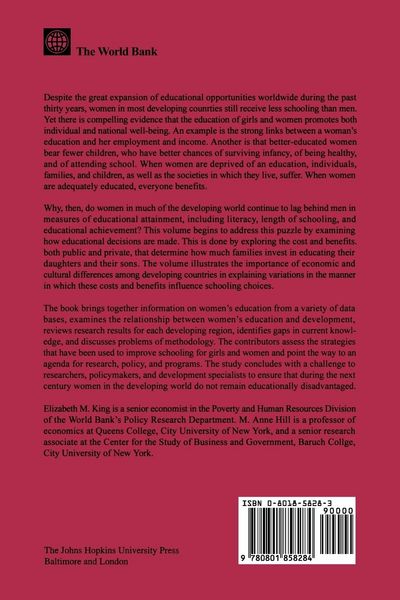
Despite the great expansion of educational opportunities worldwide during the past thirty years, women in most developing countries still receive less schooling than men. Yet there is compelling evidence that the education of girls and women promotes both individual and national well-being. An example is the strong link between a woman's education and her employment and income. Another is that better-educated women bear fewer children, who have better chances of surviving infancy, of being healthy, and of attending school. When women are deprived of an education, individuals, families, and children, as well as the societies in which they live, suffer. When women are adequately educated everyone benefits.
Why, then, do women in much of the developing world continue to lag behind men in measures of educational attainment, including literacy, length of schooling, and educational achievement? This volume begins to address this puzzle by examining how educational decisions are made. This is done by exploring the costs and benefits, both public and private, that determine how much families invest in educating their daughters and their sons. The volume illustrates the importance of economic and cultural differences among developing countries in explaining variations in the manner in which these costs and benefits influence schooling choices.
The book brings together information on women's education and development, reviews research results for each developing region, identifies gaps in current knowledge, and discusses problems of methodology. The contributors assess the strategies that have been used to improve schooling for girls and women and point the way to an agenda for research, policy, and programs. The study concludes with a challenge to researchers, policymakers, and development specialists to ensure that during the next century women in the developing world do not remain educationally disadvantaged..
Noch keine Bewertungen vorhanden
Verfassen Sie die erste Bewertung zu diesem Artikel
Helfen Sie anderen Kundinnen und Kunden durch Ihre Meinung.
Kurze Frage zu unserer Seite
Vielen Dank für Ihr Feedback
Wir nutzen Ihr Feedback, um unsere Produktseiten zu verbessern. Bitte haben Sie Verständnis, dass wir Ihnen keine Rückmeldung geben können. Falls Sie Kontakt mit uns aufnehmen möchten, können Sie sich aber gerne an unseren Kund*innenservice wenden.
zum Kundenservice