
KI-Beratung Beta

  • Produktbild: Psychology in the Courts
  • Produktbild: Psychology in the Courts

Psychology in the Courts

309,99 €

inkl. gesetzl. MwSt., Versandkostenfrei


Beschreibung

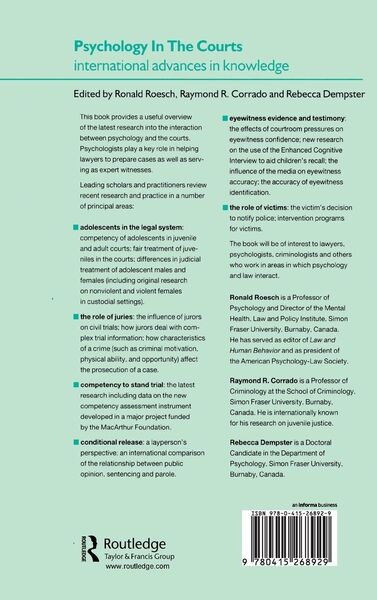
Provides a useful overview of the latest research into the interaction between psychology and the courts.

Beschreibung

Provides a useful overview of the latest research into the interaction between psychology and the courts.

Produktdetails

Einband

Gebundene Ausgabe

Erscheinungsdatum

07.06.2001

Herausgeber Raymond R. Corrado + weitere
Verlag Taylor and Francis

Produktdetails

Einband

Gebundene Ausgabe

Erscheinungsdatum

07.06.2001

Herausgeber
Verlag Taylor and Francis
Seitenzahl

368

Maße (L/B/H)

23,5/15,7/2,4 cm

Gewicht

636 g

Sprache

Englisch

ISBN

978-0-415-26892-9

Herstelleradresse

Libri GmbH
Europaallee 1
36244 Bad Hersfeld
DE

Email: gpsr@libri.de

Noch keine Bewertungen vorhanden

Verfassen Sie die erste Bewertung zu diesem Artikel

Helfen Sie anderen Kundinnen und Kunden durch Ihre Meinung.

Kundinnen und Kunden meinen

Bewertungen (0)

Die Leseprobe wird geladen.
  • Produktbild: Psychology in the Courts
  • Produktbild: Psychology in the Courts
  • Invited address; Part 1: Adolescents; 1: Toward an Expanded Definition of Adolescent Competence in Legal Contexts; 2: Girls in Jail: Punishment or Protection?; 3: Are Juveniles Getting a Fair Trial?: The Jury is Still Out; Part 2: Juries; 4: Race and the Civil Jury: How Does a Juror's Race Shape the Jury Experience?; 5: Juror Competence and Processing Style in Making Sense of Complex Trial Information; 6: Effects of Criminal Motivation, Ability, and Opportunity on Mock Jurors' Verdicts; Part 3: Civil and Criminal Court; 7: Complex Medical Litigation and Hindsight Bias: Strategies to Reduce Factfinders' Retrospective Attributions of Fault; 8: A Comparison of American and Canadian Conceptualizations of Competence to Stand Trial; 9: The Macarthur Competence Assessment Tool-Fitness to Plead: Evaluation of a Research Instrument for Assessing Fitness to Plead; 10: Public Opinion, Sentencing, and Parole: International Trends; 11: The Syndrome Evidence Phenomenon: Time to Move On?; 12: Conditional Release Attitudes: Laypersons' Perceptions of the Purposes, Effectiveness, and Acceptability of Early Release by Offense Type 1; 13: Judges' Decision-Making From Within; Part 4: Eyewitness Evidence and Testimony; 14: Children's Recall of the Unfortunate Fakir: a Further Test of the Enhanced Cognitive Interview; 15: Courtroom Pressures Can Alter Eyewitness Confidence; 16: Creating Confusion: Unconscious Transference in Media Crime Reporting; 17: The Discrimination of Deceptive, Mistaken, and Truthful Witness Testimony; 18: Previous Exposure to the Sender's Behavior and Accuracy at Judging Credibility; 19: The Influence of Personal Characteristics, Stakes and Lie Complexity on the Accuracy and Confidence to Detect Deceit 1; Part 5: Victims of Crime; 20: The Role of Social Influence in Crime Victim's Decision to Notify the Police; 21: Structured Trauma Writing (STW) as a Victim-Supportive Intervention: Examining the Efficacy of Emotional Ventilation and Downward Writing 1