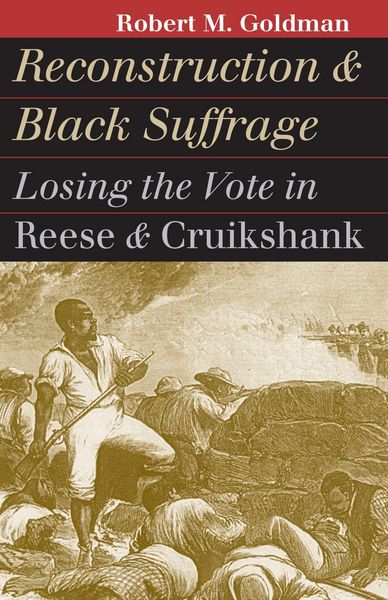
Reconstruction and Black Suffrage Losing the Vote in Reese and Cruikshank
-
- Taschenbuch ausgewählt
- eBook
-
Sprache:Englisch
39,99 €
inkl. gesetzl. MwSt.,
Beschreibung
Produktdetails
Einband
Taschenbuch
Erscheinungsdatum
01.02.2001
Verlag
University Press Of KansasSeitenzahl
198
Maße (L/B/H)
21,6/14/1,3 cm
Gewicht
236 g
Sprache
Englisch
ISBN
978-0-7006-1069-3
On Easter Sunday in 1873, more than one hundred black men were gunned down in Grant Parish, Louisiana, for daring to assert their right to vote. Several months earlier, in Lexington, Kentucky, another black man was denied the right to vote for simply failing to pay a poll tax. Both events typified the intense opposition to the federal guarantee of black voting rights. Both events led to landmark Supreme Court decisions. And, as Robert Goldman shows, both events have much to tell us about an America that was still deeply divided over the status of blacks during the Reconstruction era.
Goldman deftly highlights the cases of United States v. Reese and United States v. Cruikshank within the context of an ongoing power struggle between state and federal authorities and the realities of being black in postwar America. Focusing especially on the so-called Reconstruction Amendments and Enforcement Acts, he argues that the decisions in Reese and Cruikshank signaled an enormous gap between guaranteed and enforced rights. The Court's decisions denied the very existence of any such guarantee and, further, conferred upon the states the right to determine who may vote and under what circumstances.
In both decisions, lower court convictions were overturned through suprisingly narrrow rulings, despite the larger constitutional issues involved. In Reese the Court justified its decision by voiding only two sections of the Enforcement Acts, while in Cruikshank it merely voided the original indictments as being "insufficient in law" by failing to allege that the Grant Parish murders had been explicitly motivated by racial prejudice.
Such legalistic reasoning marked the grim beginning of a nearlycentury-long struggle to reclaim what the Fifteenth Amendment had supposedly guaranteed. As Goldman shows, the Court's decisions undermined the fledgling efforts of the newly formed justice department and made it increasingly difficult to control the racial violence, intimidati
Noch keine Bewertungen vorhanden
Verfassen Sie die erste Bewertung zu diesem Artikel
Helfen Sie anderen Kundinnen und Kunden durch Ihre Meinung.
Kurze Frage zu unserer Seite
Vielen Dank für Ihr Feedback
Wir nutzen Ihr Feedback, um unsere Produktseiten zu verbessern. Bitte haben Sie Verständnis, dass wir Ihnen keine Rückmeldung geben können. Falls Sie Kontakt mit uns aufnehmen möchten, können Sie sich aber gerne an unseren Kund*innenservice wenden.
zum Kundenservice