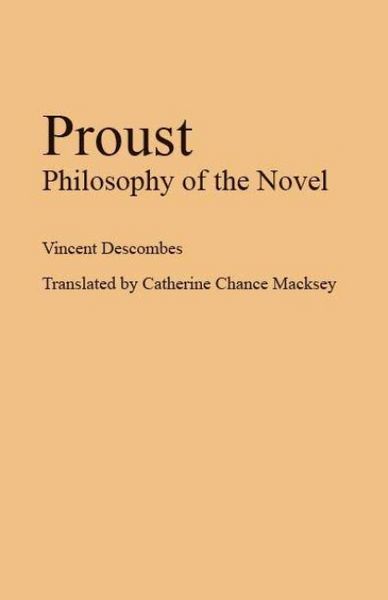
Proust Philosophy of the Novel
-
- Englisch ausgewählt
72,99 €
UVP
81,40 €
inkl. gesetzl. MwSt.,
Beschreibung
Produktdetails
Einband
Gebundene Ausgabe
Erscheinungsdatum
01.08.1992
Verlag
Stanford University PressSeitenzahl
328
Maße (L/B/H)
22,6/14,5/2,4 cm
Gewicht
558 g
Sprache
Englisch
ISBN
978-0-8047-2000-7
Through the voice of the narrator of Remembrance of Things Past, Proust observes of the painter Elstir that the paintings are bolder than the artist; Elstir the painter is bolder than Elstir the theorist. This book applies the same distinction Proust; the Proustian novel is bolder than Proust the theorist.
By this the author means that the novel is philosophically bolder, that it pursues further the task Proust identifies as the writer's work: to explain life, to elucidate what has been lived in obscurity and confusion. In this, the novelist and the philosopher share a common goal: to clarify the obscure in order to arrive at the truth. It follows that Proust's real philosophy of the novel is to be found not in the speculative passages of Remembrance, which merely echo the philosophical commonplaces of his time, but in the truly novelistic or narrative portions of his text.
In Against Sainte-Beuve, Proust sets forth his ideas about literature in the form of a critique of the method of Sainte-Beuve. Scholars who have studied Proust's notebooks describe the way in which this essay was taken over by bits of narrative originally intended as illustration supporting its theses. The philosophical portions of Remembrance were not added to the narrative as an afterthought, designed to bring out its meaning. What happened was the reverse: the novel was born of a desire to illustrate the propositions of the essay.
Why then should we not find the novel more philosophically advanced than the essay? Reversing the usual order followed by literary critics, the author interprets the novel as an elucidation, and not as a simple transposition, of the essay. The book is not only a general interpretation of Proust's novel and its construction; it includes detailed discussions of such topics as literature and philosophy, the nature of the literary genres, the poetics of the novel, the definition of art, modernity and postmodernity, and the sociology of literature.
Noch keine Bewertungen vorhanden
Verfassen Sie die erste Bewertung zu diesem Artikel
Helfen Sie anderen Kundinnen und Kunden durch Ihre Meinung.
Kurze Frage zu unserer Seite
Vielen Dank für Ihr Feedback
Wir nutzen Ihr Feedback, um unsere Produktseiten zu verbessern. Bitte haben Sie Verständnis, dass wir Ihnen keine Rückmeldung geben können. Falls Sie Kontakt mit uns aufnehmen möchten, können Sie sich aber gerne an unseren Kund*innenservice wenden.
zum Kundenservice