
• Produktbild: Managing in a European Context
  • Produktbild: Managing in a European Context

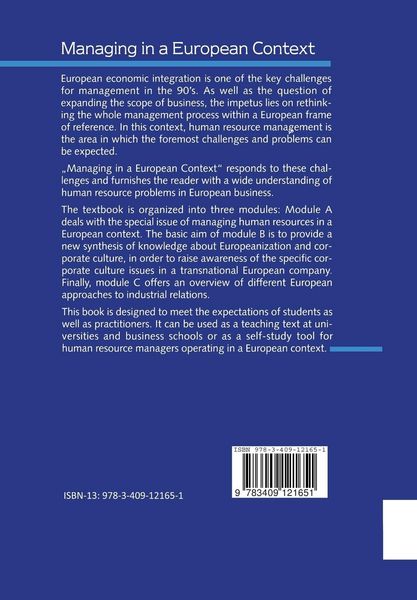
Managing in a European Context Human Resources Corporate Culture Industrial Relations Text and Cases. Text and Cases

57,50 €

inkl. gesetzl. MwSt., Versandkostenfrei


Beschreibung

Produktdetails

Einband

Taschenbuch

Erscheinungsdatum

30.01.1996

Abbildungen

XVIII, mit 108 Abbildungen, schwarz-weiss Illustrationen

Verlag

Betriebswirtschaftlicher Verlag Gabler

Seitenzahl

376

Maße (L/B/H)

24,4/17/2,1 cm

Gewicht

688 g

Auflage

1996

Sprache

Deutsch

ISBN

978-3-409-12165-1

Beschreibung

Produktdetails

Einband

Taschenbuch

Erscheinungsdatum

30.01.1996

Abbildungen

XVIII, mit 108 Abbildungen, schwarz-weiss Illustrationen

Verlag

Betriebswirtschaftlicher Verlag Gabler

Seitenzahl

376

Maße (L/B/H)

24,4/17/2,1 cm

Gewicht

688 g

Auflage

1996

Sprache

Deutsch

ISBN

978-3-409-12165-1

Herstelleradresse

Gabler, Betriebswirt.-Vlg
Abraham-Lincoln-Str. 46
65189 Wiesbaden
DE

Email: ProductSafety@springernature.com

Kundinnen und Kunden meinen

0 Bewertungen

Informationen zu Bewertungen

Zur Abgabe einer Bewertung ist eine Anmeldung im Konto notwendig. Die Authentizität der Bewertungen wird von uns nicht überprüft. Wir behalten uns vor, Bewertungstexte, die unseren Richtlinien widersprechen, entsprechend zu kürzen oder zu löschen.

Die Bewertungen sind nach Format, Anzahl Sterne und Datum sortiert.

Verfassen Sie die erste Bewertung zu diesem Artikel

Helfen Sie anderen Kund*innen durch Ihre Meinung

Kundinnen und Kunden meinen

0 Bewertungen filtern

Weitere Artikel finden Sie in

  • Produktbild: Managing in a European Context
  • Produktbild: Managing in a European Context
  • Module A: Managing Human Resources in a European Context.- 1: European Personnel Management — Is There a Problem ?.- 1.1 Challenges of the Single European Market (SEM).- 1.1.1 The Rhetoric of Europe 1992.- 1.1.2 Objectives of, and Barriers to, the SEM.- 1.1.3 The Impact of the Social Charter.- 1.2 Conceptual Foundations of Human Resource Management (HRM).- 1.2.1 The Personnel Function and HRM.- 1.2.2 From the Traditional Personnel Function to Strategic Human Resource Management.- 1.2.3 From National to International HRM.- 1.2.3.1 Configurations of Employment Systems.- 1.2.3.2 Differentiation of the Personnel Function.- 1.2.3.3 Contingency Factors on International HRM.- 1.3 HRM Implications of the SEM — General Trends and Empirical Evidence.- 1.3.1 Differences between International HRM and European HRM Responses to the SEM.- 1.3.2 Implications for Various Functional Areas of HRM.- 1.3.3 HRM in European Companies: Some Empirical Evidence.- 1.3.3.1 Has HRM Attained a Leading Role in Preparing a Company for Europe 1992?.- 1.3.3.2 International Strategic HRM.- 1.3.3.3 HRM Implications in Border-Area Companies.- 1.3.3.4 Summary and Conclusions.- 1.4 Towards a European Concept of HRM?.- 1.4.1 Convergence or Divergence of HRM?.- 1.4.2 Convergence and Divergence in Europe.- 1.4.3 A New Approach to Production, Industrial Relations, and HRM in Europe?.- Recommended Literature.- Questions.- 2: Defining, Recruiting and Selecting a European Workforce.- 2.1 Overview.- 2.1.1 The Human Resource Planning Process.- 2.1.2 Assessment of Manpower Requirements.- 2.1.3 The Recruitment Process.- 2.1.4 Personnel Selection.- 2.1.5 Recruitment as an Integral Process of Personnel Policy.- 2.2 Does the SEM Change Qualification Requirements?.- 2.2.1 In Search of the “Euro-Manager”: Super-(Wo-)Man in the Making?.- 2.2.2 Consequences for Management Requirements in Europe.- 2.2.3 Future Management Qualifications in Europe: An Example.- 2.3 Recruitment in Europe.- 2.3.1 Information on Labour Markets.- 2.3.1.1 Background Information.- 2.3.1.2 Companies’ Labour Market Research.- 2.3.2 Information on the Educational Systems and their Outputs.- 2.3.3 Recruitment Channels.- 2.4 Selection Instruments.- Recommended Literature.- Questions.- 3: Training and Developing a European Workforce.- 3.1 Introduction and Overview.- 3.1.1 Interdependence of Recruitment and Development.- 3.1.2 Some Basic Definitions.- 3.1.3 Identification of Training and Development Needs.- 3.1.4 Training and Development Means and Methods.- 3.1.5 Evaluation of Training and Development.- 3.2 Preparing the Work-Force for Europe.- 3.2.1 The European Challenge to Training and Development.- 3.2.2 Training and Development Programmes.- 3.2.3 Transfer Policy.- 3.2.3.1 Target Groups of Transfer Policy.- 3.2.3.2 Aims of Transfer Policy.- 3.2.3.3 Phases in Transfer Policy.- 3.2.3.3.1 Identification and Selection of Assignees.- 3.2.3.3.2 Preparation for Transfers and Career Planning.- 3.2.3.3.3 Counseling and Coaching.- 3.2.3.3.4 Re-patriation and Re-integration.- 3.3 Contingency Factors of Training and Development.- 3.3.1 Management Attitudes and Strategies.- 3.3.2 Task-related Aspects.- 3.3.3 Cultural (Dis-)Similarities.- 3.3.3.1 The Importance of Cultural Differences.- 3.3.3.2 Can Cultural Differences be Measured?.- 3.3.3.2.1 Dimensions of Cultural Differences.- 3.3.3.2.2 “Culture’s Consequences”.- 3.3.3.2.3 Conclusions.- 3.3.3.3 Cross-cultural Training.- Recommended Literature.- Questions.- 4: Motivating and Compensating a European Workforce.- 4.1 Motivational Foundations of Working in a European Environment.- 4.1.1 Overview.- 4.1.2 Motivational Foundations of International HRM.- 4.2 Motivation to go Abroad.- 4.2.1 A Motivational Model for International HRM.- 4.2.2 The Crucial Importance of Mobility for a European Strategy.- 4.2.3 Barriers to Mobility.- 4.2.4 Incentives to Increase Mobility.- 4.2.5 The (Limited) Supportive Role of EC Regulations.- 4.3 Compensating a European Workforce.- 4.3.1 Compensation Decisions.- 4.3.2 Problems and Goals of a European Compensation Policy.- 4.3.3 Target Groups of Compensation Policy.- 4.3.3.1 The Origin and Destination of Employees as a Distinguishing Factor.- 4.3.3.2 Length of Stay.- 4.3.3.3 The Status of the Employees.- 4.3.4 Compensation Systems.- 4.3.4.1 Compensation Packages for International Assignments, Based on Home-country Salary.- 4.3.4.1.1 A Basic Philosophy: The “Balance-sheet Approach”.- 4.3.4.1.2 Components of a Compensation System in Europe.- 4.3.4.2 Designing a Europe-wide Compensation System.- 4.3.4.2.1 The Challenge.- 4.3.4.2.2 The Information Base: International Comparisons of Salaries.- 4.3.4.2.3 Developing a Common Grading Scale for Base Pay.- 4.3.4.2.4 Performance Appraisals.- Recommended Literature.- Questions.- 5: Case Study Eismann Group.- Questions.- Module B: Corporate Culture: The Silent Language of European Business.- 6: Corporate Culture — Basic Characteristics and Importance for European Corporations.- 6.1 What is Corporate Culture?.- 6.2 Anatomy of Organizational Culture.- 6.2.1 Basic Assumptions.- 6.2.2 Norms and Standards.- 6.2.3 Symbol Systems.- 6.3 Types of Culture.- 6.4 Strong and Weak Cultures.- 6.5 Organizational Cultures and Subcultures.- 6.6 The Effects of Organizational Cultures.- 6.6.1 Functional Aspects.- 6.6.2 Dysfunctional Aspects.- 6.7 Culture Change in Organizations.- Recommended Literature.- Questions.- 7: Euro-Global Versus Euro-Local Corporate Culture(s).- 7.1 Introduction.- 7.2 Culture and Management.- 7.3 Corporate Culture and Management.- 7.4 Corporate Culture Versus National Culture.- 7.5 Pluralist Corporate Culture.- 7.6 The Universal Corporate Culture.- 7.7 Ethics of Corporate Culture Transfer.- 7.8 Corporate Culture and Corporate Control.- 7.9 Strategy and Culture.- 7.10 Multidimensional Globalization and Corporate Culture.- 7.11 Outlook: Global Culture as a New Development?.- Recommended Literature.- Questions.- Module C: Industrial Relations-Systems in Europe: Implications for Trans-Cultural Management.- 8: Human Resource Management in the Context of Industrial Relations — Frameworks for Studies in a European Context.- 8.1 The Role of Industrial Relations in Approaches to Human Resource Management.- 8.1.1 US Approaches: Industrial Relations as Neglected Factor.- 8.1.2 European Approaches: Industrial Relations as Constituent Factor.- 8.2 An Integrated View of Human Resource Management and Industrial Relations in a European Context.- 8.3 Comparative Approaches to Industrial Relations.- 8.3.1 Input — Conversion — Output Models.- 8.3.2 Convergence Theories.- 8.3.3 Corporatism.- 8.3.4 Strategic Choice Approach.- 8.4 Framework for the Study of European Human Resource Management and Industrial Relations.- Recommended Literature.- Questions.- 9: Levels of Regulation and Types of Industrial Relations Systems in Europe.- 9.1 Industrial Relations Regulations and Managerial Choices in Europe: Provisions for Structural Conflict Management.- 9.2 International and National Regulations of the Employment Relationship — Determinants within the Industrial Relations System.- 9.2.1 ILO-Conventions.- 9.2.2 European Regulations.- 9.2.3 National Regulations.- 9.3 Collective Bargaining and Company Structure.- 9.3.1 Collective Bargaining.- 9.3.1.1 Bargaining Units.- 9.3.1.2 Industrial Conflict and Conflict Management.- 9.3.2 Structure of the European Company and Employee Participation.- 9.4 Employee Representation — Participative Implementation of Human Resource Instruments.- 9.5 Types of Industrial Relations-Systems in Europe.- 9.5.1 Conflict-oriented Systems.- 9.5.2 Negotiation-oriented Systems.- 9.5.3 Harmony-oriented Systems.- Recommended Literature.- Questions.- 10: Incorporating Industrial Relations into Corporate Strategy Formulation and Implementation.- 10.1 European Management and Strategic Choices in Industrial Relations.- 10.1.1 The Concept of European Corporate Strategies.- 10.1.2 Strategic Management of Human Resources in Europe.- 10.1.3 Managerial Choices within a “European Industrial Relations Area”.- 10.2 The Impact of Industrial Relations on Managerial Strategies.- 10.2.1 Environmental Factors.- 10.2.2 Managerial Choices within the Transformation Process.- 10.2.2.1 Global Developments and Human Resource Policy Choices.- 10.2.2.2 Global Strategic Choices.- 10.2.2.3 Strategy Implementation and Human Resource Management Instruments.- 10.2.3 Industrial Relations Outcomes.- 10.2.3.1 Quantitative Indicators.- 10.2.3.2 Qualitative Interpretations.- 10.3 Corporate Cultures and the Management of Diversity.- 10.4 Present and Future Challenges for Industrial Relations in Europe.- 10.4.1 Industrial Relations and Competitive Advantages.- 10.4.2 Multinationalisation of Capital, Labour, and Institutions.- Recommended Literature.- Questions.- 11: Industrial Relations-Systems in Europe — Facts and Procedures.- 11.1 The Systems of Social Security.- 11.2 Country Studies: Facts and Procedures in Selected Countries.- 11.2.1 The British System of Industrial Relations.- 11.2.1.1 Working Time and Leave.- 11.2.1.2 Remuneration and Benefits.- 11.2.1.3 Introduction of New Technologies.- 11.2.1.4 Training and Development.- 11.2.1.5 Dismissals.- 11.2.2 The Italian System of Industrial Relations.- 11.2.2.1 Working Time and Leave.- 11.2.2.2 Remuneration and Benefits.- 11.2.2.3 Introduction of New Technologies.- 11.2.2.4 Training and Development.- 11.2.2.5 Dismissals.- 11.2.3 The French System of Industrial Relations.- 11.2.3.1 Working Time and Leave.- 11.2.3.2 Remuneration and Benefits.- 11.2.3.3 Introduction of New Technologies.- 11.2.3.4 Training and Development.- 11.2.3.5 Dismissals.- 11.2.4 The Danish System of Industrial Relations.- 11.2.4.1 Working Hours and Leave.- 11.2.4.2 Remuneration and Benefits.- 11.2.4.3 Introduction of New Technologies.- 11.2.4.4 Training and Development.- 11.2.4.5 Dismissals.- 11.2.5 The German System of Industrial Relations.- 11.2.5.1 Working Time and Leave.- 11.2.5.2 Remuneration and Benefits.- 11.2.5.3 Introduction of New Technologies.- 11.2.5.4 Training and Development.- 11.2.5.5 Dismissals.- 11.3 Outlines of Corporate Cultures in Basic Types of Industrial Relations-Systems.- 11.3.1 The Dutch System of Industrial Relations.- 11.3.2 The Belgium System of Industrial Relations.- 11.3.3 The System of Industrial Relations in Luxembourg.- 11.3.4 The Irish System of Industrial Relations.- 11.3.5 The Greek System of Industrial Relations.- 11.3.6 The Spanish System of Industrial Relations.- 11.3.7 The Portugese System of Industrial Relations.- Recommended Literature.- Questions.