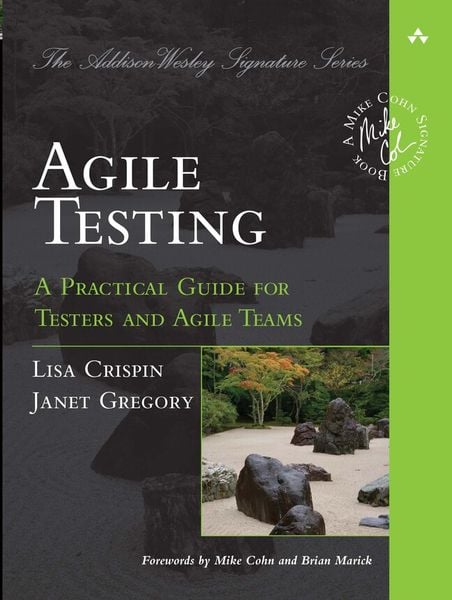
Produktbild: Agile Testing: A Practical Guide for Testers and Agile Teams

Agile Testing: A Practical Guide for Testers and Agile Teams A Practical Guide for Testers and Agile Teams

53,99 €

inkl. gesetzl. MwSt., Versandkostenfrei


Beschreibung

Produktdetails

Verkaufsrang

22866

Einband

Taschenbuch

Erscheinungsdatum

30.12.2008

Verlag

Pearson Studium

Seitenzahl

576

Maße (L/B/H)

23,5/17,8/3,1 cm

Gewicht

885 g

Auflage

1. Auflage

Sprache

Englisch

ISBN

978-0-321-53446-0

Beschreibung

Produktdetails

Verkaufsrang

22866

Einband

Taschenbuch

Erscheinungsdatum

30.12.2008

Verlag

Pearson Studium

Seitenzahl

576

Maße (L/B/H)

23,5/17,8/3,1 cm

Gewicht

885 g

Auflage

1. Auflage

Sprache

Englisch

ISBN

978-0-321-53446-0

Herstelleradresse

Financial Times Prent.
St.-Martin-Straße 82
81541 München
DE

Email: salesde@pearson.com

Kundinnen und Kunden meinen

0 Bewertungen

Informationen zu Bewertungen

Zur Abgabe einer Bewertung ist eine Anmeldung im Konto notwendig. Die Authentizität der Bewertungen wird von uns nicht überprüft. Wir behalten uns vor, Bewertungstexte, die unseren Richtlinien widersprechen, entsprechend zu kürzen oder zu löschen.

Die Bewertungen sind nach Format, Anzahl Sterne und Datum sortiert.

Verfassen Sie die erste Bewertung zu diesem Artikel

Helfen Sie anderen Kund*innen durch Ihre Meinung

Kundinnen und Kunden meinen

0 Bewertungen filtern

Die Leseprobe wird geladen.
  • Produktbild: Agile Testing: A Practical Guide for Testers and Agile Teams
  • Foreword by Mike Cohn      xxiii

    Foreword by Brian Marick      xxv

    Preface      xxvii

    Acknowledgments      xxxvii

    About the Authors      xli


    Part I: Introduction      1

    Chapter 1: What Is Agile Testing, Anyway?      3


    Agile Values 3

    What Do We Mean by “Agile Testing”? 4

    A Little Context for Roles and Activities on an Agile Team 7

    How Is Agile Testing Different? 9

    Whole-Team Approach 15

    Summary 17

    Chapter 2: Ten Principles for Agile Testers      19

    What’s an Agile Tester? 19

    The Agile Testing Mind-Set 20

    Applying Agile Principles and Values 21

    Adding Value 31

    Summary 33

    Part II: Organizational Challenges      35

    Chapter 3: Cultural Challenges      37


    Organizational Culture 37

    Barriers to Successful Agile Adoption by Test/QA Teams 44

    Introducing Change 49

    Management Expectations 52

    Change Doesn’t Come Easy 56

    Summary 58

    Chapter 4: Team Logistics      59

    Team Structure 59

    Physical Logistics 65

    Resources 66

    Building a Team 69

    Summary 71

    Chapter 5: Transitioning Typical Processes      73

    Seeking Lightweight Processes 73

    Metrics 74

    Defect Tracking 79

    Test Planning 86

    Existing Processes and Models 88

    Summary 93

    Part III: The Agile Testing Quadrants      95

    Chapter 6: The Purpose of Testing      97


    The Agile Testing Quadrants 97

    Knowing When a Story Is Done 104

    Managing Technical Debt 106

    Testing in Context 106

    Summary 108

    Chapter 7: Technology-Facing Tests that Support the Team       109

    An Agile Testing Foundation 109

    Why Write and Execute These Tests? 112

    Where Do Technology-Facing Tests Stop? 119

    What If the Team Doesn’t Do These Tests? 121

    Toolkit 123

    Summary 127

    Chapter 8: Business-Facing Tests that Support the Team      129

    Driving Development with Business-Facing Tests 129

    The Requirements Quandary 132

    Thin Slices, Small Chunks 144

    How Do We Know We’re Done? 146

    Tests Mitigate Risk 147

    Testability and Automation 149

    Summary 150

    Chapter 9: Toolkit for Business-Facing Tests that Support the Team       153

    Business-Facing Test Tool Strategy 153

    Tools to Elicit Examples and Requirements 155

    Tools for Automating Tests Based on Examples 164

    Strategies for Writing Tests 177

    Testability 183

    Test Management 186

    Summary 186

    Chapter 10: Business-Facing Tests that Critique the Product      189

    Introduction to Quadrant 3 190

    Demonstrations 191

    Scenario Testing 192

    Exploratory Testing 195

    Usability Testing 202

    Behind the GUI 204

    Testing Documents and Documentation 207

    Tools to Assist with Exploratory Testing 210

    Summary 214

    Chapter 11: Critiquing the Product Using Technology-Facing Tests       217

    Introduction to Quadrant 4 217

    Who Does It? 220

    When Do You Do It? 222

    “ility” Testing 223

    Performance, Load, Stress, and Scalability Testing 233

    Summary 238

    Chapter 12: Summary of Testing Quadrants      241

    Review of the Testing Quadrants 241

    A System Test Example 242

    Tests Driving Development 244

    Automation 245

    Critiquing the Product with Business-Facing Tests 248

    Documentation 251

    Using the Agile Testing Quadrants 252

    Summary 253

    Part IV: Automation      255

    Chapter 13: Why We Want to Automate Tests and What Holds Us Back      257


    Why Automate? 258

    Barriers to Automation—Things that Get in the Way 264

    Can We Overcome These Barriers? 270

    Summary 271

    Chapter 14: An Agile Test Automation Strategy        273

    An Agile Approach to Test Automation 274

    What Can We Automate? 279

    What Shouldn’t We Automate? 285

    What Might Be Hard to Automate? 287

    Developing an Automation Strategy—Where Do We Start? 288

    Applying Agile Principles to Test Automation 298

    Supplying Data for Tests 304

    Evaluating Automation Tools 311

    Implementing Automation 316

    Managing Automated Tests 319

    Go Get Started 324

    Summary 324

    Part V: An Iteration in the Life of a Tester      327

    Chapter 15: Tester Activities in Release or Theme Planning      329


    The Purpose of Release Planning 330

    Sizing 332

    Prioritizing 338

    What’s in Scope? 340

    Test Planning 345

    Test Plan Alternatives 350

    Preparing for Visibility 354

    Summary 366

    Chapter 16: Hit the Ground Running       369

    Be Proactive 369

    Advance Clarity 373

    Examples 378

    Test Strategies 380

    Prioritize Defects 381

    Resources 381

    Summary 382

    Chapter 17: Iteration Kickoff      383

    Iteration Planning 383

    Testable Stories 393

    Collaborate with Customers 396

    High-Level Tests and Examples 397

    Summary 403

    Chapter 18: Coding and Testing      405

    Driving Development 406

    Tests that Critique the Product 412

    Collaborate with Programmers 413

    Talk to Customers 414

    Completing Testing Tasks 415

    Dealing with Bugs 416

    It’s All about Choices 419

    Facilitate Communication 429

    Regression Tests 432

    Resources 434

    Iteration Metrics 435

    Summary 440

    Chapter 19: Wrap Up the Iteration       443

    Iteration Demo 443

    Retrospectives 444

    Celebrate Successes 449

    Summary 451

    Chapter 20: Successful Delivery       453

    What Makes a Product? 453

    Planning Enough Time for Testing 455

    The End Game 456

    Customer Testing 464

    Post-Development Testing Cycles 467

    Deliverables 468

    Releasing the Product 470

    Customer Expectations 475

    Summary 476

    Part VI: Summary      479

    Chapter 21: Key Success Factors       481


    Success Factor 1: Use the Whole-Team Approach 482

    Success Factor 2: Adopt an Agile Testing Mind-Set 482

    Success Factor 3: Automate Regression Testing 484

    Success Factor 4: Provide and Obtain Feedback 484

    Success Factor 5: Build a Foundation of Core Practices 486

    Success Factor 6: Collaborate with Customers 489

    Success Factor 7: Look at the Big Picture 490

    Summary 491

    Glossary      493

    Bibliography      501

    Index      509