KI-Beratung Beta

Gutscheinbedingungen

**Gültig am 25.11.2026 auf fremdsprachige Bücher online auf thalia.at und in der Thalia App. Einzelne Artikel können ausgeschlossen sein. Ausgenommen sind preisgebundene Artikel & eBooks. Pro Einkauf einmal einlösbar. Click & Collect nur bei Onlinevorabzahlung möglich. Keine Barauszahlung. Nicht kombinierbar mit anderen Aktionen und Gutscheinen. Gutschein wird auf max. 500€ Bestellwert angerechnet. Nicht gültig für Geschenkkarten, Versandkosten und Services.

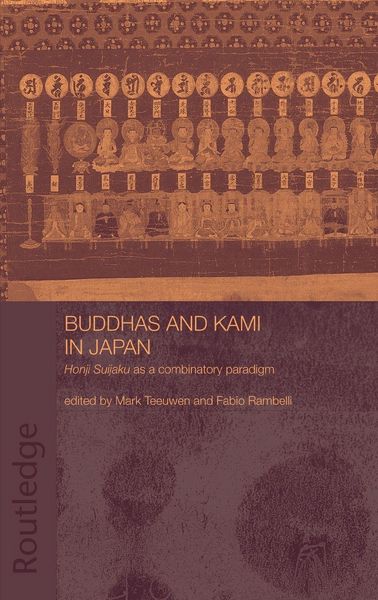
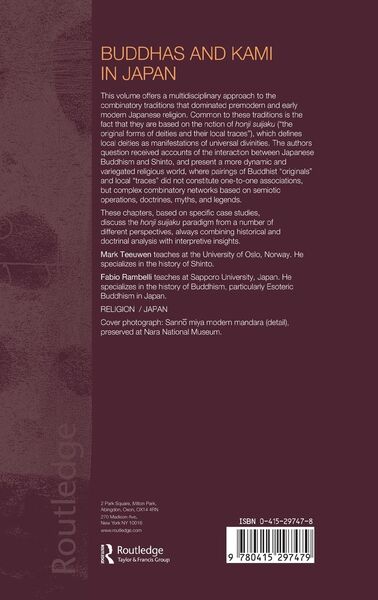
  • Produktbild: Buddhas and Kami in Japan
  • Produktbild: Buddhas and Kami in Japan

Buddhas and Kami in Japan Honji Suijaku as a Combinatory Paradigm

309,99 €

inkl. gesetzl. MwSt., Versandkostenfrei


Beschreibung

This volume offers a multidisciplinary approach to the combinatory tradition that dominated premodern and early modern Japanese religion, known as honji suijaku (originals and their traces).

Beschreibung

This volume offers a multidisciplinary approach to the combinatory tradition that dominated premodern and early modern Japanese religion, known as honji suijaku (originals and their traces).

Portrait

Mark Teeuwen teaches at the University of Oslo, Norway. He specialises in the history of Shinto. Fabio Ramballi teaches at Sapporo University, Japan. He specialises in the history of Buddhism, particularly Esoteric Buddhism in Japan.

Produktdetails

Einband

Gebundene Ausgabe

Erscheinungsdatum

28.11.2002

Herausgeber Fabio Rambelli + weitere
Verlag Routledge

Produktdetails

Einband

Gebundene Ausgabe

Erscheinungsdatum

28.11.2002

Herausgeber
Verlag Routledge
Seitenzahl

384

Maße (L/B/H)

24/16,1/2,5 cm

Gewicht

690 g

Sprache

Englisch

ISBN

978-0-415-29747-9

Herstelleradresse

Libri GmbH
Europaallee 1
36244 Bad Hersfeld
DE

Email: gpsr@libri.de

Noch keine Bewertungen vorhanden

Verfassen Sie die erste Bewertung zu diesem Artikel

Helfen Sie anderen Kundinnen und Kunden durch Ihre Meinung.

Kundinnen und Kunden meinen

Bewertungen (0)

Die Leseprobe wird geladen.
  • Produktbild: Buddhas and Kami in Japan
  • Produktbild: Buddhas and Kami in Japan
  • Contributors Preface 1. Introduction: Combinatory religion and the honji suijaku paradigm in pre-modern Japan Mark Teeuwen and Fabio Rambelli 2. From thunder child to Dharma protector: Dojo hoshi and the Buddhist appropriation of Japanese local deities Irene Lin 3. The source of oracular speech: absense? presence? or plain treachery? The case of Hachiman Usa-gú gotakusenshú Allan Grapard 4. Wrathful Deities and saving deities Sato Hiroo 5. The creation of a honji suijaku deity: Amaterasu as the Judge of the Dead Mark Teeuwen 6. Honji suijaku and the logic of combinatory images: Two case studies Iyanaga Nobumi 7. Honji suijaku and the development of etymological allegoresis as an interpretive method in medieval commentaries Susan Blakeley/Klein 8. 'Both parts' or 'only one'? Challenges to the honji suijaku paradigm in the Edo period Bernhard Scheid 9. Hokke Shinto: Kami in the Nichiren tradition Lucia Dolce 10. Honji suijaku at work: Religion, economics, and ideology in pre-modern Japan Fabio Rambelli 11. The interaction between Buddhist and Shinto traditions at Suwa Shrine Inoue Takami 12. Dancing the doctrine: Honji suijaku thought in kagura performances Irit Averbuch Notes Bibliography Index