Gutscheinbedingungen

**Gültig bis 06.07.2026 auf fremdsprachige Bücher online auf thalia.at, in der Thalia App ab einem Mindestbestellwert von 30€ und in allen Thalia Buchhandlungen in Österreich. In den Buchhandlungen nur gültig auf lagernde Ware. Einzelne Artikel können ausgeschlossen sein. Ausgenommen sind preisgebundene Artikel & eBooks. Pro Einkauf einmal einlösbar. Nur gültig gegen Vorlage oder im Onlineshop hinterlegter Bonuscard. Infos zur Einlösung in der Buchhandlung sind auf der Bonuscard-Vorteilspreisseite zu finden. Click & Collect nur bei Onlinevorabzahlung möglich. Keine Einlösung bei Scan & Go-Bezahlung. Keine Barauszahlung. Nicht kombinierbar mit anderen Aktionen und Gutscheinen. Gutschein wird auf max. 500€ Bestellwert angerechnet. Nicht gültig für Versandkosten und Services.

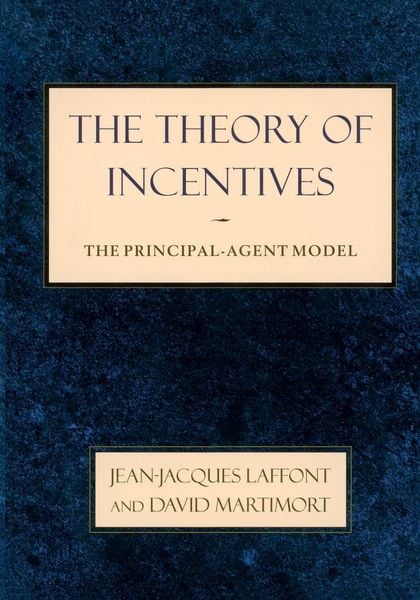
Produktbild: The Theory of Incentives

The Theory of Incentives The Principal-Agent Model

109,99 €

inkl. gesetzl. MwSt., Versandkostenfrei


Beschreibung

Produktdetails

Einband

Taschenbuch

Erscheinungsdatum

15.01.2002

Verlag

Princeton University Press

Seitenzahl

440

Maße (L/B/H)

25,4/17,8/2,4 cm

Gewicht

894 g

Sprache

Englisch

ISBN

978-0-691-09184-6

Beschreibung

Produktdetails

Einband

Taschenbuch

Erscheinungsdatum

15.01.2002

Verlag

Princeton University Press

Seitenzahl

440

Maße (L/B/H)

25,4/17,8/2,4 cm

Gewicht

894 g

Sprache

Englisch

ISBN

978-0-691-09184-6

Herstelleradresse

Libri GmbH
Europaallee 1
36244 Bad Hersfeld
DE

Email: GPSR Kontakt

Noch keine Bewertungen vorhanden

Verfassen Sie die erste Bewertung zu diesem Artikel

Helfen Sie anderen Kundinnen und Kunden durch Ihre Meinung.

Kundinnen und Kunden meinen

Bewertungen (0)

  • Produktbild: The Theory of Incentives
  • xi Foreword
    Introduction 1
    1 Incentives in Economic Thought 7
    1.1 Adam Smith and Incentive Contracts in Agriculture 8
    1.2 Chester Barnard and Incentives in Management 11
    1.3 Hume, Wicksell, Groves: The Free-Rider Problem 14
    1.4 Borda, Bowen, Vickrey: Incentives in Voting 15
    1.5 Leon Walras and the Regulation of Natural Monopolies 18
    1.6 Knight, Arrow, Pauly: Incentives in Insurance 18
    1.7 Sidgwick, Vickrey, Mirrlees: Redistribution and Incentives 20
    1.8 Dupuit, Edgeworth, Pigou: Price Discrimination 22
    1.9 Incentives in Planned Economies 23
    1.10 Leonid Hurwicz and Mechanism Design 25
    1.11 Auctions 27
    2 The Rent Extraction-Efficiency Trade-Off 28
    2.1 The Basic Model 32
    2.2 The Complete Information Optimal Contract 33
    2.3 Incentive Feasible Menu of Contracts 36
    2.4 Information Rents 39
    2.5 The Optimization Program of the Principal 40
    2.6 The Rent Extraction-Efficiency Trade-Off 41
    2.7 The Theory of the Firm Under Asymmetric Information 46
    2.8 Asymmetric Information and Marginal Cost Pricing 48
    2.9 The Revelation Principle 48
    2.10 A More General Utility Function for the Agent 51
    2.11 Ex Ante versus Ex Post Participation Constraints 57
    2.12 Commitment 63
    2.13 Stochastic Mechanisms 65
    2.14 Informative Signals to Improve Contracting 68
    2.15 Contract Theory at Work 72
    Appendix 81
    3 Incentive and Participation Constraints with Adverse Selection 82
    3.1 More than Two Types 86
    3.2 Multidimensional Asymmetric Information 93
    3.3 Type-Dependent Participation Constraint and Countervailing Incentives 101
    3.4 Random Participation Constraint 115
    3.5 Limited Liability 118
    3.6 Audit Mechanisms and Costly State Verification 121
    3.7 Redistributive Concerns and the Efficiency-Equity Trade-Off
    134 Appendices 130
    4 Moral Hazard: The Basic Trade-Offs 145
    4.1 The Model 148
    4.2 Risk Neutrality and First-Best Implementation 153
    4.3 The Trade-Off Between Limited Liability Rent Extraction and Efficiency 155
    4.4 The Trade-Off Between Insurance and Efficiency 158
    4.5 More than Two Levels of Performance 163
    4.6 Informative Signals to Improve Contracting 167
    4.7 Moral Hazard and the Theory of the Firm 172
    4.8 Contract Theory at Work 174
    4.9 Commitment Under Moral Hazard 184
    Appendices 185
    5 Incentive and Participation Constraints with Moral Hazard 187
    5.1 More than Two Levels of Effort 191
    5.2 The Multitask Incentive Problem 203
    5.3 Nonseparability of the Utility Function 226
    5.4 Redistribution and Moral Hazard 232
    Appendices 235
    6 Nonverifiability 260
    6.1 No Contract at Date 0 and Ex Post Bargaining 242
    6.2 Incentive Compatible Contract 244
    6.3 Nash Implementation 246
    6.4 Subgame-Perfect Implementation 256
    6.5 Risk Aversion 261
    6.6 Concluding Remarks 264
    7 Mixed Models 265
    7.1 Adverse Selection Followed by Moral Hazard 269
    7.2 Moral Hazard Followed by Adverse Selection 294
    7.3 Moral Hazard Followed by Nonverifiability 298
    8 Dynamics Under Full Commitment 303
    8.1 Repeated Adverse Selection 307
    8.2 Repeated Moral Hazard 319
    8.3 Constraints on Transfers: The Role of Implicit Incentives 342
    9 Limits and Extensions 347
    9.1 Informed Principal 351
    9.2 Limits to Enforcement 360
    9.3 Dynamics and Limited Commitment 364
    9.4 The Hold-Up Problem 370
    9.5 Limits to the Complexity of Contracts 375
    9.6 Limits in the Action Space 387
    9.7 Limits to Rational Behavior 391
    9.8 Endogenous Information Structures 395
    References 399
    Author Index 413
    Subject Index 417