Gutscheinbedingungen

**Gültig bis 25.06.2026 auf fremdsprachige Bücher online auf thalia.at und in der Thalia App. Einzelne Artikel können ausgeschlossen sein. Ausgenommen sind preisgebundene Artikel & eBooks. Pro Einkauf einmal einlösbar. Click & Collect nur bei Onlinevorabzahlung möglich. Keine Barauszahlung. Nicht kombinierbar mit anderen Aktionen und Gutscheinen. Gutschein wird auf max. 500€ Bestellwert angerechnet. Nicht gültig für Geschenkkarten, Versandkosten und Services.

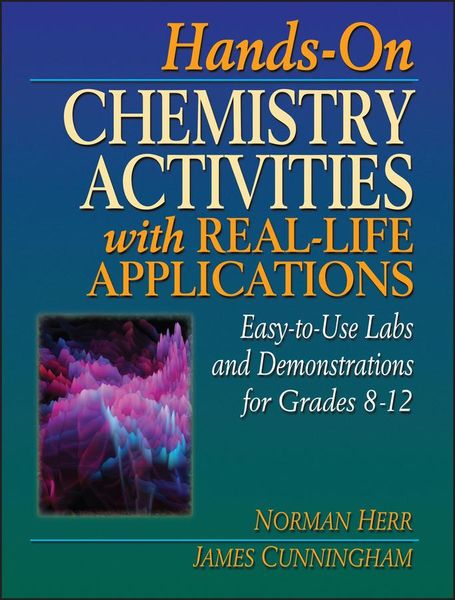
Produktbild: Hands-On Chemistry Activities with Real-Life Applications

Hands-On Chemistry Activities with Real-Life Applications Easy-To-Use Labs and Demonstrations for Grades 8-12

36,99 €

inkl. gesetzl. MwSt., Versandkostenfrei


Beschreibung

Produktdetails

Einband

Taschenbuch

Erscheinungsdatum

13.01.1999

Verlag

Wiley

Seitenzahl

656

Maße (L/B/H)

27,5/21,2/3 cm

Gewicht

1429 g

Sprache

Englisch

ISBN

978-0-87628-262-5

Beschreibung

Produktdetails

Einband

Taschenbuch

Erscheinungsdatum

13.01.1999

Verlag

Wiley

Seitenzahl

656

Maße (L/B/H)

27,5/21,2/3 cm

Gewicht

1429 g

Sprache

Englisch

ISBN

978-0-87628-262-5

Kundinnen und Kunden meinen

0 Bewertungen

Informationen zu Bewertungen

Zur Abgabe einer Bewertung ist eine Anmeldung im Konto notwendig. Die Authentizität der Bewertungen wird von uns nicht überprüft. Wir behalten uns vor, Bewertungstexte, die unseren Richtlinien widersprechen, entsprechend zu kürzen oder zu löschen.

Die Bewertungen sind nach Format, Anzahl Sterne und Datum sortiert.

Verfassen Sie die erste Bewertung zu diesem Artikel

Helfen Sie anderen Kund*innen durch Ihre Meinung

Kundinnen und Kunden meinen

0 Bewertungen filtern

Weitere Artikel finden Sie in

  • Produktbild: Hands-On Chemistry Activities with Real-Life Applications
  • ABOUT THE AUTHORS.

    ACKNOWLEDGMENTS.

    ABOUT THIS RESOURCE.

    UNIT ONE: MEASUREMENT.

    1.1 Language of Chemistry.

    1.1.1 Nomenclature: Elements.

    1.1.2 Nomenclature: Compounds.

    1.1.3 Chemical Terminology: Understanding the Language of Chemistry.

    For the Teacher (Discussion and Answer Keys for Activities 1.1.1­p;1.1.3).

    Applications to Everyday Life.

    1.2 Units of Measurement.

    1.2.1 The Importance of Units.

    1.2.2 Units in Chemistry.

    1.2.3 Problem Solving (Dimensional Analysis).

    For the Teacher (Discussion and Answer Keys for Activities 1.2.1­p;1.2.3).

    Applications to Everyday Life.

    1.3 Measurement.

    1.3.1 Length: Estimating and Measuring.

    1.3.2 Area: Estimating and Measuring.

    1.3.3 Volume: Estimating and Measuring.

    1.3.4 Measuring Mass 1.3.5 Density of Solids.

    1.3.6 Density of Liquids.

    1.3.7 Density of Solutions.

    1.3.8 Density of Solutions: The Mystery of the Strait of Gibraltar.

    1.3.9 Density of Gases.

    For the Teacher (Discussion and Answer Keys for Activities 1.3.1­p;1.3.9).

    Applications to Everyday Life.

    UNIT TWO: MATTER.

    2.1 Atomic Structure

    2.1.1 Atoms are Mostly Empty Space.

    2.1.2 Atomic Spectra.

    2.1.3 Wave Characteristics.

    2.1.4 Quantum Numbers and Electron Orbitals.

    2.1.5 Electron Configuration.

    For the Teacher (Discussion and Answer Keys for Activities 2.1.1­p;2.1.5).

    Applications to Everyday Life.

    2.2 The Periodic Law.

    2.2.1 Finding the "Missing Elements".

    2.2.2 Designing Your Own Periodic Table.

    2.2.3 Family Characteristics.

    2.2.4 Trends Within Families.

    For the Teacher (Discussion and Answer Keys for Activities 2.2.1­p;2.2.4).

    Applications to Everyday Life.

    2.3 Diffusion and Osmosis.

    2.3.1 Brownian Motion.

    2.3.2 Diffusion of Gases.

    2.3.3 The Effect of Temperature on Diffusion.

    2.3.4 The Effect of Molecular Size on Diffusion Rate.

    2.3.5 Osmosis.

    2.3.6 Osmotic Pressure.

    2.3.7 Dialysis.

    For the Teacher (Discussion and Answer Keys for Activities 2.3.1­p;2.3.7).

    Applications to Everyday Life.

    2.4 Changes of State.

    2.4.1 Relative Volumes of Solid, Liquid and Gas Phase.

    2.4.2 Heats of Fusion and Vaporization.

    2.4.3 Boiling: The Influence of Pressure.

    2.4.4 Distillation.

    2.4.5 Sublimation of Carbon Dioxide.

    2.4.6 Triple Point; Phase Diagram of Carbon Dioxide.

    2.4.7 Regelation: Phase Diagram of Water.

    For the Teacher (Discussion and Answer Keys for Activities 2.4.1­p;2.4.7).

    Applications to Everyday Life.

    2.5 Classification of Matter.

    2.5.1 Physical and Chemical Changes.

    2.5.2 Separation of Pure Substances and Mixtures: Chromatography.

    2.5.3 Identification of Physical and Chemical Changes.

    2.5.4 Elements and Compounds.

    2.5.5 Extensive and Intensive Physical Properties.

    2.5.6 Identifying Unknowns by Physical and Chemical Properties.

    For the Teacher (Discussion and Answer Keys for Activities 2.5.1­p;2.5.6).

    Applications to Everyday Life.

    UNIT THREE: CHEMICAL AND NUCLEAR REACTIONS.

    3.1 Chemical Bonding

    3.1.1 Law of Definite Proportions.

    3.1.2 Bond Formation.

    3.1.3 Nonpolar and Polar Covalent Bonds.

    3.1.4 Covalent and Ionic Bonds.

    3.1.5 Metallic Bonding.

    3.1.6 Intermolecular Forces.

    For the Teacher (Discussion and Answer Keys for Activities 3.1.1­p;3.1.6).

    Applications to Everyday Life.

    3.2 Types of Chemical Reactions.

    3.2.1 Composition (Synthesis, Combination) Reactions.

    3.2.2 Decomposition Reactions.

    3.2.3 Single Displacement (Single Replacement) Reactions.

    3.2.4 Double Replacement (Ion-Combining) Reactions.

    3.2.5 Combustion Reactions.

    3.2.6 Addition Reactions.

    For the Teacher (Discussion and Answer Keys for Activities 3.2.1­p;3.2.6).

    Applications to Everyday Life.

    3.3 Oxidation-Reduction (Redox) Reactions.

    3.3.1 Oxidation States.

    3.3.2 Oxidation and Reduction.

    3.3.3 Dramatic Oxidation Reactions.

    3.3.4 Balancing Oxidation-Reduction Reactions.

    For the Teacher (Discussion and Answer Keys for Activities 3.3.1­p;3.3.4).

    Applications to Everyday Life.

    3.4 Electrochemistry.

    3.4.1 Electrode Potentials.

    3.4.2 Energy Transformation.

    3.4.3 Voltaic Cell.

    3.4.4 Batteries.

    3.4.5 Electrolysis.

    3.4.6 Electroplating.

    For the Teacher (Discussion and Answer Keys for Activities 3.4.1­p;3.4.6).

    Applications to Everyday Life.

    3.5 Polymers.

    3.5.1 Polymerization.

    3.5.2 Cross-Linking Polymers.

    3.5.3 Uses of Polymers.

    3.5.4 Recycling Plastic Polymers.

    For the Teacher (Discussion and Answer Keys for Activities 3.5.1­p;3.5.4).

    Applications to Everyday Life.

    3.6 Nuclear Chemistry.

    3.6.1 Detecting Radiation with a Cloud Chamber.

    3.6.2 Detecting Radiation with an Electroscope.

    3.6.3 Detecting Radiation with a Geiger Counter.

    3.6.4 Modeling Nuclear Reactions.

    For the Teacher (Discussion and Answer Keys for Activities 3.6.1­p;3.6.4).

    Applications to Everyday Life.

    UNIT FOUR: THERMODYNAMICS AND KINETICS.

    4.1 Thermochemistry

    4.1.1 Endothermic Reactions.

    4.1.2 Heats of Dilution and Solution.

    4.1.3 Chemical Hand-Warmer.

    4.1.4 Heat of Reaction.

    4.1.5 Caloric Content of Foods.

    4.1.6 Entropy.

    4.1.7 Entropy-Driven Reactions.

    4.1.8 Entropy and Enthalpy.

    For the Teacher (Discussion and Answer Keys for Activities 4.1.1­p;4.1.8).

    Applications to Everyday Life.

    4.2 Heat Transfer.

    4.2.1 Heat Conduction in Metals.

    4.2.2 Conduction and Combustion.

    4.2.3 Conduction: Davy Safety Lamp.

    4.2.4 Convection in Gases.

    4.2.5 Convection in Liquids.

    4.2.6 Radiation.

    For the Teacher (Discussion and Answer Keys for Activities 4.2.1­p;4.2.6) Applications to Everyday Life.

    4.3 Chemical Kinetics.

    4.3.1 The Effect of Concentration on Reaction Rate.

    4.3.2 The Effect of Temperature on Reaction Rate.

    4.3.3 The Effect of Temperature and Concentration on Reaction Rate.

    4.3.4 Catalysts, Reaction Rates and Activation Energy.

    4.3.5 Enzymes.

    4.3.6 Oscillating Chemical Reactions.

    For the Teacher (Discussion and Answer Keys for Activities 4.3.1­p;4.3.6).

    Applications to Everyday Life.

    4.4 Chemical Equilibrium.

    4.4.1 Models of Dynamic Equilibrium.

    4.4.2 Disruption of Equilibrium.

    4.4.3 The Effect of Concentration on Equilibrium.

    4.4.4 The Effect of Pressure on Equilibrium.

    4.4.5 The Effect of Temperature on Equilibrium.

    For the Teacher (Discussion and Answer Keys for Activities 4.4.1­p;4.4.5).

    Applications to Everyday Life.

    UNIT FIVE: GASES, LIQUIDS, SOLIDS, AND MIXTURES.

    5.1.1 Properties of Gases.

    5.1.2 Pressure-Volume Relationship of Gases (Boyle's Law).

    5.1.3 Temperature-Volume Relationship of Gases (Charles's Law).

    5.1.4 Hot Air Balloons: An Application of Charles's Law.

    5.1.5 Temperature-Pressure Relationships of Gases (Gay-Lussac's Law).

    5.1.6 Avogadro's Principle.

    5.1.7 Measuring Atmospheric Pressure.

    For the Teacher (Discussion and Answer Keys for Activities 5.1.1­p;5.1.7).

    Applications to Everyday Life.

    5.2 Colloids and Suspensions.

    5.2.1 Tyndall Effect.

    5.2.2 Classification of Dispersions: Solutions, Colloids, and Suspensions.

    5.2.3 Brownian Motion in Colloids.

    5.2.4 Making Colloids.

    For the Teacher (Discussion and Answer Keys for Activities 5.2.1­p;5.2.4).

    Applications to Everyday Life.

    5.3 Solutes, Solvents, Solutions.

    5.3.1 Solubility (Solute/Solvent Interaction).

    5.3.2 Surface Area and Dissolution Rate.

    5.3.3 Temperature and Dissolution Rate.

    5.3.4 Enthalpy of Solution.

    5.3.5 Solubility of Gases in Liquids.

    For the Teacher (Discussion and.

    Applications to Everyday Life.

    5.4 Colligative Properties.

    5.4.1 Raoult's Law.

    5.4.2 Freezing Point Depression.

    5.4.3 Boiling Point Elevation.

    5.4.4 Osmotic Pressure.

    For the Teacher (Discussion and Answer Keys for Activities 5.4.1­p;5.4.4).

    Applications to Everyday Life.

    5.5 Acids and Bases.

    5.5.1 Acids.

    5.5.2 Bases.

    5.5.3 pH Scale.

    5.5.4 Acid/Base Concentration, Equivalence, and Strength.

    5.5.5 Acid Rain.

    For the Teacher (Discussion and Answer Keys for Activities 5.5.1­p;5.5.5) Applications to Everyday Life.

    5.6 Acid and Base Reactions.

    5.6.1 Neutralization.

    5.6.2 Titration.

    5.6.3 Buffering.

    5.6.4 Soil pH.

    5.6.5 pH Control of Respiration.

    For the Teacher (Discussion and Answer Keys for Activities 5.6.1­p;5.6.5).

    Applications to Everyday Life.

    5.7 Crystals and Crystallization.

    5.7.1 Supersaturation and Crystallization.

    5.7.2 Crystallization by Evaporation.

    5.7.3 Growing Crystals; Crystal Shapes.

    5.7.4 Metallic Crystals.

    5.7.5 Silicate Crystals.

    5.7.6 Stalactites and Stalagmites.

    5.7.7 Rate of Crystallization and Crystal Size.

    For the Teacher (Discussion and Answer Keys for Activities 5.7.1­p;5.7.7).

    Applications to Everyday Life.

    APPENDIX.

    A.1 Units, Quantities, and Conversions.

    1.1 Physical Quantities and Their SI Units.

    1.2 Metric System Prefixes.

    1.3 SI and Customary Units and Conversions.

    1.4 Common Conversions.

    1.5 Units of Pressure.

    1.6 Vapor Pressure of Water.

    A.2 Language of Chemistry.

    2.1 Writing Style Guidelines.

    2.2 Root Words Used Frequently in Chemistry.

    2.3 Etymology of the Names of the Elements.

    2.4 Balancing Equations.

    3.1 Sample Safety Contract.

    3.2 Chemical Storage.

    3.3 Disposa.