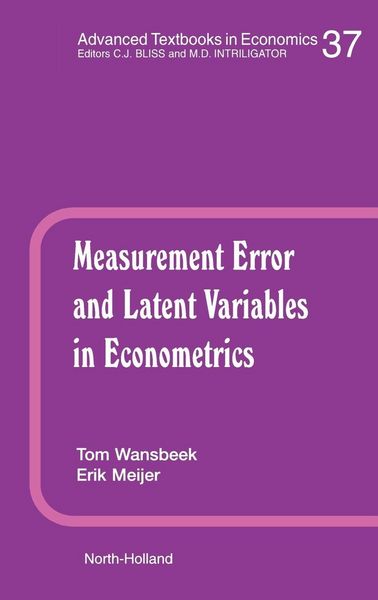

Measurement Error and Latent Variables in Econometrics
-
- Englisch ausgewählt
127,99 €
inkl. gesetzl. MwSt.,
Beschreibung
Produktdetails
Einband
Gebundene Ausgabe
Erscheinungsdatum
01.12.2000
Verlag
Elsevier BvSeitenzahl
456
Maße (L/B/H)
24,2/16,6/3,5 cm
Gewicht
845 g
Sprache
Englisch
ISBN
978-0-444-88100-7
The book first discusses in depth various aspects of the well-known inconsistency that arises when explanatory variables in a linear regression model are measured with error. Despite this inconsistency, the region where the true regression coeffecients lies can sometimes be characterized in a useful way, especially when bounds are known on the measurement error variance but also when such information is absent. Wage discrimination with imperfect productivity measurement is discussed as an important special case.
Next, it is shown that the inconsistency is not accidental but fundamental. Due to an identification problem, no consistent estimators may exist at all. Additional information is desirable. This information can be of various types. One type is exact prior knowledge about functions of the parameters. This leads to the CALS estimator. Another major type is in the form of instrumental variables. Many aspects of this are discussed, including heteroskedasticity, combination of data from different sources, construction of instruments from the available data, and the LIML estimator, which is especially relevant when the instruments are weak.
The scope is then widened to an embedding of the regression equation with measurement error in a multiple equations setting, leading to the exploratory factor analysis (EFA) model. This marks the step from measurement error to latent variables. Estimation of the EFA model leads to an eigenvalue problem. A variety of models is reviewed that involve eignevalue problems as their common characteristic.
EFA is extended to confirmatory factor analysis (CFA) by including restrictions on the parameters of the factor analysismodel, and next by relating the factors to background variables.
These models are all structural equation models (SEMs), a very general and important class of models, with the LISREL model as its best-known representation, encompassing almost all linear equation systems
Noch keine Bewertungen vorhanden
Verfassen Sie die erste Bewertung zu diesem Artikel
Helfen Sie anderen Kundinnen und Kunden durch Ihre Meinung.
Kurze Frage zu unserer Seite
Vielen Dank für Ihr Feedback
Wir nutzen Ihr Feedback, um unsere Produktseiten zu verbessern. Bitte haben Sie Verständnis, dass wir Ihnen keine Rückmeldung geben können. Falls Sie Kontakt mit uns aufnehmen möchten, können Sie sich aber gerne an unseren Kund*innenservice wenden.
zum Kundenservice