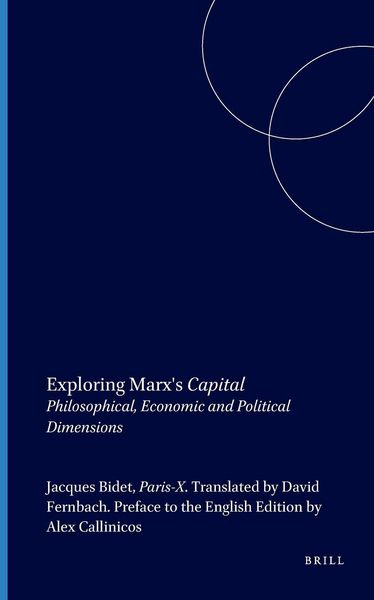
Exploring Marx's <i>Capital</i> Philosophical, Economic and Political Dimensions
-
- Hardcover ausgewählt
- Taschenbuch
-
Sprache:Englisch
307,99 €
inkl. gesetzl. MwSt.,
Beschreibung
Produktdetails
Einband
Gebundene Ausgabe
Erscheinungsdatum
14.12.2006
Verlag
Koninklijke Brill BvSeitenzahl
352
Maße (L/B/H)
23,5/15,5/2,1 cm
Gewicht
669 g
Sprache
Englisch
ISBN
978-90-04-14937-3
This volume, originally published in French under the title Que faire du Capital?, offers a new interpretation of Marx's great work. It shows how the novelty and lasting interest of Marx's theory arises from the fact that, as against the project of a 'pure' economics, it is formulated in concepts that have simultaneously an economic and a political aspect, neither of these being separable from the other.
Jacques Bidet conducts an unprecedented investigation of Marx's work in the spirit of the history of science, exploring it as a process of theoretical development. Traditional exegesis reads the successive drafts of Capital as if they were complementary and mutually illuminated one another. In actual fact, like any scientist, Marx only wrote a new version in order to correct the previous one. He started from ideas borrowed from Ricardo and Hegel, and between one draft and the next it is possible to see these being eliminated and restructured. This labour, moreover, was never fully completed.
The author thus re-assesses Marx's entire system in its set of constitutive categories: value, market, labour-power, classes, working class, exploitation, production, fetishism, ideology. He seeks to pin down the difficulties that these encountered, and the analytical and critical value they still have today.
Bidet attaches the greatest importance to Marx's order of exposition, which assigns each concept its place in the overall system, and makes the validity of the construction depend on the pertinence of its initial presuppositions. This is particularly the case with the relationship between market mechanism and capitalism - and thus also between the market and socialism.
This books an English translation of Jacques Bidet, Que faire du capital? Philosophie, economie et politique dans "La Capital" de Marx, published y Presses Universitaires de France, Paris, 2000.
Noch keine Bewertungen vorhanden
Verfassen Sie die erste Bewertung zu diesem Artikel
Helfen Sie anderen Kundinnen und Kunden durch Ihre Meinung.
Kurze Frage zu unserer Seite
Vielen Dank für Ihr Feedback
Wir nutzen Ihr Feedback, um unsere Produktseiten zu verbessern. Bitte haben Sie Verständnis, dass wir Ihnen keine Rückmeldung geben können. Falls Sie Kontakt mit uns aufnehmen möchten, können Sie sich aber gerne an unseren Kund*innenservice wenden.
zum Kundenservice