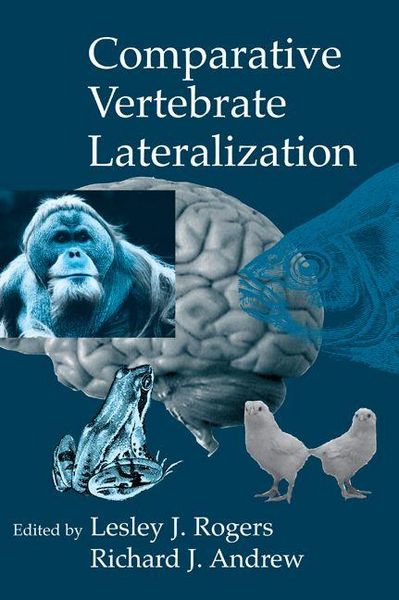

Comparative Vertebrate Lateralization
-
- Hardcover ausgewählt
- Taschenbuch
- eBook
-
Sprache:Englisch
193,99 €
inkl. gesetzl. MwSt.,
Beschreibung
Produktdetails
Einband
Gebundene Ausgabe
Erscheinungsdatum
11.02.2011
Herausgeber
Rogers Lesley J. + weitereVerlag
Cambridge AcademicSeitenzahl
672
Maße (L/B/H)
26/18,3/4 cm
Gewicht
1450 g
Sprache
Englisch
ISBN
978-0-521-78161-9
No longer viewed as a characteristic unique to humans, brain lateralization is considered a key property of most, if not all, vertebrates. This field of study provides a firm basis from which to examine a number of important issues in the study of brain and behaviour. This book takes a comparative and integrative approach to lateralization in a wide range of vertebrate species, including humans. It highlights model systems that have proved invaluable in elucidating the function, causes, development, and evolution of lateralization. The book is arranged in four parts, beginning with the evolution of lateralization, moving to its development, to its cognitive dimensions, and finally to its role in memory. Experts in lateralization in lower vertebrates, birds, non-primate mammals, and primates have contributed chapters in which they discuss their own research and consider its implications to humans. The book is suitable for researchers, graduates and advanced undergraduates in psychology, neuroscience and the behavioral sciences.
Noch keine Bewertungen vorhanden
Verfassen Sie die erste Bewertung zu diesem Artikel
Helfen Sie anderen Kundinnen und Kunden durch Ihre Meinung.
Kurze Frage zu unserer Seite
Vielen Dank für Ihr Feedback
Wir nutzen Ihr Feedback, um unsere Produktseiten zu verbessern. Bitte haben Sie Verständnis, dass wir Ihnen keine Rückmeldung geben können. Falls Sie Kontakt mit uns aufnehmen möchten, können Sie sich aber gerne an unseren Kund*innenservice wenden.
zum Kundenservice