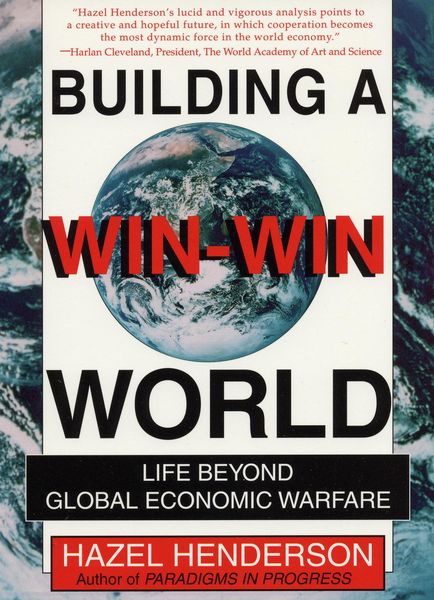
Building a Win-Win World Life Beyond Global Economic Warfare
-
- Taschenbuch ausgewählt
- eBook
-
Sprache:Englisch
26,99 €
inkl. gesetzl. MwSt.,
- Kostenlose Lieferung ab 30 € Einkaufswert
- Versandkostenfrei für Bonuscard-Kund*innen
Beschreibung
Produktdetails
Einband
Taschenbuch
Erscheinungsdatum
09.10.1997
Verlag
Berrett Koehler PublishersSeitenzahl
412
Maße (L/B/H)
23,3/15,6/2,3 cm
Gewicht
576 g
Sprache
Englisch
ISBN
978-1-57675-027-8
Building a Win-Win World demonstrates how the global economy is unsustainable because of its negative effects on employees, families, communities, and the ecosystem. Henderson shows that win-win strategies can become the norm at every level when people see the true current and future costs of short-sighted, narrow economic policies.
Henderson shows how humans are encountering the endgames of the competition/conflict paradigm, and identifies the signs of transition. Using warfare as a metaphor for the dark side of today's world economic system, she shows how both are destructive, inhumane, wasteful, irrational, inefficient, competitive, and crisis-driven. Both create more new problems than they solve. She describes how the globalization of the war system, technology, and industrialization brought the Cold War to a dead end. By the mid-1980s the global warfare paradigm had given ground to a global economic warfare which many economists, politicians, and business leaders hailed as a victory of capitalism and competitive "free markets." Yet this new type of warfare proved little better than the military warfare it was advertised to replace. By the mid-1990s global economic warfare had already reached crisis points of its own.
Building a Win-Win World examines how jobs, education, health care, human rights, democratic participation, socially responsible business, and environmental protection are all sacrificed to "global competitiveness." Henderson shows many ways out of the dilemmas faced by all countries. New agreements are described to tame the global economic casino, regulate multi-national corporations, and levy fees for commercial use of global common resources-oceans, atmosphere, space, etc.-and tax their abuse. These revenues can then be invested in civilian needs and sectors worldwide. She also describes a trend toward "grassroots globalism"-citizens movements that are addressing poverty, social inequities, pollution, resource-depletion, violence, and wars. Grassroots globalism, she says, is about thinking and acting-globally and locally. It is pragmatic problem-solving, implementing local solutions that keep the planet in mind. Such social innovations can raise the ethical floor under the global playing field so that the most ethical companies and countries can win.
Noch keine Bewertungen vorhanden
Verfassen Sie die erste Bewertung zu diesem Artikel
Helfen Sie anderen Kundinnen und Kunden durch Ihre Meinung.
Kurze Frage zu unserer Seite
Vielen Dank für Ihr Feedback
Wir nutzen Ihr Feedback, um unsere Produktseiten zu verbessern. Bitte haben Sie Verständnis, dass wir Ihnen keine Rückmeldung geben können. Falls Sie Kontakt mit uns aufnehmen möchten, können Sie sich aber gerne an unseren Kund*innenservice wenden.
zum Kundenservice