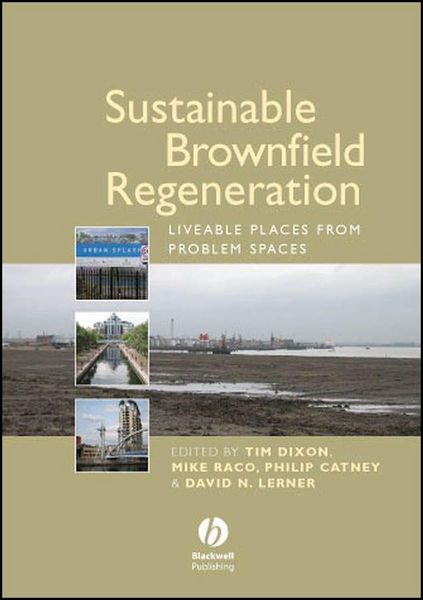
Sustainable Brownfield Regeneration Liveable Places from Problem Spaces
-
- Englisch ausgewählt
137,99 €
inkl. gesetzl. MwSt.,
Beschreibung
Produktdetails
Einband
Taschenbuch
Erscheinungsdatum
22.10.2007
Herausgeber
Tim Dixon + weitereVerlag
WileySeitenzahl
400
Maße (L/B/H)
24,4/17,2/2,1 cm
Gewicht
857 g
Sprache
Englisch
ISBN
978-1-4051-4403-2
Brownfield regeneration has become a major policy driver in developed countries. It is estimated that there are 64,000 hectares of brownfield land in England, much of which presents severe environmental challenges and lies alongside some of the most deprived communities in the country. Bringing such land back into active use has taken on a new urgency among policymakers, developers and other stakeholders in the development process. Frequently, however, policy thinking and practice has been underpinned by 'silo' mentalities, in which integrated and multidisciplinary approaches to problem-solving have been limited.
The book has two principal aims. The first is to examine the ways in which science and social science research disciplines can be brought together to help solve important brownfield regeneration issues, with a focus on the UK. The second is to assess the efficiency and effectiveness of different types of regeneration policy and practice, and to show how 'liveable spaces' can be produced from 'problem places'. The Thames Gateway in the south of England and Greater Manchester in the North of England are shown as examples of how brownfield regeneration projects are developing in an era where sustainability is high on the policy agenda.
From the Foreword by Paul Syms, National Brownfield Advisor, English Partnerships:
'Ensuring the effective and efficient reuse of brownfield land is an essential part of the British Government's land use policies in support of sustainable communities. [This book] recognises that reusing brownfield land is not just about over-coming technical issues to remove contamination or other physical problems with the ground. It highlights the importance of engaging with the many different stakeholders whose opinions and concerns need to be taken into account if sustainable outcomes are to be achieved. The authors also recognise that brownfield land reuse is not just about building new homes or places of employment - the creation of new green spaces can be just as important.'
Noch keine Bewertungen vorhanden
Verfassen Sie die erste Bewertung zu diesem Artikel
Helfen Sie anderen Kundinnen und Kunden durch Ihre Meinung.
Kurze Frage zu unserer Seite
Vielen Dank für Ihr Feedback
Wir nutzen Ihr Feedback, um unsere Produktseiten zu verbessern. Bitte haben Sie Verständnis, dass wir Ihnen keine Rückmeldung geben können. Falls Sie Kontakt mit uns aufnehmen möchten, können Sie sich aber gerne an unseren Kund*innenservice wenden.
zum Kundenservice