KI-Beratung Beta

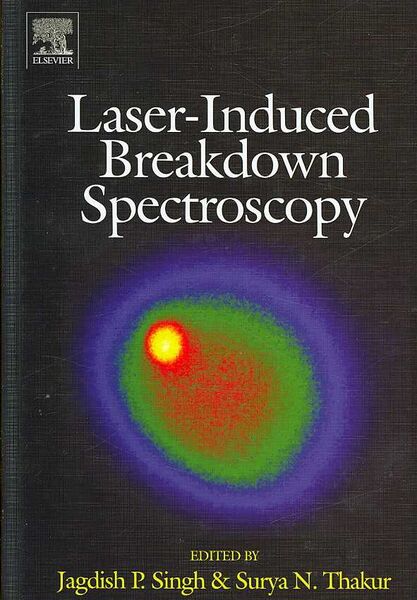
Produktbild: Laser-Induced Breakdown Spectroscopy

Laser-Induced Breakdown Spectroscopy

139,99 €

inkl. gesetzl. MwSt., Versandkostenfrei


Beschreibung

Laser induced breakdown spectroscopy (LIBS) is basically an emission spectroscopy technique where atoms and ions are primarily formed in their excited states as a result of interaction between a tightly focused laser beam and the material sample. The interaction between matter and high-density photons...

Beschreibung

Laser induced breakdown spectroscopy (LIBS) is basically an emission spectroscopy technique where atoms and ions are primarily formed in their excited states as a result of interaction between a tightly focused laser beam and the material sample. The interaction between matter and high-density photons generates a plasma plume, which evolves with time and may eventually acquire thermodynamic equilibrium. One of the important features of this technique is that it does not require any sample preparation, unlike conventional spectroscopic analytical techniques. Samples in the form of solids, liquids, gels, gases, plasmas and biological materials (like teeth, leaf or blood) can be studied with almost equal ease. LIBS has rapidly developed into a major analytical technology with the capability of detecting all chemical elements in a sample, of real- time response, and of close-contact or stand-off analysis of targets. The present book has been written by active specialists in this field, it includes the basic principles, the latest developments in instrumentation and the applications of LIBS . It will be useful to analytical chemists and spectroscopists as an important source of information and also to graduate students and researchers engaged in the fields of combustion, environmental science, and planetary and space exploration.

Produktdetails

Einband

Gebundene Ausgabe

Erscheinungsdatum

01.11.2007

Herausgeber Jagdish P. Singh + weitere
Verlag Elsevier Science & Technology

Produktdetails

Einband

Gebundene Ausgabe

Erscheinungsdatum

01.11.2007

Herausgeber
Verlag Elsevier Science & Technology
Seitenzahl

454

Maße (L/B/H)

24/17,2/2,4 cm

Gewicht

980 g

Sprache

Englisch

ISBN

978-0-444-51734-0

EU-Ansprechpartner

Kolibri 360 GmbH
Ettore-Bugatti-Straße 6-14
51149 Köln
DE
produktsicherheit@kolibri360.de

Herstelleradresse

Elsevier Science & Technology
125 London Wall
EC2Y 5AS London
GB
tradeorders@elsevier.com

Noch keine Bewertungen vorhanden

Verfassen Sie die erste Bewertung zu diesem Artikel

Helfen Sie anderen Kundinnen und Kunden durch Ihre Meinung.

Kundinnen und Kunden meinen

Bewertungen (0)

Die Leseprobe wird geladen.
  • Produktbild: Laser-Induced Breakdown Spectroscopy
  • PART I : BASIC PHYSICS & INSTRUMENTATION
    1. Fundamentals of LIBS (S. N. Thakur and J. P. Singh)
    2. Atomic Emission Spectroscopy (S. N. Thakur)
    3. Laser Ablation (R. E. Russo, X. L. Mao, J. Yoo and J. J. Gonzalez)
    4. Physics of Plasma in LIBS (V. N. Rai and S. N. Thakur)
    5. Instrumentation for LIBS (V. N. Rai and S. N. Thakur)

    PART II: NEW LIBS TECHNIQUES
    6. Dual Pulse LIBS (J. Scaffidi, D. A. Cremers and S. M. Angel)
    7. Femtosecond LIBS (M. Sabsabi)
    8. Micro LIBS (M. T. Taschuk, I. V. Cravetchi, Y. Y. Tsui and R. Fedosejevs)

    PART III: LIBS APPLICATIONS
    9. LIBS Application to off-Gas Measurement (F. Y. Yueh and J. P. Singh)
    10. LIBS of Liquid Samples (V. N. Rai, F. Y. Yueh and J. P. Singh)
    11. LIBS of Solid and Molten Material (A. K. Rai, F. Y.Yueh, J. P. Singh and D. K. Rai)
    12. LIBS of Powder Materials (B. Lal, L.St-Onge, F.Y. Yueh and J. P. Singh)
    13. LIBS for the Analysis of Chemical and Biological Hazards (S.G. Buckley)
    14. Life-Science Applications of LIBS (F. Y. Yueh, A. Kumar and J. P. Singh)
    15. Measurement of Carbon for Carbon Sequestration and Site Monitoring (M. Z. Martin, S. D. Wullschleger, C. T. Garten Jr., and A. V. Palumbo)
    16. Remote Analysis by LIBS: Application to Space Exploration (D. A. Cremers)
    17. LIBS for Aerosol Analysis (D.W. Hahn and U. Panne)
    18. Scope of Future Development in LIBS (J. P. Singh and F. Y. Yueh)