Gutscheinbedingungen

**Gültig bis 17.08.2026 auf Schreibwaren & Office-Artikel online auf thalia.at, in der Thalia App und in teilnehmenden Thalia Buchhandlungen in Österreich mit Schulsortiment. In den Buchhandlungen nur gültig auf lagernde Ware. Einzelne Artikel können ausgeschlossen sein. Ausgenommen sind preisgebundene Artikel. Pro Einkauf einmal einlösbar. Nur gültig gegen Vorlage oder im Onlineshop hinterlegter Bonuscard. Infos zur Einlösung in der Buchhandlung sind auf der Bonuscard-Vorteilspreisseite zu finden. Click & Collect nur bei Onlinevorabzahlung möglich. Keine Einlösung bei Scan & Go-Bezahlung. Keine Barauszahlung. Nicht kombinierbar mit anderen Aktionen und Gutscheinen. Gutschein wird auf max. 500€ Bestellwert angerechnet. Nicht gültig für Geschenkkarten, Versandkosten und Services.

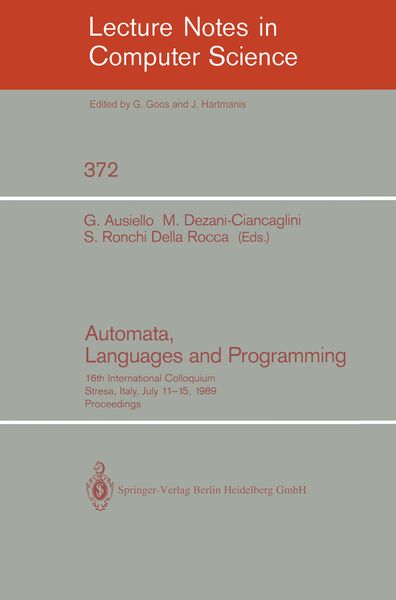
  • Produktbild: Automata, Languages and Programming
  • Produktbild: Automata, Languages and Programming
Band 372

Automata, Languages and Programming 16th International Colloquium, Stresa, Italy, July 11-15, 1989. Proceedings

99,99 €

inkl. gesetzl. MwSt., Versandkostenfrei


Beschreibung

Produktdetails

Einband

Taschenbuch

Erscheinungsdatum

28.06.1989

Herausgeber

Giorgio Ausiello + weitere

Verlag

Springer Berlin

Seitenzahl

790

Maße (L/B/H)

23,5/15,5/4,3 cm

Gewicht

1194 g

Auflage

1989

Sprache

Englisch

ISBN

978-3-540-51371-1

Beschreibung

Produktdetails

Einband

Taschenbuch

Erscheinungsdatum

28.06.1989

Herausgeber

Verlag

Springer Berlin

Seitenzahl

790

Maße (L/B/H)

23,5/15,5/4,3 cm

Gewicht

1194 g

Auflage

1989

Sprache

Englisch

ISBN

978-3-540-51371-1

Herstelleradresse

Springer-Verlag KG
Sachsenplatz 4-6
1201 Wien
AT

Email: GPSR Kontakt

Noch keine Bewertungen vorhanden

Verfassen Sie die erste Bewertung zu diesem Artikel

Helfen Sie anderen Kundinnen und Kunden durch Ihre Meinung.

Kundinnen und Kunden meinen

Bewertungen (0)

  • Produktbild: Automata, Languages and Programming
  • Produktbild: Automata, Languages and Programming
  • Realizable and unrealizable specifications of reactive systems.- Limitations of the upward separation technique (preliminary version).- Lower bounds for the low hierarchy.- Efficient text searching of regular expressions.- Factors of words.- Asymptotically optimal distributed consensus.- Time lower bounds for CREW-PRAM computation of monotone functions.- Subduing self-application.- Everything in NP can be argued in perfect zero-knowledge in a bounded number of rounds.- Polymorphic rewriting conserves algebraic strong normalization and confluence.- Completion of finite codes with finite deciphering delay.- Relational semantics for recursive types and bounded quantification.- A singly-exponential stratification scheme for real semi-algebraic varieties and its applications.- About primitive recursive algorithms.- The definability of equational graphs in monadic second-order logic.- Dominoes and the regularity of DNA splicing languages.- Causal trees.- Infinite normal forms.- On recent trends in algebraic specification.- Automata with storage on infinite words.- Parallel algorithmic techniques for combinatorial computation.- On dice and coins: models of computation for random generation.- An optimal probabilistic algorithm for synchronous Byzantine agreement.- Finding triconnected components by local replacements.- An improved algorithm for approximate string matching.- A pointer-free data structure for merging heaps and min-max heaps.- Structured operational semantics and bisimulation as a congruence.- Parallel retrieval of scattered information.- Tensor rank is NP-complete.- The complexity of nonlinear separable optimization.- General methods for the analysis of the maximum size of dynamic data structures.- How to share concurrent asynchronous wait-free variables.- A new approach to formal language theory by kolmogorov complexity.- Dynamic algorithms in D.E. Knuth's model: A probabilistic analysis.- Completing the temporal picture.- Lower bounds for computations with the floor operation.- Programming, transforming, and proving with function abstractions and memories.- Automata theory meets circuit complexity.- Two versus one index register and modifiable versus non-modifiable programs.- Shortest paths without a map.- Modular system design applying graph grammars techniques.- Partial communations.- On the synthesis of an asynchronous reactive module.- The complexity of controlled selection.- Memory versus randomization in on-line algorithms.- Syntactic control of interference Part 2.- Characteristic formulae.- A combinatorial technique for separating counting complexity classes.- Horn programs and semicomputable relations on abstract structures.- A note on model checking the modal v-calculus.- DI-domains as information systems.