
Biology by Numbers An Encouragement to Quantitative Thinking
-
- Hardcover ausgewählt
- Taschenbuch
-
Sprache:Englisch
106,99 €
inkl. gesetzl. MwSt.,
Beschreibung
Produktdetails
Einband
Gebundene Ausgabe
Erscheinungsdatum
27.09.2007
Verlag
Cambridge AcademicSeitenzahl
256
Maße (L/B/H)
23,5/15,7/2 cm
Gewicht
522 g
Sprache
Englisch
ISBN
978-0-521-57156-2
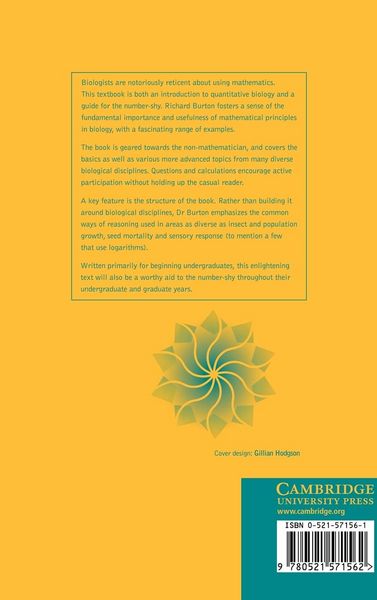
Biologists are notoriously reticent about using mathematics. This textbook is both an introduction to quantitative biology and a guide for the number-shy. Richard Burton fosters a sense of the fundamental importance and usefulness of mathematical principles in biology, with a fascinating range of examples. The book is geared towards the non-mathematician, and covers the basics as well as various more advanced topics from many diverse biological disciplines. Questions and calculations encourage active participation without holding up the reader. A key feature is the structure of the book. Rather than building it around biological disciplines, Dr Burton emphasises the common ways of reasoning used in areas as diverse as insect and population growth, seed mortality and sensory response (to mention a few that use logarithms). Written primarily for beginning undergraduates, this enlightening text will also be an essential aid for students throughout their undergraduate and graduate years.
Noch keine Bewertungen vorhanden
Verfassen Sie die erste Bewertung zu diesem Artikel
Helfen Sie anderen Kundinnen und Kunden durch Ihre Meinung.
Kurze Frage zu unserer Seite
Vielen Dank für Ihr Feedback
Wir nutzen Ihr Feedback, um unsere Produktseiten zu verbessern. Bitte haben Sie Verständnis, dass wir Ihnen keine Rückmeldung geben können. Falls Sie Kontakt mit uns aufnehmen möchten, können Sie sich aber gerne an unseren Kund*innenservice wenden.
zum Kundenservice