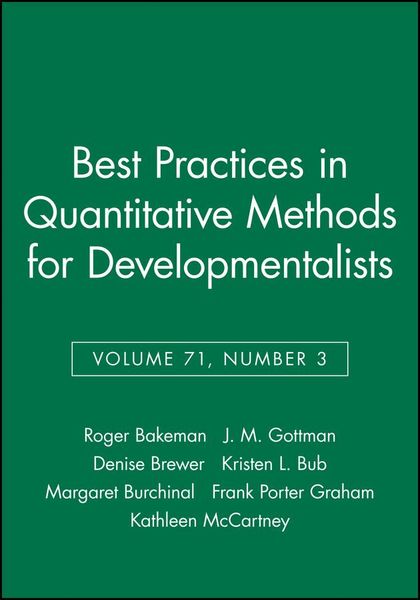
Best Practices in Quantitative Methods for Developmentalists, Volume 71, Number 3 71, Number
-
- Englisch ausgewählt
67,99 €
inkl. gesetzl. MwSt.,
Beschreibung
Produktdetails
Einband
Taschenbuch
Erscheinungsdatum
01.11.2006
Herausgeber
Bakeman Roger + weitereVerlag
WileySeitenzahl
172
Maße (L/B/H)
22,9/15,2/1 cm
Gewicht
227 g
Sprache
Englisch
ISBN
978-1-4051-6941-7
hypotheses is widely recognized, yet even very experienced
quantitative researchers often lack the knowledge required
for good decision-making on methodology. The end result is
a disconnect between research and practice in methods. The
purpose of this monograph is to fill a gap in the literature by
offering a series of overviews on common data-analytic
issues of particular interest to researchers in child development.
Our hope is that this monograph will make already
developed methods accessible to developmentalists so they
can understand and use them in their research. We start at
the beginning with chapters on data management and
measurement, two neglected topics in methods training
despite the fact that every investigation should begin with
proper consideration of each. We follow with two important
topics for developmental research, missing data and growth
modeling. Missing data can plague developmental work
because participants sometimes miss one or more assessment
points. Growth modeling methods offer researchers a
true means to assess change over time as compared with
cruder methods like difference scores and residualized
change scores. Then comes a discussion of mediation and
moderation, two tools that can be used to elucidate developmental
processes. Because so much developmental
science is non-experimental, we include a chapter on selection
bias that compares five modeling strategies. Proper attention
to data management, measurement, missing data, growth
modeling (whenever possible), mediation and moderation,
and potential selection bias is guaranteed to result in greater
precision in inference-making. Even when researchers make
good decisions about methods, it is critical for them to use
good judgment about the practical importance of findings,
so we conclude with this important discussion. We view this
monograph as a first step to getting quantitative researchers
started and we believe this reference will help researchers
make better-informed decisions about methodology.
Noch keine Bewertungen vorhanden
Verfassen Sie die erste Bewertung zu diesem Artikel
Helfen Sie anderen Kundinnen und Kunden durch Ihre Meinung.
Kurze Frage zu unserer Seite
Vielen Dank für Ihr Feedback
Wir nutzen Ihr Feedback, um unsere Produktseiten zu verbessern. Bitte haben Sie Verständnis, dass wir Ihnen keine Rückmeldung geben können. Falls Sie Kontakt mit uns aufnehmen möchten, können Sie sich aber gerne an unseren Kund*innenservice wenden.
zum Kundenservice