KI-Beratung Beta

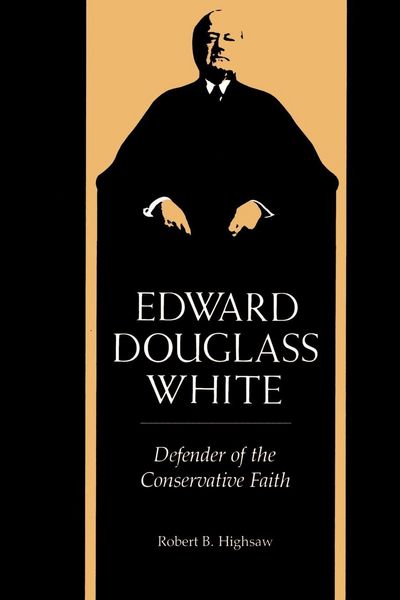
Produktbild: Edward Douglass White

Edward Douglass White Defender of the Conservative Faith

35,99 €

inkl. gesetzl. MwSt., Versandkostenfrei


Beschreibung

Elite, personable, and persuasive, Edward Douglass White, a ''large and bearish man from Louisiana,'' served on the United States Supreme Court for twenty-seven years. During his tenure, first as an associate justice (1894-1910) and then as the ninth chief justice (1910-1921), White significantly influenced...

Beschreibung

Elite, personable, and persuasive, Edward Douglass White, a ''large and bearish man from Louisiana,'' served on the United States Supreme Court for twenty-seven years. During his tenure, first as an associate justice (1894-1910) and then as the ninth chief justice (1910-1921), White significantly influenced American public law.
Robert Highsaw' s extensive judicial biography stresses White's constitutional thought and philosophy. Several chapters discuss his early years in Louisiana, his training in Jesuit schools there and at Georgetown University, and his early legal career in New Orleans. The emphasis, however, remains on White's theories and applications of the judicial and constitutional processes. Edward Douglass White ""looked upon the American constitutional system as a model for a well-ordered society that must be preserved.""
White's concept of a federal system in which the national and state governments each operated within a defined sphere of powers underlay many of his opinions. White considered farm issues that developed after the closing of the western frontier, economic issues precipitated by a growing laboring class, and tense political issues of civil liberties that emerged during World War I. He played an important part in developing administrative law and was, perhaps, most responsible for strengthening dual federalism of commerce and taxing powers. His pragmatism, evidenced in the Insular cases where his doctrine of ""incorporated"" and ""unincorporated"" territories, synthesized American constitutional law with the political reality of American imperialism.
White was a conservative, but unlike the conservative justices of the 1920s and 1930s whose intransigence produced the judicial revolution of 1937, he saw that injury to the Constitution might result from its consistent use as a barrier to social progress. Significantly, Edward Douglass White demonstrates that ""the judicial revolution of 1937 and the ensuing decades of the Court's history are meaningless unless we know what happened fifty or so years earlier.

Produktdetails

Einband

Taschenbuch

Erscheinungsdatum

01.12.1981

Verlag Louisiana State University Press
Seitenzahl

236

Produktdetails

Einband

Taschenbuch

Erscheinungsdatum

01.12.1981

Verlag Louisiana State University Press
Seitenzahl

236

Maße (L/B/H)

22,9/15,2/1,4 cm

Gewicht

390 g

Sprache

Englisch

ISBN

978-0-8071-2428-4

Herstelleradresse

Libri GmbH
Europaallee 1
36244 Bad Hersfeld
DE

Email: Libri GmbH

Noch keine Bewertungen vorhanden

Verfassen Sie die erste Bewertung zu diesem Artikel

Helfen Sie anderen Kundinnen und Kunden durch Ihre Meinung.

Kundinnen und Kunden meinen

Bewertungen (0)

  • Produktbild: Edward Douglass White