
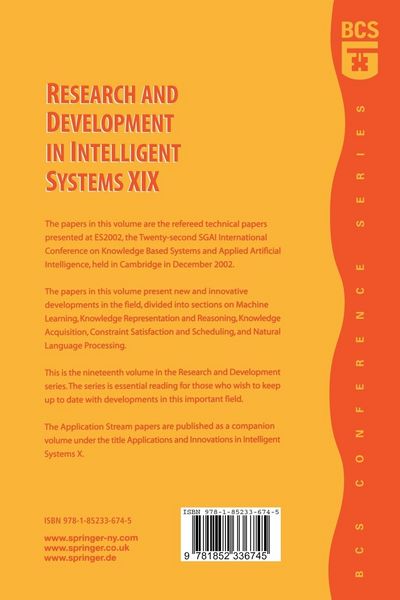
• Produktbild: Research and Development in Intelligent Systems XIX
  • Produktbild: Research and Development in Intelligent Systems XIX

Research and Development in Intelligent Systems XIX Proceedings of ES2002, the Twenty-second SGAI International Conference on Knowledge Based Systems and Applied Artificial Intelligence

99,99 €

inkl. gesetzl. MwSt., Versandkostenfrei


Beschreibung

Produktdetails

Einband

Taschenbuch

Erscheinungsdatum

05.12.2002

Abbildungen

XI, 40 illus., schwarz-weiss Illustrationen

Herausgeber

Alun Preece + weitere

Verlag

Springer London

Seitenzahl

467

Maße (L/B/H)

23,5/15,5/2,6 cm

Gewicht

720 g

Auflage

1st Edition.

Sprache

Englisch

ISBN

978-1-85233-674-5

Beschreibung

Portrait

The conference proceedings of the twenty-second annual International
Conference of the British Computer Society's Specialist Group on
Knowledge-Based systems and Applied Artificial Intelligence - Technical
stream.

Produktdetails

Einband

Taschenbuch

Erscheinungsdatum

05.12.2002

Abbildungen

XI, 40 illus., schwarz-weiss Illustrationen

Herausgeber

Verlag

Springer London

Seitenzahl

467

Maße (L/B/H)

23,5/15,5/2,6 cm

Gewicht

720 g

Auflage

1st Edition.

Sprache

Englisch

ISBN

978-1-85233-674-5

Herstelleradresse

Springer-Verlag GmbH
Tiergartenstr. 17
69121 Heidelberg
DE

Email: ProductSafety@springernature.com

Noch keine Bewertungen vorhanden

Verfassen Sie die erste Bewertung zu diesem Artikel

Helfen Sie anderen Kundinnen und Kunden durch Ihre Meinung.

Kundinnen und Kunden meinen

Bewertungen (0)

  • Produktbild: Research and Development in Intelligent Systems XIX
  • Produktbild: Research and Development in Intelligent Systems XIX
  • Best Refereed Technical Paper.- Covering the Path Space: A Casebase Analysis for Mobile Robot Path Planning.- Session 1A: Machine Learning 1.- A Rough Set Model with Ontological Information for Discovering Maximal Association Rules in Document Collections.- Simplest Rules Characterizing Classes Generated by ?-Free Sets.- Epicurean-style Learning Applied to the Classification of Gene-Expression Data.- Case and Feature Subset Selection in Case-based Software Project Effort Prediction.- Session 1B: Knowledge Representation and Reasoning 1.- Generating Context-Based Explanations.- Facilitating DL-based Hybrid Reasoning with Inference Fusion.- Representing and Eliciting “If… Then Rules”: An Empirical Analysis.- A Hybrid KRS to Treat Fuzzy and Taxonomic Knowledge.- Session 2A: Machine Learning.- SAT-Based Algorithms for Bayesian Network Inference.- An Approach to Artificial Neural Network Training.- Genetic Algorithm Hybridized with Ruin and Recreate Procedure: Application to the Quadratic Assignment Problem.- ECCLAT: A New Approach of Clusters Discovery in Categorical Data.- Session 2B: Knowledge Representation and Reasoning 2.- Reverse Engineering Ontologies from Performance Systems.- Ontology, Knowledge Management, Knowledge Engineering and the ACM Classification Scheme.- How Habermas’ Action Types Can Influence KBS Design.- Business Service Components: A Knowledge Based Approach.- Session 3A: Knowledge Acquisition.- Capturing Consensus Knowledge from Multiple Experts.- Improving Collaborative Personalized TV Services — A Study of Implicit and Explicit User Profiling.- Personalized Information Ordering: A Case Study in Online Recruitment.- KA-Tool and Domain Construction for AI Planning Applications.- Session 3B: Knowledge Representation and Reasoning 3.- Holons and Agents. Do they Differ?.- Logic Programming Agents Playing Games.- A Constraint Functional Logic Language for Solving Combinatorial Problems.- OO Analysis Patterns as UML Metalevel Collaborations.- Session 4: Constraint Satisfaction and Scheduling.- A Hybrid AI Approach to Staff Scheduling.- A Contention-Oriented Timeslot Selection Heuristic for School Timetabling.- CSP — There is more than one way to model it.- A Polynomial Algorithm for Continuous Non-binary Disjunctive CSPs.- Session 5: Natural Language Processing.- Representing Requirements in Natural Language as Concept Lattices.- Natural Language Understanding Using Generative Dependency Grammar.- Towards a Development Methodology for Managing Linguistic Knowledge Bases.- Author Index.