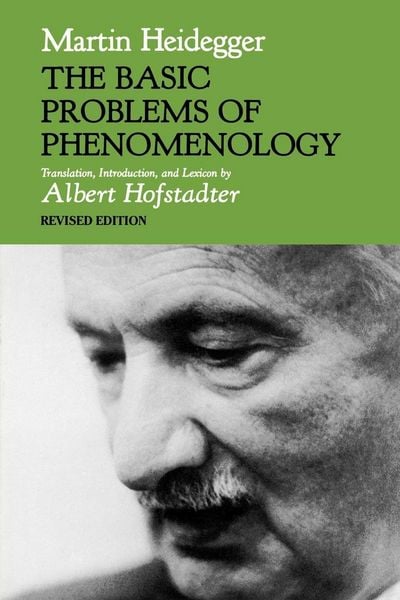
Produktbild: The Basic Problems of Phenomenology

The Basic Problems of Phenomenology

27,99 €

inkl. gesetzl. MwSt., zzgl. Versandkosten


  • Kostenlose Lieferung ab 30 € Einkaufswert
  • Versandkostenfrei für Bonuscard-Kund*innen

Beschreibung

Produktdetails

Einband

Taschenbuch

Erscheinungsdatum

01.08.1988

Verlag

Indiana University Press

Seitenzahl

432

Maße (L/B/H)

23,5/15,7/3,2 cm

Gewicht

725 g

Auflage

2. Auflage

Übersetzt von

Albert Hofstadter

Sprache

Englisch

ISBN

978-0-253-20478-3

Beschreibung

Rezension

"This volume belongs in every collection on Heidegger and is required reading for anyone interested in this major thinker."-Religious Studies Review
"In Albert Hofstadter's excellent translation, we can listen in as Heidegger clearly and patiently explains . . . the ontological difference."-Times Literary Supplement
"Perhaps the most generally accessible text that Heidegger published. . . . The translation is superb."-Key Reporter
"For all students and scholars, Basic Problems will provide the "missing link" between Husserl and Heidegger, between phenomenology and Being and Time."-Teaching Philosophy

Produktdetails

Einband

Taschenbuch

Erscheinungsdatum

01.08.1988

Verlag

Indiana University Press

Seitenzahl

432

Maße (L/B/H)

23,5/15,7/3,2 cm

Gewicht

725 g

Auflage

2. Auflage

Übersetzt von

Albert Hofstadter

Sprache

Englisch

ISBN

978-0-253-20478-3

Herstelleradresse

Libri GmbH
Europaallee 1
36244 Bad Hersfeld
DE

Email: gpsr@libri.de

Noch keine Bewertungen vorhanden

Verfassen Sie die erste Bewertung zu diesem Artikel

Helfen Sie anderen Kundinnen und Kunden durch Ihre Meinung.

Kundinnen und Kunden meinen

Bewertungen (0)

Die Leseprobe wird geladen.
  • Produktbild: The Basic Problems of Phenomenology
  • Translator's Preface
    Translator's Introduction
    Introduction
    1. Exposition and General Division of the theme
    2. The concept of philosophy. Philosophy and world-view
    3. Philosophy as science of being
    4. The four theses about being and the basic problems of phenomenology
    5. The character of ontological method. The three basic components of phenomenological method
    6. Outline of the course
    Part One: Critical Phenomenological Discussion of Some Traditional Theses about Being
    Chapter One: Kant's Thesis: Being Is Not a Real Predicate
    7. The content of the Kantian thesis
    8. Phenomenological analysis of the explanation of the concept of being or of existence given by Kant
    9. Demonstration of the need for a more fundamental formulation of the problem of the thesis and of a more radical foundation of this problem
    Chapter Two: The Thesis of Medeval Ontology Derived from Aristotle: To the Constitution of the Being of a Being There Belong Essence and Existence
    10. The Content of the thesis and its traditional discussion
    11. Phenomenological clarification of the problem underlying the second thesis
    12. Proof of the inadequate foundation of the traditional treatment of the problem
    Chapter Three: The Thesis of Modern Ontology: The Basic Ways of Being Are the Being of Nature (res Extensa) and the Being of Mind (Res Cogitans)
    13. Characterization of the ontological distinction between res extensa and res cogitans with the aid of the Kantian formulation of the problem
    14. Phenomenological critique of the Kantian solution and demonstration of the need to pose the question in fundamental principle
    15. The fundamental problem of the multiplicity of ways of being and of the unity of the concept of being in general
    Chapter Four: The Thesis of Logic: Every Being, Regardless of Its Particular Way of Being, Can Be Addressed and Talked About by Means of the "Is". The Being of the Copula
    16. Delineation of the ontological problem of the copula with reference to some characteristic arguments in the course of the histroy of logic
    17. Being as copula and the phenomenological problem of assertion
    18. Assertional truth, the idea of truth in general, and its relation to the concept of being
    Part Two:
    The Fundamental Ontological Question of the Meaning of Being in General
    The Basic Structures and Basic Ways of Being
    Chapter One: The Problem of the Ontological Difference
    19. Time and temporality
    20. temporality [Zeitlichkeit] and Temporality [Temporalitat]
    21. Temporality [Temporalitat] and being
    22. Being and beings. The ontological difference
    Editor's Epilogue
    Translator's Appendix: A Note on the Da and the Dasein
    Lexicon