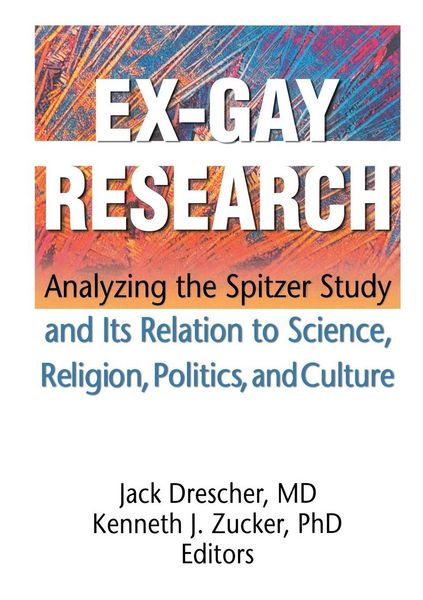
Produktbild: Ex-Gay Research

Ex-Gay Research Analyzing the Spitzer Study and Its Relation to Science, Religion, Politics, and Culture

64,99 €

inkl. gesetzl. MwSt., Versandkostenfrei


Beschreibung

Produktdetails

Einband

Taschenbuch

Erscheinungsdatum

22.03.2006

Verlag

Taylor and Francis

Seitenzahl

374

Maße (L/B/H)

21,3/15,3/2,4 cm

Gewicht

690 g

Sprache

Englisch

ISBN

978-1-56023-557-6

Beschreibung

Produktdetails

Einband

Taschenbuch

Erscheinungsdatum

22.03.2006

Verlag

Taylor and Francis

Seitenzahl

374

Maße (L/B/H)

21,3/15,3/2,4 cm

Gewicht

690 g

Sprache

Englisch

ISBN

978-1-56023-557-6

Herstelleradresse

Libri GmbH
Europaallee 1
36244 Bad Hersfeld
DE

Email: gpsr@libri.de

Noch keine Bewertungen vorhanden

Verfassen Sie die erste Bewertung zu diesem Artikel

Helfen Sie anderen Kundinnen und Kunden durch Ihre Meinung.

Kundinnen und Kunden meinen

Bewertungen (0)

Die Leseprobe wird geladen.
  • Produktbild: Ex-Gay Research
    • About the Editors
    • Contributors
    • Preface
    • Section I: Editors’ Introductions
    • 1. The Politics and Science of Reparative Therapy (Kenneth J. Zucker)
    • 2. Gold or Lead? Introductory Remarks on Conversions (Jack Drescher)
    • Section II: Perspectives on Changing Sexual Orientation
    • 3. Position Statement on Therapies Focused on Attempts to Change Sexual Orientation (Reparative or Conversion Therapies) (Commission on Psychotherapy by Psychiatrists [COPP] and American Psychiatric Association)
    • 4. Can Some Gay Men and Lesbians Change Their Sexual Orientation? 200 Participants Reporting a Change from Homosexual to Heterosexual Orientation (Robert L. Spitzer)
    • Section III: Commentaries on the Spitzer Study and Dr. Spitzer’s Response from Archives of Sexual Behavior
    • 5. Can Sexual Orientation Change? A Long-Running Saga (John Bancroft)
    • 6. Understanding the Self-Reports of Reparative Therapy Successes (A. Lee Beckstead)
    • 7. The Malleability of Homosexuality: A Debate Long Overdue (A. Dean Byrd)
    • 8. A Methodological Critique of Spitzer’s Research on Reparative Therapy (Helena M. Carlson)
    • 9. Are Converts to Be Believed? Assessing Sexual Orientation Conversions (Kenneth M. Cohen and Ritch C. Savin-Williams)
    • 10. Reconsidering Sexual Desire in the Context of Reparative Therapy (Lisa M. Diamond)
    • 11. The Spitzer Study and the Culture Wars (Jack Drescher)
    • 12. Sexual Orientation Change: A Study of Atypical Cases (Richard C. Friedman)
    • 13. The Politics of Sexual Choices (John H. Gagnon)
    • 14. Too Flawed: Don’t Publish (Lawrence Hartmann)
    • 15. Evaluating Interventions to Alter Sexual Orientation: Methodological and Ethical Considerations (Gregory M. Herek)
    • 16. Guttman Scalability Confirms the Effectiveness of Reparative Therapy (Scott L. Hershberger)
    • 17. Methodological Limitations Do Not Justify the Claim That Same-Sex Attraction Changed Through Reparative Therapy (Craig A. Hill and Jeannie D. DiClementi)
    • 18. Initiating Treatment Evaluations (Donald F. Klein)
    • 19. A Positive View of Spitzer’s Research and an Argument for Further Research (Richard B. Krueger)
    • 20. Penile Plethysomography and Change in Sexual Orientation (Nathaniel McConaghy)
    • 21. Finally, Recognition of a Long-Neglected Population (Joseph Nicolosi)
    • 22. Sexual Orientation Change and Informed Consent in Reparative Therapy (Bruce Rind)
    • 23. Reparative Science and Social Responsibility: The Concept of a Malleable Core As Theoretical Challenge and Psychological Comfort (Paula C. Rodríguez Rust)
    • 24. A Candle in the Wind: Spitzer’s Study of Reparative Therapy (Donald S. Strassberg)
    • 25. Spitzer’s Oversight: Ethical-Philosophical Underpinnings of Reparative Therapy (Marcus C. Tye)
    • 26. Sexual Diversity and Change Along a Continuum of Bisexual Desire (Paul L. Vasey and Drew Rendall)
    • 27. Science and the Nuremberg Code: A Question of Ethics and Harm (Milton L. Wainberg,
      Donald Bux, Alex Carballo-Dieguez, Gary W. Dowsett, Terry Dugan, Marshall Forstein, Karl Goodkin, Joyce Hunter, Thomas Irwin, Paulo Mattos, Karen McKinnon, Ann O’Leary, Jeffrey Parsons, and Edward Stein)
    • 28. Sexual Reorientation Therapy: Is It Ever Ethical? Can It Ever Change Sexual Orientation? (Jerome C. Wakefield)
    • 29. Heterosexual Identities, Sexual Reorientation Therapies, and Science (Roger L. Worthington)
    • 30. How Spitzer’s Study Gives a Voice to the Disenfranchised Within a Minority Group (Mark A. Yarhouse)
    • 31. Study Results Should Not Be Dismissed and Justify Further Research on the Efficacy of Sexual Reorientation Therapy (Robert L