KI-Beratung Beta

Gutscheinbedingungen

**Gültig bis 30.11.2026 auf Spielzeug, Schreibwaren, Filme, Geschenke & Trends, Musik, tolino eReader & Zubehör, Hörbücher und Hörbuch-Downloads, nicht preisgebundene Bücher und Kalender online auf thalia.at und in der Thalia App. Einzelne Artikel können ausgeschlossen sein. Aufgrund der Buchpreisbindung sind deutschsprachige Bücher und eBooks ausgenommen. Zusätzlich ausgenommen sind Abos & Flatrates, Games, Geschenkkarten/-boxen, Shelfies, Software, Zeitschriften sowie einzelne Artikel von tonies®. Pro Einkauf einmal einlösbar. Nur gültig mit im Onlineshop hinterlegter Bonuscard. Click & Collect nur bei Onlinevorabzahlung möglich. Keine Barauszahlung. Nicht kombinierbar mit anderen Aktionen und Gutscheinen. Gutschein wird auf max. 500€ Bestellwert angerechnet. Nicht gültig für Versandkosten und Services.

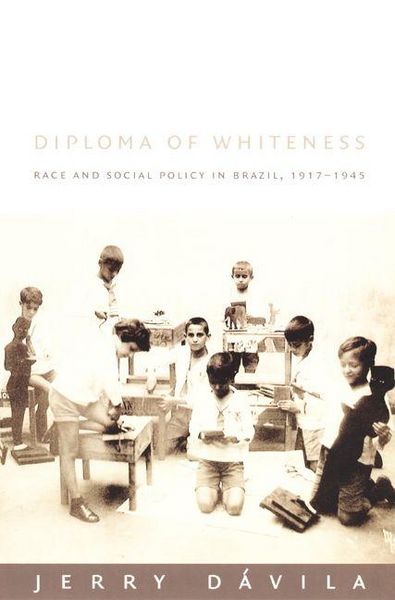
Produktbild: Diploma of Whiteness

Diploma of Whiteness Race and Social Policy in Brazil, 1917-1945

46,99 €

inkl. gesetzl. MwSt., Versandkostenfrei


Beschreibung

In Brazil, the country with the largest population of African descent in the Americas, the idea of race underwent a dramatic shift in the first half of the twentieth century. Brazilian authorities, who had considered race a biological fact, began to view it as a cultural and environmental condition....

Beschreibung

In Brazil, the country with the largest population of African descent in the Americas, the idea of race underwent a dramatic shift in the first half of the twentieth century. Brazilian authorities, who had considered race a biological fact, began to view it as a cultural and environmental condition. Jerry DÁvila explores the significance of this transition by looking at the history of the Rio de Janeiro school system between 1917 and 1945. He demonstrates how, in the period between the world wars, the dramatic proliferation of social policy initiatives in Brazil was subtly but powerfully shaped by beliefs that racially mixed and nonwhite Brazilians could be symbolically, if not physically, whitened through changes in culture, habits, and health.
Providing a unique historical perspective on how racial attitudes move from elite discourse into people’s lives, Diploma of Whiteness shows how public schools promoted the idea that whites were inherently fit and those of African or mixed ancestry were necessarily in need of remedial attention. Analyzing primary material-including school system records, teacher journals, photographs, private letters, and unpublished documents-DÁvila traces the emergence of racially coded hiring practices and student-tracking policies as well as the development of a social and scientific philosophy of eugenics. He contends that the implementation of the various policies intended to “improve” nonwhites institutionalized subtle barriers to their equitable integration into Brazilian society.

Produktdetails

Einband

Taschenbuch

Erscheinungsdatum

19.03.2003

Verlag Duke University Press
Seitenzahl

312

Produktdetails

Einband

Taschenbuch

Erscheinungsdatum

19.03.2003

Verlag Duke University Press
Seitenzahl

312

Maße (L/B/H)

22,8/15,4/2,8 cm

Gewicht

530 g

Sprache

Englisch

ISBN

978-0-8223-3070-7

Herstelleradresse

Libri GmbH
Europaallee 1
36244 Bad Hersfeld
DE

Email: gpsr@libri.de

Noch keine Bewertungen vorhanden

Verfassen Sie die erste Bewertung zu diesem Artikel

Helfen Sie anderen Kundinnen und Kunden durch Ihre Meinung.

Kundinnen und Kunden meinen

Bewertungen (0)

  • Produktbild: Diploma of Whiteness
  • Acknowledgments ix
    Introduction 1
    1. Building the “Brazilian Man” 21
    2. Educating Brazil 52
    3. What Happened to Rio’s Teachers of Color? 90
    4. Elementary Education 125
    5. Escola Nova no Estado Novo: The New School in the New State 155
    6. Behaving White: Rio’s Secondary Schools 192
    Epilogue: The Enduring Brazilian Fascination with Race 233
    List of Abbreviations 244
    Notes 247
    Bibliography 271
    Index 287