KI-Beratung Beta

Gutscheinbedingungen

**Gültig bis 18.11.2026 auf englischsprachige Klassiker (klassiker-32728) online auf thalia.at und in der Thalia App. Einzelne Artikel können ausgeschlossen sein. Ausgenommen sind preisgebundene Artikel & eBooks. Pro Einkauf einmal einlösbar. Click & Collect nur bei Onlinevorabzahlung möglich. Keine Barauszahlung. Nicht kombinierbar mit anderen Aktionen und Gutscheinen. Gutschein wird auf max. 500€ Bestellwert angerechnet. Nicht gültig für Geschenkkarten, Versandkosten und Services.

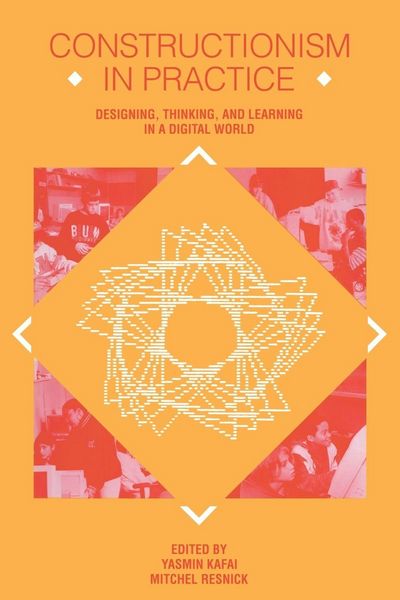
Produktbild: Constructionism in Practice

Constructionism in Practice Designing, Thinking, and Learning in A Digital World

85,99 €

inkl. gesetzl. MwSt., Versandkostenfrei


Beschreibung

The digital revolution necessitates, but also makes possible, radical changes in how and what we learn. This book describes a set of innovative educational research projects at the MIT Media Laboratory, illustrating how new computational technologies can transform our conceptions of learning, education,...

Beschreibung

The digital revolution necessitates, but also makes possible, radical changes in how and what we learn. This book describes a set of innovative educational research projects at the MIT Media Laboratory, illustrating how new computational technologies can transform our conceptions of learning, education, and knowledge. The book draws on real-world education experiments conducted in formal and informal contexts: from inner-city schools and university labs to neighborhoods and after-school clubhouses. The papers in this book are divided in four interrelated sections as follows:
* Perspectives in Constructionism further develops the intellectual underpinnings of constructionist theory. This section looks closely at the role of perspective-taking in learning and discusses how both cognitive and affective processes play a central role in building connections between old and new knowledge.
* Learning through Design analyzes the relationship between designing and learning, and discusses ways that design activities can provide personally meaningful contexts for learning. This section investigates how and why children can learn through the processes of constructing artifacts such as games, textile patterns, robots and interactive devices.
* Learning in Communities focuses on the social aspects of constructionist learning, recognizing that how people learn is deeply influenced by the communities and cultures with which they interact. It examines the nature of learning in classroom, inner-city, and virtual communities.
* Learning about Systems examines how students make sense of biological, technological, and mathematical systems. This section explores the conceptual and epistemological barriers to learning about feedback, self-organization, and probability, and it discusses new technological tools and activities that can help people develop new ways of thinking about these phenomena.

Rezension

"...examples of highly innovative computer technology (e.g., individually programmable LOGO brincks) are presented in considerable detail."
-Contemporary Psychology

"...the very broad spectrum of the discussed issues guarantees that this book will be useful and informative for a broad audience of social scientists, educators, and programming designers, as well as all who are interested in designing learning environments that promote creativity, motivation, sense of community, and agency in the participants....it is easy and fun to read."
-Journal of Educational Computing Research

"...is a valuable collecton of essays written by MIT Media Lab faculty and students. The collection succeeds in providing an insighful look at developments in student-centered learning in science, mathematics engineering, and technology."
-Technical Communication Quarterly

Portrait

Yasmin B. Kafai, Mitchel Resnick

Produktdetails

Einband

Taschenbuch

Erscheinungsdatum

01.04.1996

Herausgeber Yasmin B. Kafai + weitere
Verlag Taylor & Francis

Produktdetails

Einband

Taschenbuch

Erscheinungsdatum

01.04.1996

Herausgeber
Verlag Taylor & Francis
Seitenzahl

360

Maße (L/B/H)

22,9/15,2/2,1 cm

Gewicht

584 g

Sprache

Englisch

ISBN

978-0-8058-1985-4

Herstelleradresse

Libri GmbH
Europaallee 1
36244 Bad Hersfeld
DE

Email: gpsr@libri.de

Noch keine Bewertungen vorhanden

Verfassen Sie die erste Bewertung zu diesem Artikel

Helfen Sie anderen Kundinnen und Kunden durch Ihre Meinung.

Kundinnen und Kunden meinen

Bewertungen (0)

Die Leseprobe wird geladen.
  • Produktbild: Constructionism in Practice
  • Contents:Y.B. Kafai, M. Resnick, Introduction. Part I:Perspectives in Constructionism.S. Papert, A Word for Learning. E. Ackermann, Perspective-Taking and Object Construction: Two Keys to Learning. A.A. Brandes, Elementary School Children's Images of Science. Part II:Learning Through Design.Y.B. Kafai, Learning Design by Making Games: Children's Development of Design Strategies in the Creation of a Complex Computational Artifact. Y.B. Kafai, Electronic Play Worlds: Gender Differences in Children's Constructions of Video Games. G. Gargarian, The Art of Design. R. Sargent, M. Resnick, F. Martin, B. Silverman, Building and Learning with Programmable Bricks. Part III:Learning in Communities.A. Shaw, Social Constructionism and the Inner City: Designing Environments for Social Development and Urban Renewal. A. Bruckman, M. Resnick, The MediaMOO Project: Constructionism and Professional Community. M. Evard, A Community of Designers: Learning Through Exchanging Questions and Answers. P.K. Hooper, "They Have Their Own Thoughts": A Story of Constructionist Learning in an Alternative African-Centered Community School. Part IV:Learning About Systems.M. Resnick, New Paradigms for Computing, New Paradigms for Thinking. U. Wilensky, Making Sense of Probability Through Paradox and Programming: A Case Study in a Connected Mathematics Framework. F.G. Martin, Ideal and Real Systems: A Study of Notions of Control in Undergraduates Who Design Robots.