Beschreibung
Produktdetails
Einband
Taschenbuch
Erscheinungsdatum
25.10.2001
Verlag
WileySeitenzahl
340
Maße (L/B/H)
23,4/15,6/1,8 cm
Gewicht
518 g
Sprache
Englisch
ISBN
978-0-632-05519-7
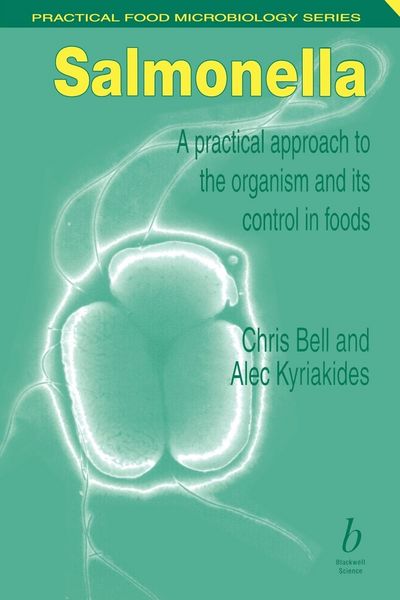
Human illness attributed to foodborne pathogenic microorganisms has been prominent in the mass media in recent years. The Practical Food Microbiology Series has been devised to give practical and accurate information about specific organisms of concern to public health. The information is designed for use by those in the food industry working in manufacturing, retailing and quality assurance, those in associated professional sectors e.g. public health, and students in each of these areas.
The series is unique in its practical approach as it draws on real life situations to highlight practical means for controlling the organism in foods.
Salmonella species are arguably the most commonly reported food associated human pathogens in the developed world. They are zoonotic agents and many different animal reservoirs are known. They can be found widely in the environment and may also establish in food processing environments. Over 2000 serotypes of Salmonella have been identified to-date, some of which cause very serious illness in humans particularly in vulnerable populations such as the elderly. Although rare, illness may result in fatality or long term debility and sequelae. Salmonella spp. are so widespread in raw foods and food source environments that the food industry has to maintain constant vigilance regarding contamination in raw materials, effectiveness of food processing systems and control of finished product characteristics for assuring food safety with respect to this important pathogen.
This book details the causes of selected outbreaks and assesses the lessons that can be learnt from them. It examines the characteristics of Salmonella spp. and identifies factors that make foods susceptible to contamination and growth of these organisms. Specific product sectors are used to indicate practical measures that can be applied to control Salmonella spp. in foods and minimise their potential to cause harm to the consumer. It also provides guidance in selecting effective sampling plans and test methods to monitor and detect the organism and offers pragmatic advice on action to be taken when the organism is detected during monitoring programmes.
Noch keine Bewertungen vorhanden
Verfassen Sie die erste Bewertung zu diesem Artikel
Helfen Sie anderen Kundinnen und Kunden durch Ihre Meinung.
Kurze Frage zu unserer Seite
Vielen Dank für Ihr Feedback
Wir nutzen Ihr Feedback, um unsere Produktseiten zu verbessern. Bitte haben Sie Verständnis, dass wir Ihnen keine Rückmeldung geben können. Falls Sie Kontakt mit uns aufnehmen möchten, können Sie sich aber gerne an unseren Kund*innenservice wenden.
zum Kundenservice