KI-Beratung Beta

Gutscheinbedingungen

**Gültig am 20.11.2026 ab einem Mindestbestellwert von 30€ auf Spielzeug, Schreibwaren, Filme, Geschenke & Trends, Musik, tolino eReader & Zubehör, Hörbücher und Hörbuch-Downloads, nicht preisgebundene Bücher und Kalender online auf thalia.at und in der Thalia App. Einzelne Artikel können ausgeschlossen sein. Aufgrund der Buchpreisbindung sind deutschsprachige Bücher und eBooks ausgenommen. Zusätzlich ausgenommen sind Abos & Flatrates, Games, Geschenkkarten/-boxen, Shelfies, Software, Zeitschriften sowie einzelne Artikel von tonies®. Pro Einkauf einmal einlösbar. Click & Collect nur bei Onlinevorabzahlung möglich. Keine Barauszahlung. Nicht kombinierbar mit anderen Aktionen und Gutscheinen. Gutschein wird auf max. 500€ Bestellwert angerechnet. Nicht gültig für Versandkosten und Services. Preisgebundene Artikel sind vom Mindestbestellwert ausgeschlossen.

  • Produktbild: Collective Remembering
  • Produktbild: Collective Remembering
- 11%

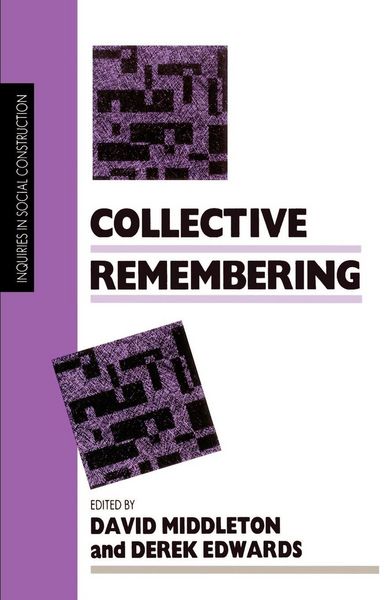
Collective Remembering

11% sparen

63,99 € UVP 72,70 €

inkl. gesetzl. MwSt., Versandkostenfrei


Beschreibung

Profoundly challenging the traditional view of memory as the product and property of individual minds, Collective Remembering is concerned with remembering and forgetting as socially constituted activities. The starting point is a conceptualization of remembering and forgetting as forms of social action....

Beschreibung

Profoundly challenging the traditional view of memory as the product and property of individual minds, Collective Remembering is concerned with remembering and forgetting as socially constituted activities. The starting point is a conceptualization of remembering and forgetting as forms of social action. Individual memories cannot be understood as `internal mental processes' which occur independently of the interpretive and communicative practices which characterize a particular society or culture. Individuals `read', account for and negotiate their memories within the pragmatics of social life. Contributions also explore the collective processes through which communities' social memories are created, sustained and transformed - in families, other groups and cultures, organizations.

Rezension

`The study of memory, as a social and political phenomenon, is one of the most exciting areas of current work... This collection of essays makes a useful addition to the literature' - The Sociological Review

`When carrying out fieldwork, stress is laid on the obtaining and checking of information. This golden rule can be readily appreciated against the background of Bartlett's work. The essays in this book burnish the gold. They deal with the fieldwork as against controlled experiment. They show how memory is social in origin, that memories are socially constituted states, representing a form of social memory, irreducible in a single mind yet essential to the mental life of each individual' - Lore and Language

`Argues (and to considerable effect) that memory does not reside in an individual's head, as all the hard-line experimental psychologists and neurocognitivists would claim, but in the collective talk which underpins all social interaction... It is difficult right now to say how the lively and provocative work reported in this book will interface with all those tedious laboratory studies of memory, but I feel that any such relations can only be for the good' - Systems Practice

`A terrific book... This collection of case studies and theoretical perspectives demonstrates that the most exciting new understandings of memory will come on the undeveloped terrain that lies between the study of unnaturally isolated individual recollection and the study of unnaturally passive cultural myth. Taken together, these essays are the freshest and most promising approach I have seen to begin to map the features we are likely to find in this terrain' - David Thelen, Indiana University

`This is one of the most important new volumes we have in the trend to take memory out of the artificial laboratory and put it into the real contexts of cultural, historical and institutional settings. The authors have brilliantly described a wide range of phenomena that fall under the heading of collective remembering, but perhaps even more importantly they have challenged many of the theoretical constructs and boundaries of contemporary social science. It is a major accomplishment and will be looked upon for years as being well ahead of its time' -

James V Wertsch, Clark University
Produktdetails

Einband

Taschenbuch

Erscheinungsdatum

10.10.2001

Herausgeber David Middleton + weitere
Verlag Sage Publications

Produktdetails

Einband

Taschenbuch

Erscheinungsdatum

10.10.2001

Herausgeber
Verlag Sage Publications
Seitenzahl

244

Maße (L/B/H)

21,6/14/1,5 cm

Gewicht

350 g

Sprache

Englisch

ISBN

978-0-8039-8235-2

EU-Ansprechpartner

Kolibri 360 GmbH
Ettore-Bugatti-Straße 6-14
51149 Köln
DE
produktsicherheit@kolibri360.de

Herstelleradresse

SAGE Publications
1 Oliver's Yard 55 City Road
EC1Y 1SP London
GB
orders@sagepub.co.uk

Noch keine Bewertungen vorhanden

Verfassen Sie die erste Bewertung zu diesem Artikel

Helfen Sie anderen Kundinnen und Kunden durch Ihre Meinung.

Kundinnen und Kunden meinen

Bewertungen (0)

  • Produktbild: Collective Remembering
  • Produktbild: Collective Remembering
  • Preface - Michael Cole
    Introduction - David Middleton and Derek Edwards
    Conversational Remembering - David Middleton and Derek Edwards
    A Social Psychological Approach
    Artefacts, Memory and a Sense of the Past - Alan Radley
    Collective Memory, Ideology and the British Royal Family - Michael Billig
    The Reconstruction of Abraham Lincoln - Barry Schwartz
    Ronald Reagan Misremembered - Michael Schudson
    The Social Construction of Remembering and Forgetting - John Shotter
    Organizational Forgetting - Yrj[um]o Engestr[um]om, Katherine Brown, Ritva Engestr[um]om and Kirsi Koistinen
    An Activity-Theoretical Perspective
    Sharing Knowledge, Celebrating Identity - Julian E Orr
    Community Memory in a Service Culture
    Folk Explanation in Language Survival - Carol A Padden
    Social Memory in Soviet Thought - David Bakhurst