Gutscheinbedingungen

**Gültig bis 22.07.2026 ab einem Mindestbestellwert von 40€ auf Spielzeug, Schreibwaren, Filme, Geschenke & Trends, Musik, tolino eReader & Zubehör, Hörbücher und Hörbuch-Downloads (außer Abo), nicht preisgebundene Bücher und Kalender online auf thalia.at und in der Thalia App. Einzelne Artikel können ausgeschlossen sein. Aufgrund der Buchpreisbindung sind deutschsprachige Bücher und eBooks ausgenommen. Zusätzlich ausgenommen sind preisgebundene Artikel, Abos & Flatrates, eBooks, Games, Geschenkkarten/-boxen, Shelfies, Software, Zeitschriften sowie einzelne Artikel von tonies®. Pro Einkauf einmal einlösbar. Click & Collect nur bei Onlinevorabzahlung möglich. Keine Barauszahlung. Nicht kombinierbar mit anderen Aktionen und Gutscheinen. Gutschein wird auf max. 500€ Bestellwert angerechnet. Nicht gültig für Versandkosten und Services. Preisgebundene Artikel sind vom Mindestbestellwert ausgeschlossen.

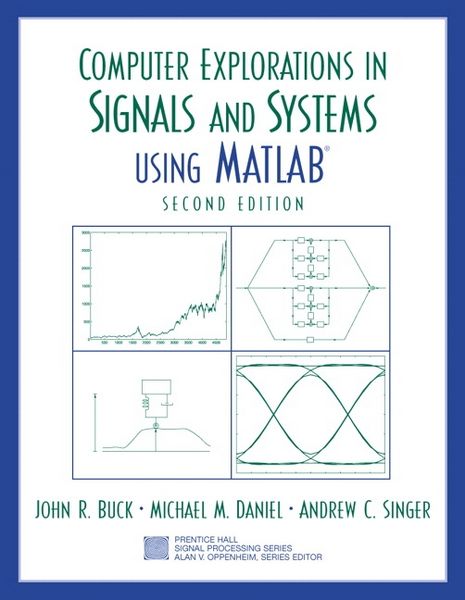
Produktbild: Computer Explorations in Signals and Systems Using MATLAB
- 14%

Computer Explorations in Signals and Systems Using MATLAB

14% sparen

81,99 € UVP 95,49 €

inkl. gesetzl. MwSt., Versandkostenfrei


Beschreibung

Produktdetails

Einband

Taschenbuch

Erscheinungsdatum

24.07.2001

Verlag

Pearson

Seitenzahl

224

Maße (L/B/H)

27,6/21,6/1,3 cm

Gewicht

562 g

Auflage

2

Sprache

Englisch

ISBN

978-0-13-042155-5

Beschreibung

Produktdetails

Einband

Taschenbuch

Erscheinungsdatum

24.07.2001

Verlag

Pearson

Seitenzahl

224

Maße (L/B/H)

27,6/21,6/1,3 cm

Gewicht

562 g

Auflage

2

Sprache

Englisch

ISBN

978-0-13-042155-5

Herstelleradresse

Pearson
St.-Martin-Straße 82
81541 München
DE

Email: salesde@pearson.com

Noch keine Bewertungen vorhanden

Verfassen Sie die erste Bewertung zu diesem Artikel

Helfen Sie anderen Kundinnen und Kunden durch Ihre Meinung.

Kundinnen und Kunden meinen

Bewertungen (0)

  • Produktbild: Computer Explorations in Signals and Systems Using MATLAB


  • 1. Signals and Systems.

    Tutorial: Basic MATLAB Functions for Representing Signals. Discrete-Time Sinusoidal Signals. Transformations of the Time Index for Discrete-Time Signals. Properties of Discrete-Time Systems. Implementing a First-Order Difference Equation. Continuous-Time Complex Exponential Signals. Transformations of the Time Index for Continuous-Time Signals. Energy and Power for Continuous-Time Signals.

    2. Linear Time-Invariant Systems.

    Tutorial: conv. Tutorial: filter. Tutorial: lsim with Differential Equations. Properties of Discrete-Time LTI Systems. Linearity and Time-Invariance. Noncausal Finite Impulse Response Filters. Discrete-Time Convolution. Numerical Approximations of Continuous-Time Convolution. The Pulse Response of Continuous-Time LTI Systems. Echo Cancellation via Inverse Filtering.

    3. Fourier Series Representation of Periodic Signals.

    Tutorial: Computing the Discrete-Time Fourier Series with fft. Tutorial: freqz. Tutorial: lsim with System Functions. Eigenfunctions of Discrete-Time LTI Systems. Synthesizing Signals with the Discrete-Time Fourier Series. Properties of the Continuous-Time Fourier Series. Energy Relations in the Continuous-Time Fourier Series. First-Order Recursive Discrete-Time Filters. Frequency Response of a Continuous-Time System. Computing the Discrete-Time Fourier Series. Synthesizing Continuous-Time Signals with the Fourier Series. The Fourier Representation of Square and Triangle Waves. Continuous-Time Filtering.

    4. The Continuous-Time Fourier Transform.

    Tutorial: freqs. Numerical Approximation to the Continuous-Time Fourier Transform. Properties of the Continuous-Time Fourier Transform. Time- and Frequency-Domain Characterizations of Systems. Impulse Responses of Differential Equations by Partial Fraction Expansion. Amplitude Modulation and the Continuous-Time Fourier Transform. Symbolic Computation of the Continuous-Time Fourier Transform.

    5. The Discrete-Time Fourier Transform.

    Computing Samples of the DTFT. Telephone Touch-Tone. Discrete-Time All-Pass Systems. Frequency Sampling: DTFT-Based Filter Design. System Identification. Partial Faction Expansion for Discrete-Time Systems.

    6. Time and Frequency Analysis of Signals and Systems.

    A Second-Order Shock Absorber. Image Processing with One-Dimensional Filters. Filter Design by Transformation. Phase Effects for Lowpass Filters. Frequency Division Multiple-Access. Linear Prediction on the Stock Market.

    7. Sampling.

    Aliasing due to Undersampling. Signal Reconstruction from Samples. Upsampling and Downsampling. Bandpass Sampling. Half-Sample Delay. Discrete-Time Differentiation.

    8. Communications Systems.

    The Hilbert Transform and Single-Sideband AM. Vector Analysis of Amplitude Modulation with Carrier. Amplitude Demodulation and Receiver Synchronization. Intersymbol Interference in PAM Systems. Frequency Modulation.

    9. The Laplace Transform.

    Tutorial: Making Continuous-Time Pole-Zero Diagrams. Pole Locations for Second-Order Systems. Butterworth Filters. Surface Plots of Laplace Transforms. Implementing Noncausal Continuous-Time Filters.

    10. The z-Transform.

    Tutorial: Making Discrete-Time Pole-Zero Diagrams. Geometric Interpretation of the Discrete-Time Frequency Response. Quantization Effects in Discrete-Time Filter Structures. Designing Discrete-Time Filters with Euler Approximations. Discrete-Time Butterworth Filter Design Using the Bilinear Transformation.

    11. Feedback Systems.

    Feedback Stabilization: Stick Balancing. Stabilization of Unstable Systems. Using Feedback to Increase the Bandwidth of an Amplifier.

    Bibliography.

    Index.