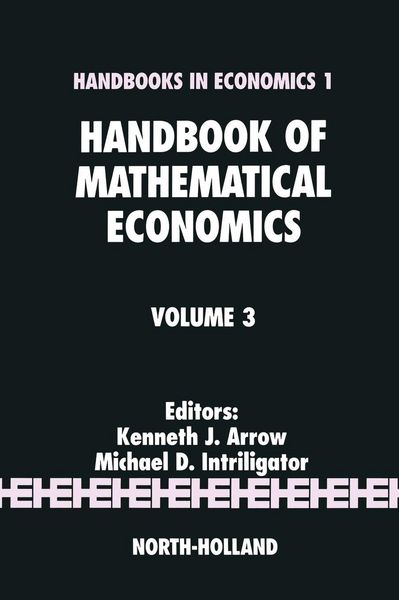
Beschreibung
The Handbook of Mathematical Economics aims to provide a definitive source, reference, and teaching supplement for the field of mathematical economics. It surveys, as of the late 1970's the state of the art of mathematical economics. This is a constantly developing field and all authors were invited to review and to appraise the current status and recent developments in their presentations. In addition to its use as a reference, it is intended that this Handbook will assist researchers and students working in one branch of mathematical economics to become acquainted with other branches of this field. Volume I deals with Mathematical Methods in Economics, including reviews of the concepts and techniques that have been most useful for the mathematical development of economic theory. Volume II elaborates on Mathematical Approaches to Microeconomic Theory, including consumer, producer, oligopoly, and duality theory, as well as Mathematical Approaches to Competitive Equilibrium including such aspects of competitive equilibrium as existence, stability, uncertainty, the computation of equilibrium prices, and the core of an economy.
Portrait
Michael D. Intriligator is Professor Emeritus of Economics, Political Science, and Policy Studies at the University of California, Los Angeles (UCLA), where he is also Co-Director of the Jacob Marschak Interdisciplinary Colloquium on Mathematics in the Behavioral Sciences. In addition, he is a Senior Fellow at the Milken Institute in Santa Monica, a Senior Fellow of the Gorbachev Foundation of North America in Boston, a Foreign Member of the Russian Academy of Science, and a Fellow of the American Association for the Advancement of Science. He received his Ph.D. in Economics at MIT in 1963 and the same year joined the UCLA Department of Economics. He teaches courses in economic theory, econometrics, mathematical economics, international relations, and health economics, and he has received several distinguished teaching awards.Kenneth Arrow is the Joan Kenney Professor of Economics and Professor of Operations Research, emeritus; a CHP/PCOR fellow; and an FSI senior fellow by courtesy. He is the joint winner of the Nobel Memorial Prize in Economics with John Hicks in 1972. To date, he is the youngest person to have received this award, at 51. In economics, he is a figure in post-World War II neo-classical economic theory. Many of his former graduate students have gone on to win the Nobel Memorial Prize themselves. His most significant works are his contributions to social choice theory, notably "Arrow's impossibility theorem", and his work on general equilibrium analysis. He has also provided foundational work in many other areas of economics, including endogenous growth theory and the economics of information. He has been co-editor of the Handbooks in Economics series since the mid-1980s.