KI-Beratung Beta

Gutscheinbedingungen

**Gültig bis 18.11.2026 auf englischsprachige Klassiker (klassiker-32728) online auf thalia.at und in der Thalia App. Einzelne Artikel können ausgeschlossen sein. Ausgenommen sind preisgebundene Artikel & eBooks. Pro Einkauf einmal einlösbar. Click & Collect nur bei Onlinevorabzahlung möglich. Keine Barauszahlung. Nicht kombinierbar mit anderen Aktionen und Gutscheinen. Gutschein wird auf max. 500€ Bestellwert angerechnet. Nicht gültig für Geschenkkarten, Versandkosten und Services.

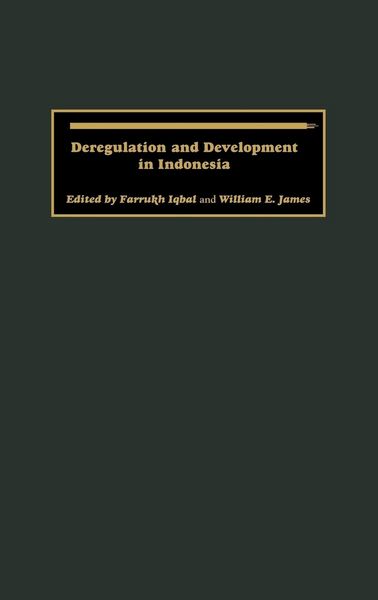
Produktbild: Deregulation and Development in Indonesia

Deregulation and Development in Indonesia

112,99 €

inkl. gesetzl. MwSt., Versandkostenfrei


Beschreibung

Of the developing nations of East Asia, Indonesia came relatively late to liberalizing its trade and investment regime. Only in the mid-1980s, when it was clear that oil revenues alone would not suffice and that a new engine of growth was needed, did the country's government swing behind a systematic...

Beschreibung

Of the developing nations of East Asia, Indonesia came relatively late to liberalizing its trade and investment regime. Only in the mid-1980s, when it was clear that oil revenues alone would not suffice and that a new engine of growth was needed, did the country's government swing behind a systematic deregulation effort. Tariffs were cut, non-tariff barriers were lowered, foreign investment restrictions were reduced, export promotion incentives were enhanced, and various financial sector regulations were eased. All this combined to spark a labor-intensive export-led economic boom that was accompanied by an expansion in wages and employment and a boost in productivity. This book documents how Indonesia truly became part of the East Asian miracle story starting in the mid-1980s. Destined to become a leading case study of export-led development in Indonesia, this book grew out of a World Bank/Indonesian Economic Society Symposium held in Jakarta.
There was, however, a parallel story as well, of crony capitalism and weak governance, that led to the financial and political crisis of 1997-98. These aspects were reflected in continued protection of certain sectors where the cronies were active, in restrictions on domestic trade and competition that were left in place for their benefit, and in financial manipulations that were conducted to their advantage. These aspects are noted as well in the book and pulled together in the concluding chapter, which takes the story up through the crisis years to the present.

Portrait

FARRUKH IQBAL is Lead Economist and Regional Coordinator for East Asia at the World Bank Institute.
WILLIAM E. JAMES is Chief of the Research Division and Research Professor of the International Centre for the Study of East Asian Development, based in Japan.

Produktdetails

Einband

Gebundene Ausgabe

Erscheinungsdatum

05.09.2000

Herausgeber Farrukh Iqbal + weitere
Verlag Bloomsbury Academic

Produktdetails

Einband

Gebundene Ausgabe

Erscheinungsdatum

05.09.2000

Herausgeber
Verlag Bloomsbury Academic
Seitenzahl

216

Maße (L/B/H)

24/16,1/1,6 cm

Gewicht

443 g

Sprache

Englisch

ISBN

978-0-275-97407-7

Herstelleradresse

Libri GmbH
Europaallee 1
36244 Bad Hersfeld
DE

Email: gpsr@libri.de

Noch keine Bewertungen vorhanden

Verfassen Sie die erste Bewertung zu diesem Artikel

Helfen Sie anderen Kundinnen und Kunden durch Ihre Meinung.

Kundinnen und Kunden meinen

Bewertungen (0)

  • Produktbild: Deregulation and Development in Indonesia
  • Deregulation and Development in Indonesia: An Introductory Overview by Farrukh Iqbal and Faham Rashid
    The Evolution of Economic Policy Reforms: Determinants, Sequencing, and Reasons for Success by William James and Sherry Stephenson
    Foreign Investment Policy: Evolution and Characteristics by Mari Pangestu
    The Rise in Total Factor Productivity During Deregulation, 1985-1992 by Dipak Dasgupta, Edison Hulu, and James Hanson
    The Determinants of Indonesia's Non-oil Exports by Dipak Dasgupta, Edison Hulu, and Bejoy Das Gupta
    The Impact of Deregulation on the Manufacturing Sector by Farrukh Iqbal
    The Impact of Liberalization on Employment and Earnings by Nisha Agrawal
    Sulawesi's Cocoa Boom: Lessons of Small-holder Dynamism and Hands-off Policy by Akihiko Nishio and Takamasa Akiyama
    Costs and Benefits of Soymeal Deregulation, 1991-1994 by Jacqueline L. Pomeroy
    The Indonesian Cement Industry: A Case for Modified Regulation by Herb Plunkett and Anwar Pasinringi
    Distributional Impact of Government Policies in the Sugar Sector by Martin P.H. Panggabean
    The Impact of Regional Trade Liberalization on Selected APEC Countries and Indonesia by Jeffrey D. Lewis and Sherman Robinson
    Economic Reforms During the Crisis and Beyond by William James and Anwar Nasution