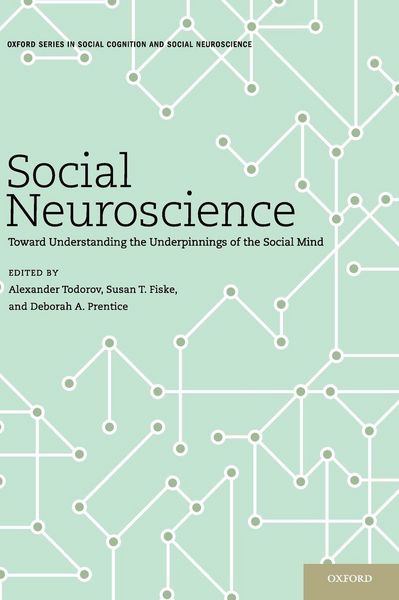
Social Neuroscience Toward Understanding the Underpinnings of the Social Mind
208,99 €
inkl. gesetzl. MwSt.,
Beschreibung
Produktdetails
Einband
Gebundene Ausgabe
Erscheinungsdatum
01.02.2011
Abbildungen
13 B&W line drawings, 6 B&W halftones, 9 Color Line drawings, 28 Color halftones
Herausgeber
Todorov Alexander + weitereVerlag
Oxford AcademicSeitenzahl
328
Maße (L/B/H)
26/18,3/2,2 cm
Gewicht
814 g
Sprache
Englisch
ISBN
978-0-19-531687-2
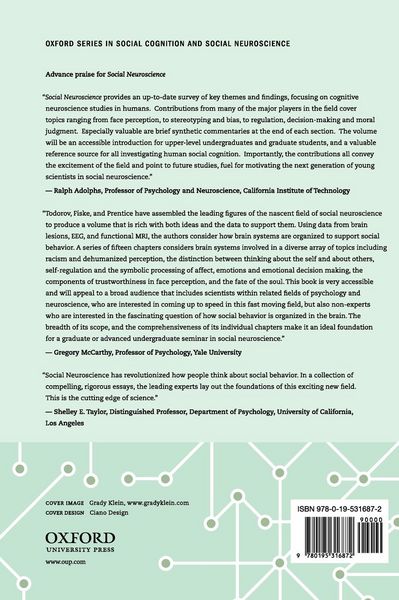
The field of social cognitive neuroscience has captured the attention of many researchers during the past ten years. Much of the impetus for this new field came from the development of functional neuroimaging methods that made it possible to unobtrusively measure brain activation over time. Using these methods over the last 30 years has allowed psychologists to move from simple validation questions -- would flashing stimuli activate the visual cortex -- to those about the functional specialization of brain regions-- are there regions in the inferior temporal cortex dedicated to face processing-- to questions that, just a decade ago, would have been considered to be intractable at such a level of analysis.
These so-called "intractable" questions are the focus of the chapters in this book, which introduces social cognitive neuroscience research addressing questions of fundamental importance to social psychology: How do we understand and represent other people? How do we represent social groups? How do we regulate our emotions and socially undesirable responses? This book also presents innovative combinations of multiple methodologies, including behavioral experiments, computer modeling, functional Magnetic Resonance Imaging (fMRI) experiments, Event-Related Potential (ERP) experiments, and brain lesion studies. It is divided into four sections. The first three sections present the latest research on, respectively, understanding and representing other people, representing social groups, and the interplay of cognition and emotion in social regulation. In the fourth section, contributors step back and consider a range of novel topics that have emerged in the context of social neuroscience research: understanding social exclusion as pain, deconstructing our moral intuitions, understanding cooperative exchanges with other agents, and the effect of aging on brain function and its implications for well-being. Taken together, these chapters provide a rich introduction to an exciting, rapidly developing and expanding field that promises a richer and deeper understanding of the social mind.
Noch keine Bewertungen vorhanden
Verfassen Sie die erste Bewertung zu diesem Artikel
Helfen Sie anderen Kundinnen und Kunden durch Ihre Meinung.
Kurze Frage zu unserer Seite
Vielen Dank für Ihr Feedback
Wir nutzen Ihr Feedback, um unsere Produktseiten zu verbessern. Bitte haben Sie Verständnis, dass wir Ihnen keine Rückmeldung geben können. Falls Sie Kontakt mit uns aufnehmen möchten, können Sie sich aber gerne an unseren Kund*innenservice wenden.
zum Kundenservice