Gutscheinbedingungen

**Gültig bis 06.07.2026 auf fremdsprachige Bücher online auf thalia.at, in der Thalia App ab einem Mindestbestellwert von 30€ und in allen Thalia Buchhandlungen in Österreich. In den Buchhandlungen nur gültig auf lagernde Ware. Einzelne Artikel können ausgeschlossen sein. Ausgenommen sind preisgebundene Artikel & eBooks. Pro Einkauf einmal einlösbar. Nur gültig gegen Vorlage oder im Onlineshop hinterlegter Bonuscard. Infos zur Einlösung in der Buchhandlung sind auf der Bonuscard-Vorteilspreisseite zu finden. Click & Collect nur bei Onlinevorabzahlung möglich. Keine Einlösung bei Scan & Go-Bezahlung. Keine Barauszahlung. Nicht kombinierbar mit anderen Aktionen und Gutscheinen. Gutschein wird auf max. 500€ Bestellwert angerechnet. Nicht gültig für Versandkosten und Services.

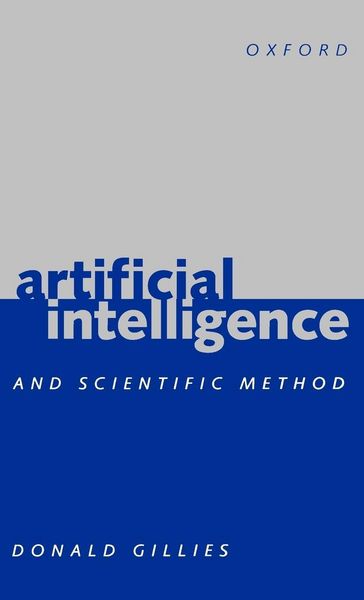
Produktbild: Artificial Intelligence and Scientific Method

Artificial Intelligence and Scientific Method

197,99 €

inkl. gesetzl. MwSt., Versandkostenfrei


Beschreibung

Produktdetails

Einband

Gebundene Ausgabe

Erscheinungsdatum

05.09.1996

Verlag

Oxford Academic

Seitenzahl

192

Maße (L/B/H)

22,2/14,5/1,4 cm

Gewicht

346 g

Sprache

Englisch

ISBN

978-0-19-875158-8

Beschreibung

Produktdetails

Einband

Gebundene Ausgabe

Erscheinungsdatum

05.09.1996

Verlag

Oxford Academic

Seitenzahl

192

Maße (L/B/H)

22,2/14,5/1,4 cm

Gewicht

346 g

Sprache

Englisch

ISBN

978-0-19-875158-8

Herstelleradresse

Libri GmbH
Europaallee 1
36244 Bad Hersfeld
DE

Email: gpsr@libri.de

Noch keine Bewertungen vorhanden

Verfassen Sie die erste Bewertung zu diesem Artikel

Helfen Sie anderen Kundinnen und Kunden durch Ihre Meinung.

Kundinnen und Kunden meinen

Bewertungen (0)

  • Produktbild: Artificial Intelligence and Scientific Method
    • Preface

    • Acknowledgements

    • Chapter 1 The Inductivist Controversy, or Bacon versus Popper

    • 1.1: Bacon's Inductivism

    • 1.2: Popper's Falsificationism

    • 1.3: Kepler's Discovery of the Laws of Planetary Motion

    • 1.4: The Discovery of the Sulphonamide Drugs

    • Chapter 2 Machine Learning in the Turing Tradition

    • 2.1: The Turing Tradition

    • 2.2: The Practical Problem: Expert Systems and Feigenbaum's Bottleneck

    • 2.3: Attribute-based Learning, Decision Trees, and Quinlan's ID3

    • 2.4: GOLEM as an example of Relational Learning

    • 2.5: Bratko's summary of the successes of Machine Learning in the Turing Tradition, 1992

    • 2.6: GOLEM's Discovery of a Law of Nature

    • Chapter 3: How Advances in Machine Learning affect the Inductivist Controversy

    • 3.1: Bacon's Example of Heat

    • 3.2: The Importance of Falsification

    • 3.3: Bacon's Method has only recently come to be used

    • 3.4: The Need for Background Knowledge

    • Chapter 4: Logic and Programming and a New Framework for Logic

    • 4.1: The Development of PROLOG

    • 4.2: PROLOG as a Non-Monotonic Logic

    • 4.3: Two Examples of Translations from One Logical System to Another

    • 4.4: Logic = Inference + Control

    • 4.5: PROLOG introduces Control into Deductive Logic

    • 4.6: PROLOG and Certainty. Is Logic a priori or empirical?

    • Chapter 5: Can there be an Inductive Logic?

    • 5.1: The Divergence between Deductive and Inductive Logic (up to the early 1970s)

    • 5.2: Inductive Logic as Inference + Control

    • 5.3: Confirmation Values as Control in a Deductive Logic

    • 5.4: The Empirical Testing of Rival Logics

    • Chapter 6: Do Gödel's Incompleteness Theorems place a Limit on Artificial Intelligence?

    • 6.1: Anxieties caused by Advances in AI

    • 6.2: Informal Exposition of Gödel's Incompleteness Theorems

    • 6.3: The Lucas Argument

    • 6.4: Objections to the Lucas Argument: i) Possible Limitations on Self-Knowledge

    • 6.5: Objections to the Lucas Argument: ii) Possible Additions of Learning Systems

    • 6.6: Why Advances in Computing are more likely to Stimulate Human Thinking than to Render it Superfluous

    • Notes, References, Index