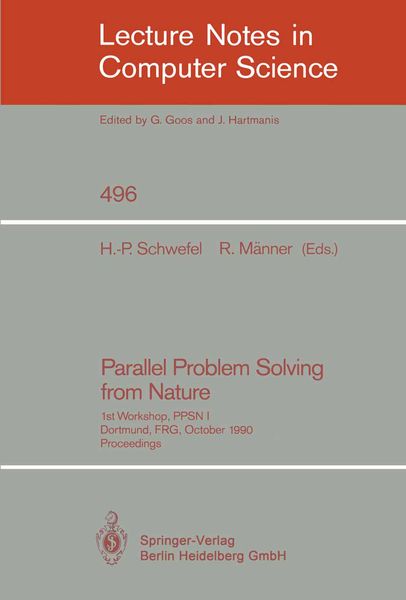
Produktbild: Parallel Problem Solving from Nature
Band 496

Parallel Problem Solving from Nature 1st Workshop, PPSN I Dortmund, FRG, October 1-3, 1990. Proceedings

51,99 €

inkl. gesetzl. MwSt., Versandkostenfrei


Beschreibung

Produktdetails

Einband

Taschenbuch

Erscheinungsdatum

12.06.1991

Herausgeber

Hans-Paul Schwefel + weitere

Verlag

Springer Berlin

Seitenzahl

489

Maße (L/B/H)

23,5/15,5/2,8 cm

Gewicht

754 g

Auflage

1991

Sprache

Englisch

ISBN

978-3-540-54148-6

Beschreibung

Produktdetails

Einband

Taschenbuch

Erscheinungsdatum

12.06.1991

Herausgeber

Verlag

Springer Berlin

Seitenzahl

489

Maße (L/B/H)

23,5/15,5/2,8 cm

Gewicht

754 g

Auflage

1991

Sprache

Englisch

ISBN

978-3-540-54148-6

Herstelleradresse

Springer-Verlag GmbH
Tiergartenstr. 17
69121 Heidelberg
DE

Email: ProductSafety@springernature.com

Kundinnen und Kunden meinen

0 Bewertungen

Informationen zu Bewertungen

Zur Abgabe einer Bewertung ist eine Anmeldung im Konto notwendig. Die Authentizität der Bewertungen wird von uns nicht überprüft. Wir behalten uns vor, Bewertungstexte, die unseren Richtlinien widersprechen, entsprechend zu kürzen oder zu löschen.

Die Bewertungen sind nach Format, Anzahl Sterne und Datum sortiert.

Verfassen Sie die erste Bewertung zu diesem Artikel

Helfen Sie anderen Kund*innen durch Ihre Meinung

Kundinnen und Kunden meinen

0 Bewertungen filtern

  • Produktbild: Parallel Problem Solving from Nature
  • Global convergence of genetic algorithms: A markov chain analysis.- The theory of virtual alphabets.- Towards an optimal mutation probability for genetic algorithms.- An alternative Genetic Algorithm.- An analysis of the interacting roles of population size and crossover in genetic algorithms.- Gleam a system for simulated "intuitive learning".- Genetic algorithms and highly constrained problems: The time-table case.- An evolution standing on the design of redundant manipulators.- Redundant coding of an NP-complete problem allows effective Genetic Algorithm search.- Circuit partitioning with genetic algorithms using a coding scheme to preserve the structure of a circuit.- Genetic algorithms, production plan optimisation and scheduling.- System identification using genetic algorithms.- Conformational analysis of DNA using genetic algorithms.- Operator-oriented genetic algorithm and its application to sliding block puzzle problem.- A topology exploiting genetic algorithm to control dynamic systems.- Genetic local search algorithms for the traveling salesman problem.- Genetic programming artificial nervous systems artificial embryos and embryological electronics.- Concept formation and decision tree induction using the genetic programming paradigm.- On solving travelling salesman problems by genetic algorithms.- Genetic algorithms and punctuated equilibria in VLSI.- Implementing the genetic algorithm on transputer based parallel processing systems.- Explicit parallelism of genetic algorithms through population structures.- Parallel genetic packing of rectangles.- Partitioning a graph with a parallel genetic algorithm.- Solving the mapping-problem — Experiences with a genetic algorithm.- Optimization using distributed genetic algorithms.- Application of the Evolutionsstrategie to discrete optimization problems.- A variant of evolution strategies for vector optimization.- Application of evolution strategy in parallel populations.- Global optimization by means of distributed evolution strategies.- Solving sequential games with Boltzmann-learned tactics.- Optimizing simulated annealing.- Parallel Implementations Of Simulated Annealing / A local timing model for parallel optimization with Boltzmann Machines.- Error-free parallel implementation of simulated annealing.- Trimm: A parallel processor for image reconstruction by simulated annealing.- The response-time constraint in neural evolution.- An artificial neural network representation for artificial organisms.- Feature construction for back-propagation.- Improved convergence rate of back-propagation with dynamic adaption of the learning rate.- Performance evaluation of evolutionarily created neural network topologies.- Optical image preprocessing for neural network classifier system.- Gannet: Genetic design of a neural net for face recognition.- The application of a genetic approach as an algorithm for neural networks.- Genetic improvements of feedforward nets for approximating functions.- Exploring adaptive agency III: Simulating the evolution of habituation and sensitization.- A learning strategy for neural networks based on a modified evolutionary strategy.- Genetic algorithms and the immune system.- Selectionist categorization.- A classifier system with integrated genetic operators.- The fuzzy classifier system: Motivations and first results.- Hints for adaptive problem solving gleaned from immune networks.- A reactive robot navigation system based on a fluid dynamics metaphor.- Transfer of natural metaphors to parallel problem solving applications.- Modelling and simulation of distributed evolutionary search processes for function optimization.- Parallel, decentralized spatial mapping for robot navigation and path planning.- Ecological dynamics under different selection rules in distributed and iterated prisoner's dilemma game.- Adaptation in signal spaces.- A principle of minimum complexity in evolution.- The emergence of data structures from local interactions.- The view from the adaptive landscape.- Boltzmann-, Darwin- and Haeckel-strategies in optimization problems.- Optimizing complex problems by nature's algorithms: Simulated annealing and evolution strategy—a comparative study.- Genetic Algorithms and evolution strategies: Similarities and differences.- Building the ultimate machine: The emergence of artificial cognition.